15 Amp vs 20 Amp Outlet: Key Differences Explained
Understand the critical differences between 15 and 20 amp outlets for safer home electrical systems.
Understanding 15 Amp vs 20 Amp Outlets
When it comes to home electrical systems, understanding the difference between 15 amp and 20 amp outlets is crucial for safety and proper functionality. While these outlets may appear nearly identical at first glance, they have distinct differences that make them suitable for different applications throughout your home. Knowing these differences helps you make informed decisions about electrical upgrades and ensures your household remains safe and efficient.
The amperage rating of an outlet directly correlates to the amount of electrical current it can safely handle. This rating is determined by the circuit it’s connected to, the gauge of the wiring, and the breaker protecting that circuit. Using the wrong outlet type for your needs or misunderstanding their capabilities can lead to circuit overloads, fire hazards, and damaged appliances.
Visual Differences Between 15 Amp and 20 Amp Outlets
One of the easiest ways to distinguish between these outlet types is by examining their physical design. While they share similar overall dimensions, a careful inspection reveals important distinctions that are actually engineered for safety purposes.
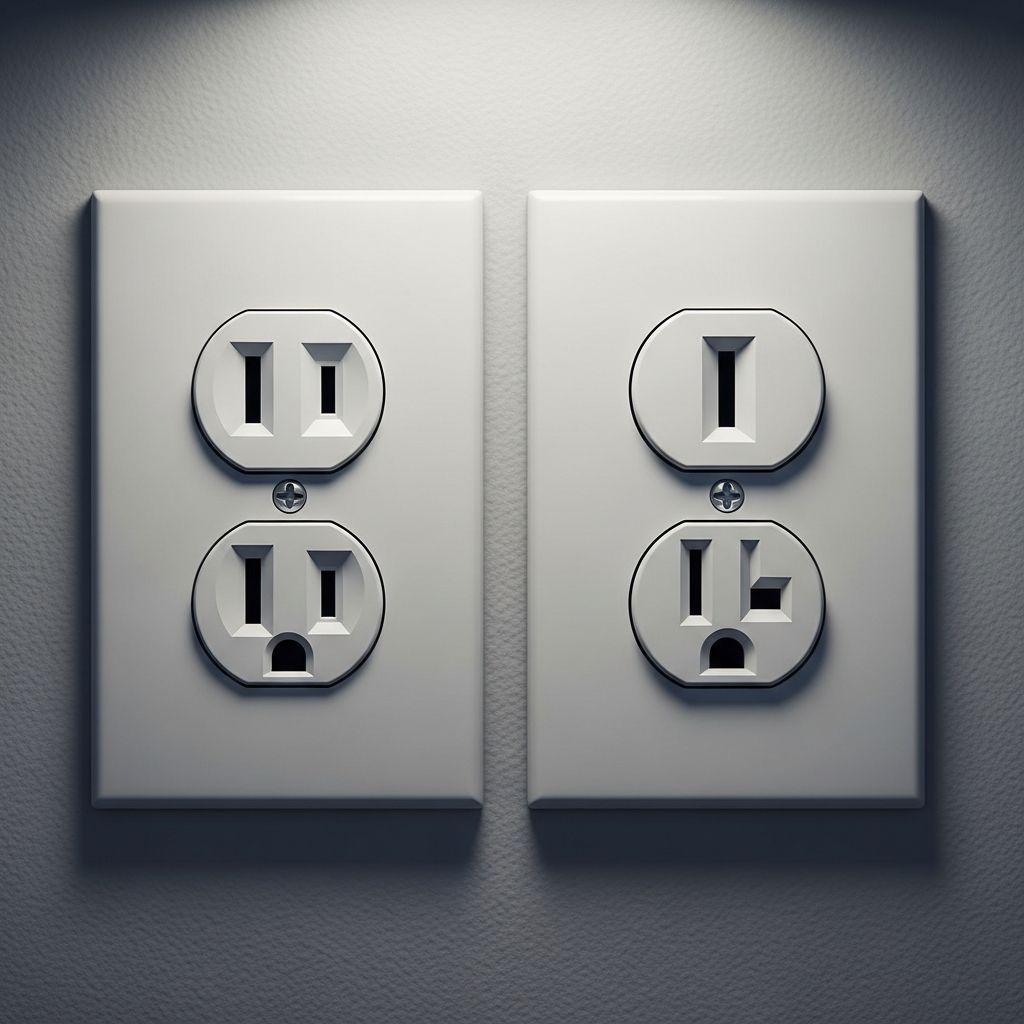
15 Amp Outlets: These standard outlets feature two vertical slots arranged side by side, along with a circular or U-shaped grounding hole positioned above or below the slots. The vertical orientation of both slots is straightforward and uniform. This simple design has become the standard in most American homes and offices, and you’ll find them in living rooms, bedrooms, and other general-purpose areas.
20 Amp Outlets: The distinguishing feature of a 20 amp outlet is the presence of a horizontal T-shaped slot that extends from one of the vertical slots. This T-shaped notch is positioned perpendicular to one of the vertical slots, creating a distinctive design that immediately sets it apart from its 15 amp counterpart. The T-shaped slot is not merely a cosmetic difference—it serves a critical safety function.
The T-shaped slot design is intentional and engineered to provide better electrical contact and prevent incompatible connections. This design allows 20 amp plugs to fit securely into 20 amp outlets, and interestingly, 15 amp plugs can also fit into 20 amp outlets due to the backward compatibility design. However, 20 amp plugs cannot fit into 15 amp outlets, which is a crucial safety feature that prevents overloading.
Electrical Specifications and Wiring Differences
Beyond visual appearance, the electrical specifications of these outlets differ significantly, and understanding these differences is essential for proper installation and safety.
Wire Gauge: The wiring connected to 15 amp outlets uses 14-gauge wire, which is thinner and suitable for lower amperage loads. In contrast, 20 amp outlets require either 12-gauge or 10-gauge wire, which is thicker and can safely carry more current without overheating. Using inadequate wire gauge for a circuit is a serious safety hazard that can cause fires.
Circuit Breaker Ratings: A 15 amp outlet must be protected by a 15 amp circuit breaker, while a 20 amp outlet requires a 20 amp breaker. These breakers are designed to trip and cut off power when the circuit draws more amperage than it’s rated for, providing essential protection against electrical fires and equipment damage.
Current Capacity: A 15 amp outlet can safely handle continuous loads up to 1,440 watts (calculated as 15 amps × 120 volts × 0.8, where 0.8 represents the recommended continuous load limit). A 20 amp outlet can handle up to 1,920 watts under the same calculation. This 33 percent increase in capacity makes a significant difference for power-hungry appliances.
Where to Use 15 Amp and 20 Amp Outlets
Proper outlet placement throughout your home ensures safety and meets electrical code requirements. Different rooms have different electrical demands, and code requirements reflect this reality.
15 Amp Outlets Are Suitable For:
- Living rooms and bedrooms where small appliances and entertainment devices are used
- Office spaces with computers, lamps, and standard office equipment
- Bathrooms with light loads and standard bathroom accessories
- Any area where light-duty appliances such as televisions, lamps, phone chargers, fans, and small power tools will be connected
- General-purpose circuits that serve standard household needs
20 Amp Outlets Are Required For:
- Kitchen countertops, where code typically requires dedicated 20 amp circuits for receptacles
- Laundry rooms where washing machines and dryers need substantial power
- Garages where power tools and heavy equipment operate
- Any area designated for high-power appliances such as refrigerators, electric ovens, toasters, blenders, dishwashers, and microwave ovens
- Rooms with equipment requiring sustained high electrical loads
Most residential building codes require kitchens and laundry areas to have 20 amp circuits for safety and functionality. These rooms typically have the highest concentration of power-hungry appliances and the greatest risk of electrical overload.
Can You Replace a 15 Amp Outlet with a 20 Amp Outlet?
This is a common question among homeowners considering electrical upgrades. The answer is nuanced and depends on the existing circuit infrastructure.
When It’s Safe to Upgrade: If your circuit wiring and breaker are already rated for 20 amps, you can safely install a 20 amp outlet in place of a 15 amp outlet. This situation often occurs when homes are built with infrastructure designed for future upgrades. In this case, the upgrade is straightforward and safe.
When It’s Not Safe to Upgrade: If your circuit wiring is 14-gauge and your breaker is rated for 15 amps, you absolutely cannot install a 20 amp outlet. Doing so would create a dangerous situation where the outlet could accept plugs drawing 20 amps of current, but the wiring and breaker are only designed for 15 amps. This mismatch creates a serious fire hazard.
The Safety Principle: All components of a circuit—the outlet, wiring, and breaker—must work together as a matched system. If any component is rated higher than the others, the lower-rated component becomes a bottleneck that could overheat and fail. Upgrading one component without upgrading the others violates electrical code and creates safety hazards.
If you want to add a 20 amp outlet to an area currently served by 15 amp circuits, you would need to hire a licensed electrician to install new wiring, add a new 20 amp breaker, and properly integrate it into your electrical panel.
The 80 Percent Rule and Safe Loading
Professional electricians follow an important safety principle known as the 80 percent rule. This guideline states that you should never continuously load a circuit beyond 80 percent of its rated capacity. This rule provides a safety margin and prevents overheating of wires and components.
For a 15 amp outlet, this means the safe continuous load is 12 amps or approximately 1,440 watts. For a 20 amp outlet, the safe continuous load is 16 amps or approximately 1,920 watts. Understanding this distinction is especially important when using power strips, which can easily lead to overloading if multiple high-power devices are connected simultaneously.
Duplex Outlets and Multiple Loads
Many outlets in homes are duplex outlets, meaning they have two receptacles in a single outlet box. Understanding how to properly load these outlets is important for safety.
A 20 amp duplex outlet can safely handle:
- Two 20 amp plugs simultaneously (if each draws up to 16 amps continuously)
- Two 15 amp plugs simultaneously
- One 15 amp plug and one 20 amp plug together
However, you should still apply the 80 percent rule when calculating total load. If both receptacles are being used simultaneously, the combined current draw should not exceed 16 amps for a 20 amp circuit.
Installation Considerations and Electrical Code
Installing new outlets or replacing existing ones should follow current electrical codes in your jurisdiction. Building codes exist for very good reasons—they’re based on decades of electrical safety experience and fire prevention knowledge.
Kitchen Requirements: Most building codes require at least two 20 amp circuits dedicated to kitchen countertop receptacles. Bathrooms typically require GFCI-protected outlets, which may be either 15 or 20 amp depending on local code.
Professional Installation: For any work beyond simple outlet replacement on the same circuit, hiring a licensed electrician is strongly recommended. Electrical work affects safety and home value, and improper installation can void insurance coverage or prevent home sale approval.
Permits and Inspections: Many jurisdictions require permits for electrical work and inspections before work is approved. These requirements ensure that installations meet code and are performed safely.
Common Mistakes to Avoid
Understanding what not to do is as important as knowing what to do when dealing with electrical outlets. Common mistakes include overloading circuits with power strips, attempting to force incompatible plugs into outlets, and mismatching outlet amperage with circuit capacity. Never attempt to modify outlets or adapt plugs to fit incompatible receptacles, as this defeats the safety mechanisms built into the design.
Frequently Asked Questions
Q: What is the main difference between 15 amp and 20 amp outlets?
A: The primary difference is current capacity—20 amp outlets can handle 33 percent more electrical current. Visually, 20 amp outlets have a distinctive T-shaped slot, while 15 amp outlets have only vertical slots. The wiring and circuit breaker ratings also differ accordingly.
Q: Can I plug a 15 amp device into a 20 amp outlet?
A: Yes, this is safe. The T-shaped slot design allows 15 amp plugs to fit into 20 amp outlets. This backward compatibility is intentional and does not pose a safety risk.
Q: Can I plug a 20 amp device into a 15 amp outlet?
A: No, this is not possible and not safe. The outlet design prevents 20 amp plugs from fitting into 15 amp outlets. This safety feature protects against overloading 15 amp circuits.
Q: What amperage outlets does my kitchen need?
A: Most building codes require kitchens to have at least two dedicated 20 amp circuits for countertop receptacles. This accommodates the high power demands of kitchen appliances.
Q: Is it safe to run a 15 amp outlet on a 20 amp circuit?
A: Yes, this is actually a safe configuration because the 15 amp outlet limits current draw to 15 amps, which is well below the 20 amp circuit capacity. However, this configuration is uncommon and generally unnecessary.
Q: What wire gauge is required for each outlet type?
A: 15 amp outlets require 14-gauge wire, while 20 amp outlets require 12-gauge or 10-gauge wire. Using incorrect wire gauge is a serious safety hazard.
Q: How do I know if an outlet needs replacement?
A: If an outlet is loose, damaged, discolored, doesn’t hold plugs firmly, or feels warm to the touch, it may need replacement. Have a licensed electrician evaluate outlets that seem problematic.
Q: Can I install a 20 amp outlet myself?
A: While replacing an outlet on an existing circuit may be a DIY task for experienced homeowners, adding new circuits or upgrading circuits should be done by licensed electricians to ensure code compliance and safety.
Conclusion
Understanding the differences between 15 amp and 20 amp outlets is fundamental to maintaining a safe and functional home electrical system. While these outlets may look similar, they serve different purposes based on their current capacity and the demands of the areas they serve. By recognizing the visual differences, understanding their specifications, and following proper installation guidelines, you can ensure your home’s electrical system operates safely and efficiently for years to come. When in doubt, consulting with a licensed electrician is always the best course of action for electrical questions and installations.
References
- National Electrical Code (NEC) Article 210: Branch Circuits and Outlets — National Fire Protection Association. 2023. https://www.nfpa.org/codes-and-standards/all-codes-and-standards/list-of-codes-and-standards/detail?code=70
- Guide to Residential Wiring: Outlet Requirements and Specifications — U.S. Department of Energy. 2023. https://www.energy.gov/
- Electrical Safety in the Home: Understanding Amperage and Circuit Protection — Consumer Product Safety Commission. 2024. https://www.cpsc.gov/
- Standard for Electrical Safety in the Workplace — OSHA. 2024. https://www.osha.gov/electrical
- Residential Electrical Wiring: Design and Installation — International Code Council (ICC). 2023. https://www.iccsafe.org/
Similar Articles






Read full bio of medha deb