Absorption Cooling Explained
Discover how heat-driven absorption cooling systems revolutionize energy-efficient climate control for homes and industries.
Absorption cooling represents a innovative approach to air conditioning that harnesses heat rather than electricity to produce chilled air or water. Unlike traditional vapor-compression systems reliant on power-hungry compressors, absorption units leverage thermal energy from sources like waste heat, solar power, or natural gas to drive the refrigeration cycle. This makes them particularly valuable in settings where heat is abundant but electricity costs are high.
Core Principles Behind Heat-Driven Refrigeration
The foundation of absorption cooling rests on three fundamental thermodynamic concepts: liquids vaporize when heated and condense when cooled; pressure reductions lower boiling points; and heat naturally transfers from hot to cold regions. These principles enable a closed-loop system using two fluids—a refrigerant (typically water) and an absorbent (often lithium bromide)—that have a strong mutual affinity.
In practice, the refrigerant evaporates at low pressure to absorb ambient heat, creating cooling. The absorbent then captures this vapor, maintaining the low-pressure environment without mechanical compression. Heat input later separates the pair, restarting the cycle. This thermochemical process mimics compression but uses thermal energy exclusively.
Key Components of an Absorption Chiller
An absorption chiller integrates several interconnected chambers and exchangers to facilitate continuous operation. Here’s a breakdown of the primary elements:
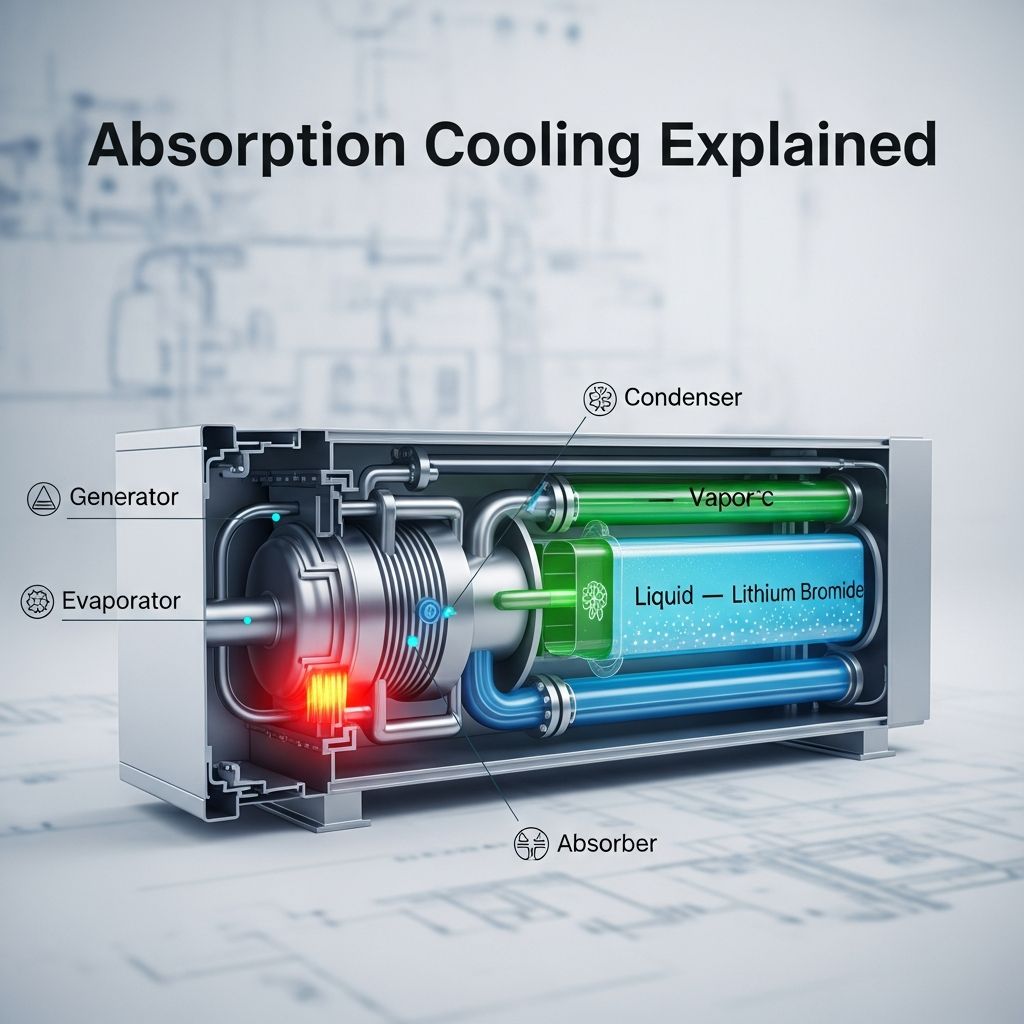
- Generator: Applies heat to the absorbent-refrigerant mixture, boiling off the refrigerant vapor while leaving concentrated absorbent behind.
- Absorber: Draws in refrigerant vapor using dilute absorbent, releasing heat in an exothermic reaction.
- Condenser: Cools high-pressure vapor back into liquid refrigerant, rejecting heat to a cooling medium like tower water.
- Evaporator: Low-pressure zone where liquid refrigerant evaporates, absorbing heat from the chilled water loop serving the building.
- Heat Exchanger: Boosts efficiency by preheating dilute solution and precooling concentrated absorbent between stages.
These components operate in a vacuum-assisted environment, with minimal electricity needed only for pumps and fans.
Detailed Operational Cycle Step-by-Step
The cycle begins in the absorber, where concentrated lithium bromide solution eagerly absorbs water vapor from the evaporator. This absorption generates heat, which cooling water removes to sustain the process. The resulting dilute solution (rich in water) pumps to the generator via the heat exchanger.
In the generator, external heat—such as hot water, steam, or exhaust gases—heats the dilute solution. Water boils at low pressure, rising as vapor to the condenser, while denser lithium bromide settles and flows back through the heat exchanger to the absorber.
The water vapor condenses in the condenser, cooled by tower water, forming liquid that trickles to the evaporator. There, under vacuum, it evaporates rapidly, chilling the building’s water loop by absorbing its heat load from air handlers and fan coils.
The vapor from evaporation heads to the absorber, completing the loop. A heat exchanger ensures thermal efficiency by balancing solution temperatures throughout.
Cycle Efficiency Enhancements
Modern designs incorporate multi-stage generators for higher efficiency. Single-effect units achieve a coefficient of performance (COP) around 0.7, meaning 0.7 units of cooling per unit of heat input. Double-effect models reach 1.2 COP by cascading heat recovery.
Contrasting with Vapor-Compression Systems
| Aspect | Absorption Chiller | Vapor-Compression Chiller |
|---|---|---|
| Energy Source | Heat (gas, waste, solar) | Electricity |
| Main Driver | Thermal separation | Mechanical compressor |
| COP Range | 0.6–1.4 | 3–6 |
| Electricity Use | Low (pumps only) | High |
| Noise Level | Quiet | Loud |
| Best Applications | High heat availability | General use |
While vapor-compression excels in raw efficiency, absorption shines where heat is cheap or byproduct, slashing peak electrical demand.
Advantages Driving Adoption
- Energy Cost Savings: Leverages free waste heat, reducing operational expenses by up to 50% in cogeneration setups.
- Grid Relief: Minimal electricity draw eases utility peak loads, ideal for large facilities.
- Environmental Benefits: Uses water as refrigerant—no high-GWP hydrofluorocarbons—lowering carbon footprint when paired with renewables.
- Reliability: Fewer moving parts mean less maintenance and longer lifespan, often exceeding 25 years.
- Versatility: Integrates with district energy, solar thermal, or industrial processes.
Challenges and Limitations
Absorption systems require substantial upfront investment and space due to their size. They demand consistent cooling water quality to prevent scaling or corrosion, especially with lithium bromide’s corrosiveness. Performance dips in very high ambient temperatures, and startup time lags behind electric units. Crystallization risk in the absorbent solution necessitates careful control.
Practical Applications Across Sectors
Commercial buildings, hospitals, and data centers deploy absorption chillers for reliable cooling with trigeneration (power, heat, chill). Industries like chemicals and food processing utilize waste heat recovery. Emerging residential uses pair them with solar collectors for off-grid cooling.
Installation Considerations
Site selection must accommodate cooling towers for heat rejection. Piping for hot and chilled water demands insulation. Professional sizing based on load profiles ensures optimal performance. Regular maintenance includes solution analysis and vacuum checks.
Future Innovations in Absorption Technology
Ongoing research targets advanced absorbents like ionic liquids for higher COP and compactness. Hybrid systems combining absorption with compression promise broader viability. Integration with smart grids and AI controls will optimize heat sourcing dynamically.
Frequently Asked Questions
Can absorption chillers work in homes?
Primarily suited for large-scale use, but compact gas-fired models exist for residential applications where natural gas is economical.
What maintenance do they need?
Annual checks for leaks, solution strength, and tube cleanliness; purge non-condensables to maintain vacuum.
Are they more efficient than standard AC?
In terms of electricity, yes—but overall COP is lower unless heat is free. Total energy use drops in heat-rich environments.
Do they produce ice or just cooling?
Standard units chill water to 40–45°F; specialized versions enable ice storage for peak shaving.
How safe is lithium bromide?
Non-toxic and non-flammable, but corrosive—systems include inhibitors and require proper ventilation.
References
- How Absorption Chillers Work — EnergyLink. 2023. https://goenergylink.com/blog/how-absorption-chillers-work/
- Absorption Chiller, How it works — The Engineering Mindset. 2022-10-15. https://theengineeringmindset.com/absorption-chiller-works/
- How do absorption chillers work? — Thermax Global. 2024. https://www.thermaxglobal.com/how-do-absorption-chillers-work/
- Absorption Chillers: The Paradox of Cooling with Heat — VERTEX Engineering. 2023-05-12. https://vertexeng.com/insights/absorption-chillers-the-paradox-of-cooling-with-heat/
- Absorption refrigerator — Wikipedia (informational, primary principles verified). 2026-03-28. https://en.wikipedia.org/wiki/Absorption_refrigerator
Similar Articles



Read full bio of medha deb