Build Your Own Potato Cannon: Step-By-Step Guide
Master the art of constructing a powerful potato cannon with step-by-step instructions, safety tips, and the physics that make it fly.
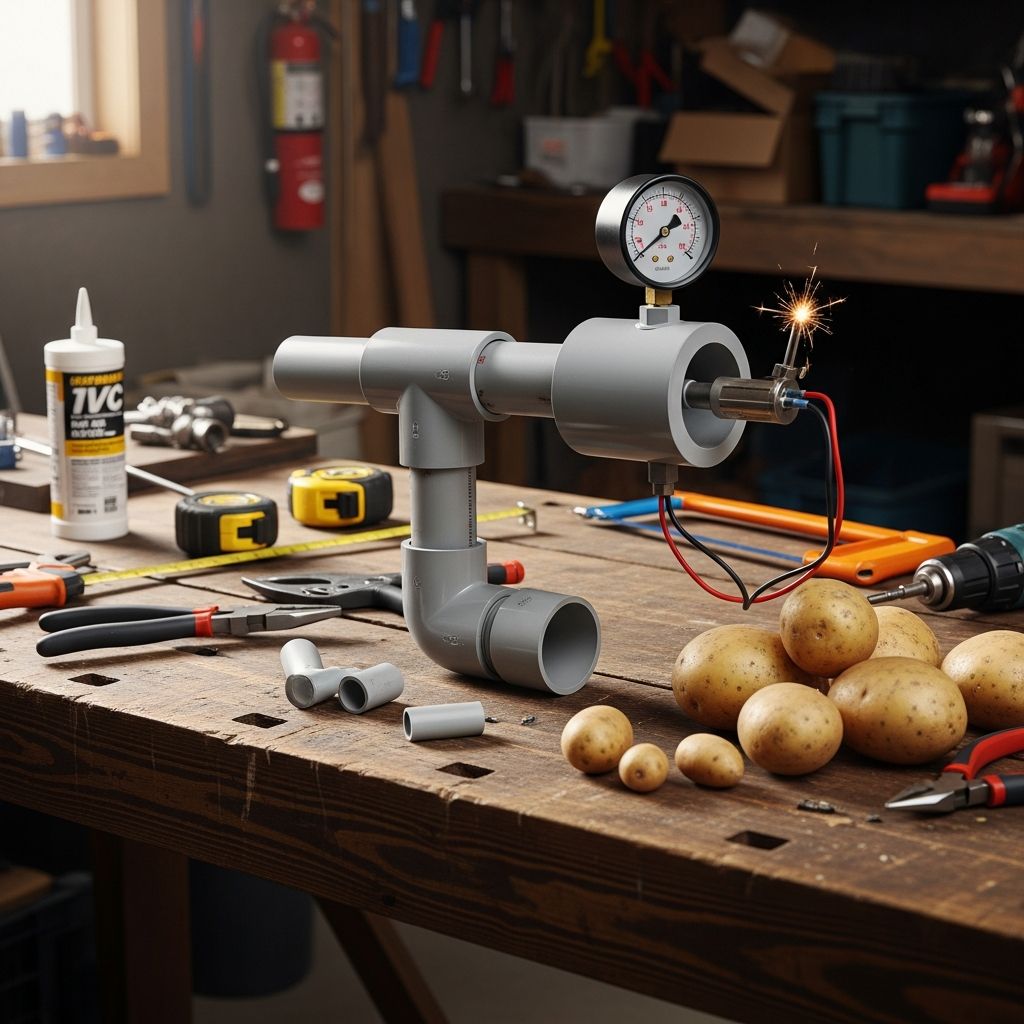
Build Your Own Potato Cannon Guide
Potato cannons harness basic principles of physics to launch spud projectiles at impressive speeds, making them a thrilling DIY project for hobbyists and science fans alike. These devices operate via pneumatic pressure or combustion, propelling potatoes over remarkable distances when built correctly.
Understanding Potato Cannon Fundamentals
At their core, potato cannons convert stored energy into kinetic motion. Pneumatic versions use compressed air to drive the projectile, while combustion types ignite fuel vapors for explosive force. Research shows pneumatic models can achieve muzzle velocities around 78 m/s under ideal conditions, comparable to commercial air guns. Combustion designs often exceed 400 feet per second, driven by rapid gas expansion.
The barrel acts as the launch tube, with a separate chamber building pressure behind a snug-fitting potato slice. Key factors include barrel length, chamber volume, and propellant efficiency, all influencing projectile speed and range.
Types of Potato Cannons Explored
Two primary designs dominate: pneumatic and combustion. Pneumatic cannons store compressed gas, releasing it suddenly to accelerate the projectile like a piston in a cylinder. They model well with Newton’s second law, the ideal gas law, and thermodynamics, assuming frictionless motion and adiabatic expansion.
- Pneumatic: Safer for beginners, uses bike pumps or air tanks. Ideal for controlled demos.
- Combustion: More powerful, employs hairspray or propane. Requires precise fuel-air ratios for optimal burn.
Hybrid variants combine elements, achieving record speeds up to 933 m/s with specialized slugs, though potato projectiles typically top out lower.
Gathering Essential Materials and Tools
Constructing a reliable potato cannon demands schedule 40 PVC pipes for durability. Select components based on your design type.
| Component | Pneumatic Build | Combustion Build | Purpose |
|---|---|---|---|
| Barrel | 2-inch PVC, 3-4 ft long | 2-inch PVC, 3-4 ft long | Holds and guides projectile |
| Chamber | 4-inch PVC, 1-2 ft long | 4-inch PVC, 1-2 ft long | Builds pressure |
| End Cap | 4-inch threaded cap | 4-inch threaded cap | Seals chamber |
| Reducer | 4×2-inch PVC reducer | 4×2-inch PVC reducer | Connects chamber to barrel |
| Valve/Igniter | High-pressure ball valve | BBQ piezo igniter | Releases or sparks propellant |
| Misc | PVC cement, ramrod, air source | PVC cement, ramrod, fuel | Assembly and operation |
Tools include PVC cutter, sandpaper, drill, and safety gear. Total cost stays under $50 for basic builds. Ensure all fittings are pressure-rated to handle 10+ atm.
Step-by-Step Pneumatic Cannon Construction
Begin with the chamber: cut 4-inch PVC to 18 inches, attach end cap with cement. Install a ball valve on the side for air input. Connect the reducer to one end, transitioning to the 2-inch barrel pipe, about 36 inches long. Smooth all joints for airtight seals.
- Assemble chamber base securely.
- Glue reducer and barrel in place; allow 24-hour cure.
- Drill and mount valve; test for leaks with soapy water.
- Create a wooden ramrod for loading.
Test at low pressure (20-30 psi) before full pressurization. Initial acceleration follows a0 = nRT0 / (m x0), where gas moles and initial volume dictate force.
Assembling a Combustion Potato Cannon
For explosive power, mirror the pneumatic frame but add ignition. Position the piezo igniter through a drilled hole near the chamber’s rear, wires extending out. Use threaded caps for easy fuel access.
- Prepare chamber with igniter port, sealed with epoxy.
- Attach barrel via reducer; reinforce joints.
- Install a removable plug or cap at chamber end.
Fuel with 2-4 seconds of aerosol spray (hairspray works best). Optimal ratios yield peak pressures post-ignition, propelling potatoes via expanding hot gases.
Physics Driving Projectile Performance
Internal ballistics reveal why design matters. In pneumatics, gas expands adiabatically, pressure dropping as volume grows: p Vγ = constant for diatomic air (γ=1.4). Velocity plateaus after expansion ratio of ~5:1.
Combustion adds heat from fuel burn, mimicking piston acceleration. High-speed video shows flame fronts chasing projectiles, with velocity measurable along the barrel. Range optimizes at 45-degree launch, ignoring drag: R = v²/g.
Experiments confirm larger potato masses build more chamber pressure, boosting distance despite lower acceleration.
Precise Loading and Firing Techniques
Select firm, raw potatoes; cut plugs slightly oversized for barrel fit. Ram firmly to chamber entrance without crushing.
- Pneumatic: Pressurize to 60-100 psi via compressor; open valve sharply.
- Combustion: Insert fuel, seal, ignite from distance.
Launch at 45 degrees on open fields. Measure distances to refine: longer barrels extend acceleration phase but add friction.
Optimization Strategies for Maximum Range
Balance chamber-to-barrel volume ratio around 3:1 for pneumatics. Combustion thrives on lean fuel mixes. Transparent barrels aid testing, revealing velocity profiles.
| Factor | Effect on Velocity | Optimal Setting |
|---|---|---|
| Barrel Length | Increases acceleration time | 30-48 inches |
| Pressure/Fuel | Directly proportional | 80 psi or 3s spray |
| Projectile Mass | Higher mass = more pressure | 1.5-2 inch lengths |
| Angle | Maximizes range | 45 degrees |
Safety Protocols and Legal Considerations
Potato cannons pack real power—treat as firearms. Wear goggles, gloves; fire in isolated areas away from people, property. Never exceed 120 psi; inspect for cracks.
- Check local laws: many regions regulate as destructive devices.
- Avoid indoors; ricochet risks high.
- Supervise youth; store disassembled.
Physics demos highlight pneumatics’ safety edge over combustion’s flammability.
Troubleshooting Common Issues
No launch: Verify seals, pressure, fit.
Weak shots: Increase fuel/psi, shorten potato.
Misfires: Clean igniter, adjust mix.
Leaks: Re-cement joints.
Advanced Modifications and Experiments
Upgrade to CO2 tanks for pneumatics or propane injectors for combustion. Test variables like potato size—data shows 2-inch chunks outperform smaller ones via pressure buildup. Transparent acrylic barrels enable high-speed analysis.
FAQ
Q: Is a potato cannon legal?
A: Varies by location; check ordinances as some ban combustion types.
Q: What’s the farthest a potato cannon shoots?
A: Optimized builds reach 600m range theoretically, though practical max is lower.
Q: Pneumatic or combustion better?
A: Pneumatic for safety and repeatability; combustion for power.
Q: Can I use other projectiles?
A: Yes, but potatoes seal best; avoid metals.
Q: How fast do they go?
A: 70-400+ fps typical; records near supersonic.
References
- Internal ballistics of a pneumatic potato cannon — C.E. Mungan, United States Naval Academy. 2005. https://www.usna.edu/Users/physics/mungan/_files/documents/Publications/EJP5.pdf
- Potato Cannon Experiment — TUHSD Physics Students. Accessed 2026. https://tuhsphysics.ttsd.k12.or.us/Research/IB11/RottRaffLoenFran/index.htm
- The Science Behind Potato Guns — OreAte AI Blog. 2023. https://www.oreateai.com/blog/the-science-behind-potato-guns-how-they-propel-spuds-with-power/10466ecad68ed3740b6eac6d57dee046
- Studying the Internal Ballistics of a Combustion Driven Potato Cannon — arXiv Preprint. 2013-05-04. https://arxiv.org/pdf/1305.0966
- Potato cannon — Wikipedia (references primary records). Ongoing. https://en.wikipedia.org/wiki/Potato_cannon
Similar Articles








Read full bio of Sneha Tete