Camshaft vs Crankshaft: Key Differences Explained
Understanding the essential roles of camshafts and crankshafts in engine operation.
Camshaft vs Crankshaft: Understanding Engine Fundamentals
Every internal combustion engine relies on thousands of precisely coordinated movements to convert fuel into motion. Two of the most critical components in this complex dance are the camshaft and the crankshaft. While both are essential for engine operation, they perform distinctly different functions. Understanding the differences between these two components is fundamental to grasping how your engine works and appreciating the engineering marvel under your vehicle’s hood.
What Is a Camshaft?
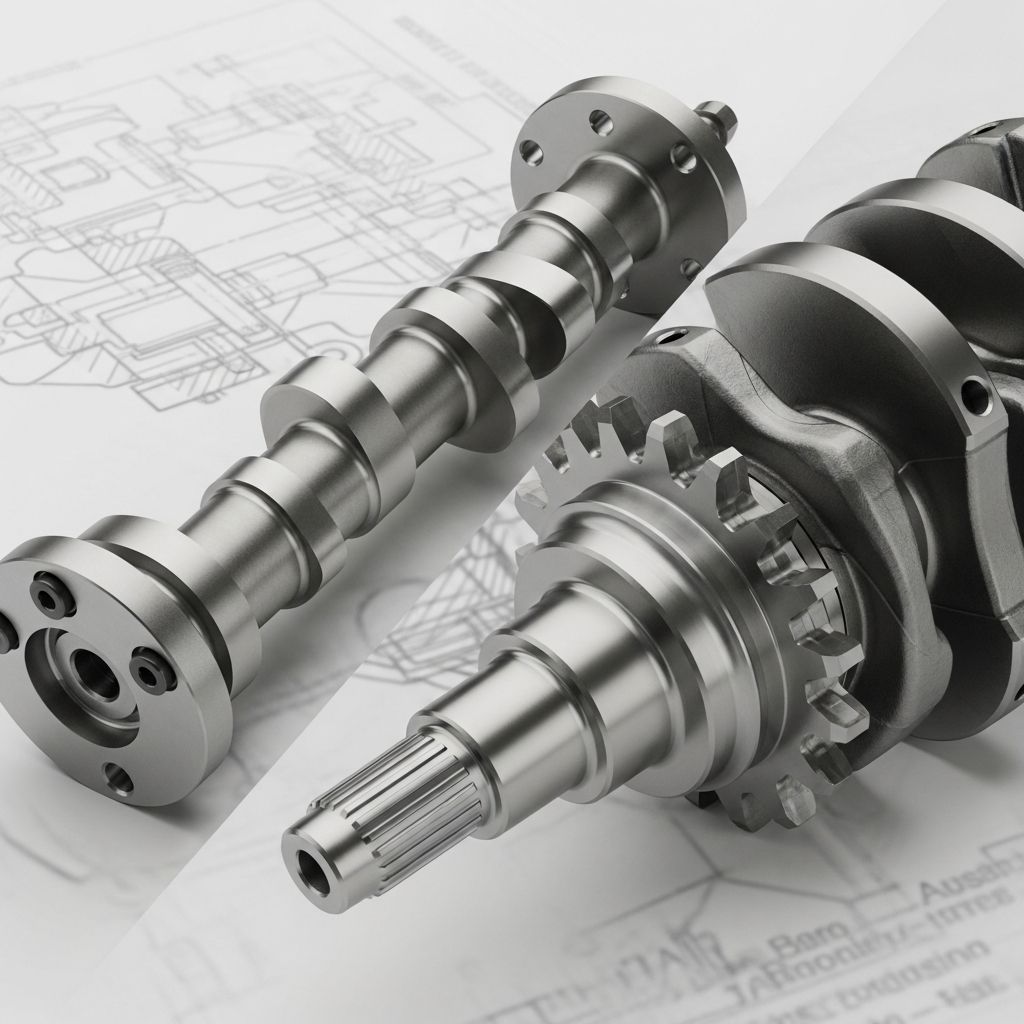
The camshaft is located in the top end of your engine, often referred to as the “top end” or “cylinder head” area. This cylindrical shaft is a critical component of the valve train system, responsible for controlling when and how long your engine’s intake and exhaust valves remain open. The camshaft is studded with a series of egg-shaped lobes, with one lobe dedicated to each valve in the engine. Modern engines can have up to four camshafts—known as dual or multiple cam configurations—with some advanced designs featuring four valves per cylinder, including two intake and two exhaust valves.
As the camshaft rotates, these specially shaped lobes push against valve lifters, tappets, or rocker arms. These components then open and close the valves in a precisely choreographed sequence. The lobes vary in shape and size, allowing engineers to control exactly how much each valve opens and for how long it stays open. This precise control is essential for optimizing the combustion process and engine performance.
How Does a Camshaft Work?
The camshaft is driven by the crankshaft through a timing chain, timing belt, or mesh gear set located at the front of the engine. As the camshaft rotates, its lobes engage with the valve train components in a specific sequence. Here’s how the process unfolds:
- The lobes push downward on valve lifters or rocker arms
- This motion opens the intake or exhaust valves
- Springs then close the valves when the lobe rotates away
- The precise timing ensures valves open only during their designated stroke
The shape and positioning of each lobe determine valve timing and duration, which are critical parameters that affect how much air and fuel enter the combustion chamber and how completely exhaust gases exit. Performance enthusiasts often upgrade to high-performance camshafts with more aggressive lobe profiles to increase valve lift and duration, thereby boosting engine power and efficiency.
What Is a Crankshaft?
Located in the bottom end of the engine, the crankshaft is the backbone of your engine’s power generation system. This large, heavy-duty shaft is one of the most robust components in your vehicle, engineered to withstand tremendous forces. The crankshaft features multiple connection points along its length where connecting rods attach, linking the pistons to the crankshaft. Additionally, it has a central main journal that rotates on main bearings, allowing the entire assembly to spin smoothly within the engine block.
The crankshaft is typically forged from alloy steel, making it incredibly strong and durable. Its primary job is to convert the linear up-and-down motion of the pistons into rotational motion, which ultimately transfers power to your transmission and drives your vehicle forward. Without this conversion, the explosive force of combustion would be wasted as mere up-and-down movement with no useful output.
How Does a Crankshaft Work?
The crankshaft operates through a brilliant mechanical principle. When combustion occurs in the cylinder, the burning of the air-fuel mixture creates an explosion that drives the piston downward with tremendous force. This downward motion is transferred to the connecting rod, which is attached to the crankshaft at an offset angle. This offset, called a “crank,” converts the linear motion into rotational motion. As pistons move up and down, they cause the crankshaft to rotate continuously.
To maintain smooth operation despite the violent and uneven forces from combustion, the crankshaft is carefully balanced. Counterweights are strategically positioned along its length to offset the reciprocating mass of the pistons and connecting rods. This balancing is crucial for minimizing vibrations and ensuring the engine runs smoothly while extending component longevity.
Comparing Camshafts and Crankshafts
| Characteristic | Camshaft | Crankshaft |
|---|---|---|
| Location | Top end of engine (overhead or in-block) | Bottom end of engine (engine block) |
| Primary Function | Opens and closes intake and exhaust valves | Converts piston motion into rotational power |
| Material | Cast steel or iron | Forged alloy steel |
| Power Source | Driven by the crankshaft via timing chain/belt | Driven by combustion force on pistons |
| Rotational Speed | Rotates once per combustion cycle | Rotates twice per combustion cycle |
| Number per Engine | Up to four in modern engines | Typically one per engine |
How Camshafts and Crankshafts Work Together
Although the camshaft and crankshaft perform different functions, they must work in perfect synchronization for your engine to operate correctly. This coordination is so critical that if these components fall out of time with each other, your engine will not run at all. The relationship between these two components is maintained through a timing chain or timing belt that connects their gears, ensuring they rotate in perfect harmony.
Understanding Valve Timing
The camshaft and crankshaft are connected by a timing chain (similar to a bicycle chain) or timing belt (similar to a drive belt but with teeth). In some engines, they are connected via interlocking mesh gears. These connections are located at the front of the engine and are absolutely critical for proper engine operation.
During each complete four-stroke combustion cycle—consisting of intake, compression, power, and exhaust strokes—the crankshaft rotates two full revolutions (720 degrees) while the camshaft rotates only once (360 degrees). This 2:1 ratio ensures that each valve opens exactly once for every two crankshaft revolutions in relation to the piston position.
This precise timing orchestrates the entire combustion process: the intake valve opens during the intake stroke to allow the air-fuel mixture to enter the cylinder, both valves remain closed during compression and combustion to contain the explosion, and the exhaust valve opens during the exhaust stroke to allow burned gases to escape. Any deviation from this perfect timing results in poor engine performance, misfires, or engine damage.
The Significance of Proper Synchronization
Modern engines rely on position sensors for both the camshaft and crankshaft. These sensors continuously monitor the rotational position of both shafts and send this information to the powertrain control module (PCM). The PCM uses this data to determine the precise timing for fuel injection, spark plug ignition, and valve operation. If these signals are disrupted or out of sync, the engine computer will illuminate warning lights and may disable certain engine functions to prevent damage.
Engine Performance and Component Upgrades
Understanding the roles of camshafts and crankshafts helps explain why performance modifications focus on these components. A performance camshaft with more aggressive lobe profiles can increase valve lift and duration, allowing more air and fuel to enter the combustion chamber and more exhaust gases to exit. This increases engine power and efficiency. However, upgrading a camshaft typically requires precise timing adjustments to maintain proper synchronization with the crankshaft.
Similarly, high-performance crankshafts are engineered with improved balancing and sometimes lighter weight to reduce rotational inertia, allowing the engine to rev more quickly. Some racing applications use forged crankshafts that are even stronger than standard units, capable of handling higher combustion pressures and stress.
Common Maintenance and Issues
Over time, timing chains or belts can stretch or wear, compromising the precise synchronization between the camshaft and crankshaft. This leads to timing problems that reduce performance and fuel efficiency. Timing belt replacement is a scheduled maintenance item on many vehicles, as a worn timing belt can break suddenly, potentially causing severe engine damage.
Camshaft lobes can also wear down due to friction and age, reducing their effectiveness at opening and closing valves. Similarly, crankshaft bearings can wear, causing increased vibration and noise. Regular oil changes are essential for keeping both components properly lubricated and functioning smoothly, as adequate lubrication prevents premature wear on these critical moving parts.
Frequently Asked Questions
Q: Can an engine run with a broken camshaft?
A: No, an engine cannot run if the camshaft is broken. The camshaft controls valve operation, which is essential for combustion. A broken camshaft will prevent the valves from opening and closing, halting engine operation immediately.
Q: What happens if timing is off between camshaft and crankshaft?
A: If timing is incorrect, the engine will not start or will run very poorly with misfires and rough operation. The valves will open and close at the wrong times relative to the piston position, preventing proper combustion and potentially causing engine damage.
Q: How often should I replace my timing belt?
A: Timing belt replacement intervals vary by vehicle manufacturer, typically ranging from 60,000 to 100,000 miles. Check your owner’s manual for the specific interval for your vehicle. Regular replacement prevents sudden failure that could damage your engine.
Q: Why does my engine have multiple camshafts?
A: Multiple camshafts allow for independent control of intake and exhaust valve timing, improving engine efficiency and performance. Modern engines often have four camshafts (two per cylinder head in a V-engine) to control multiple valves per cylinder with greater precision.
Q: Can I upgrade my camshaft for better performance?
A: Yes, you can install a performance camshaft to increase valve lift, duration, and overlap, which can improve engine power and efficiency. However, this requires professional installation and proper timing adjustment to ensure correct synchronization with the crankshaft.
Q: What is a timing chain versus a timing belt?
A: A timing chain is made of metal links like a bicycle chain and typically lasts the life of the engine. A timing belt is made of rubber with reinforced teeth and requires periodic replacement. Both serve the same function of synchronizing the camshaft and crankshaft.
References
- Understanding Engine Components and Valve Timing — Society of Automotive Engineers. 2024. https://www.sae.org/
- Internal Combustion Engine Design and Operation — American Society of Mechanical Engineers. 2024. https://www.asme.org/
- Automotive Timing Systems and Synchronization — National Institute for Automotive Service Excellence (ASE). 2024. https://www.ase.com/
- Engine Performance and Component Wear Analysis — Institute of Mechanical Engineers. 2023-2024. https://www.imeche.org/
Similar Articles








Read full bio of medha deb