Transform Cardboard Into a Stylish Desk Drawer Organizer
Turn scrap cardboard into a custom, clutter-free drawer system in one weekend afternoon.
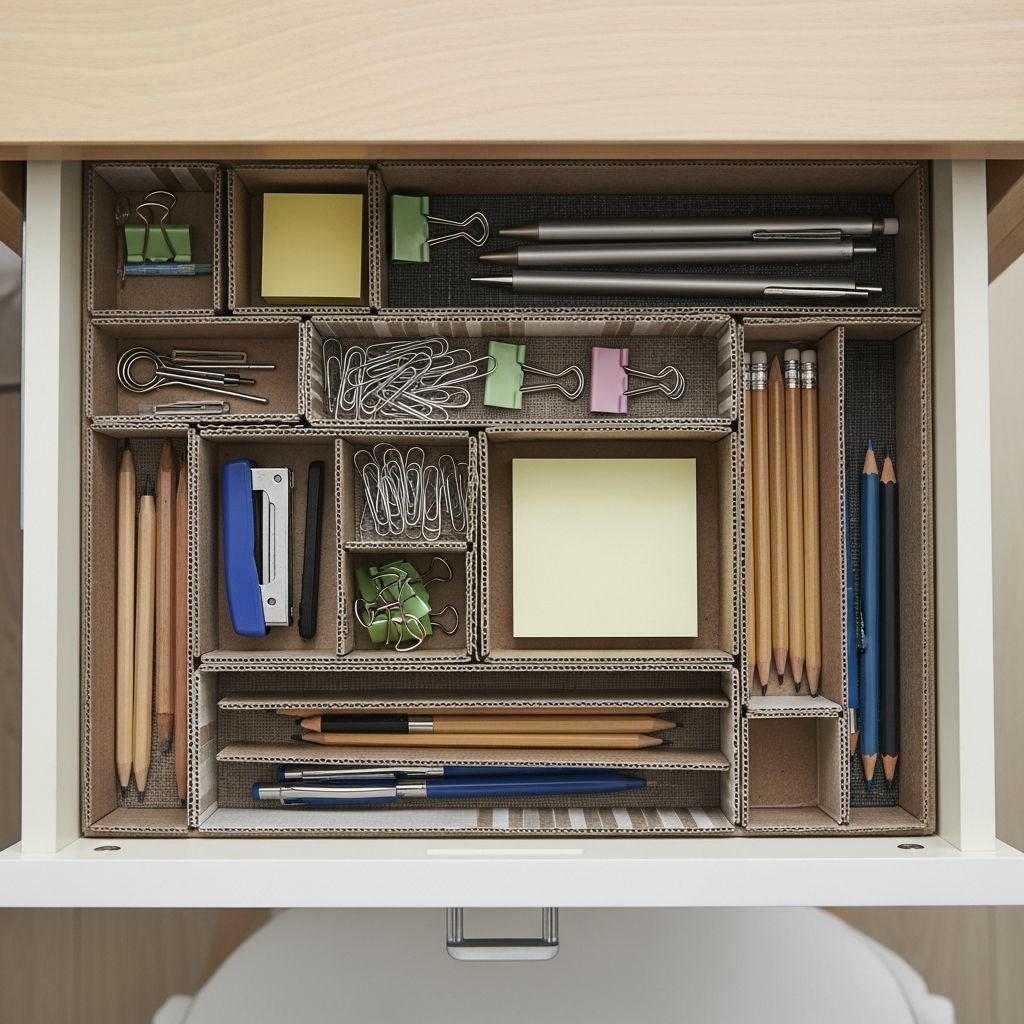
Cardboard Desk Drawer Organizer: A Complete Upcycling Guide
Desk drawers have a way of swallowing things whole—pens, paper clips, sticky notes, and cables all slide into one jumbled pile. A made-to-fit drawer organizer solves this instantly, and the best part is that you can build one from cardboard you already have at home. This guide walks you through planning, building, and decorating a sturdy, custom organizer using simple tools and thoughtful design.
Why Upcycle Cardboard For Organizing?
Cardboard is surprisingly strong when layered and reinforced correctly, making it an excellent material for drawer dividers and compartments. Instead of buying plastic trays that never quite fit, you can tailor each section to your exact desk tools, from rulers and scissors to USB sticks and sticky notes.
- Low cost: Uses packaging boxes, cereal boxes, and shipping cartons you already own.
- Custom fit: Every slot is designed around the items you actually use.
- Eco-friendly: Extends the life of cardboard before it hits the recycling bin.
- Creative outlet: Combines basic construction with endless options for color and style.
Gathering Materials And Tools
You do not need specialized equipment to build a professional-looking organizer. A few basic tools and common household items are enough for the entire project.
Essential Materials
- Sturdy corrugated cardboard (shipping boxes work best for structural pieces).
- Thinner cardboard (cereal boxes, shoe boxes) for small dividers.
- Paper or fabric to cover the cardboard (wrapping paper, kraft paper, scrapbook paper, or cotton fabric).
- Adhesive: white craft glue, tacky glue, or a glue stick; optional hot glue for fast bonding.
- Clear tape or masking tape for temporary holds and internal seams.
Tools
- Sharp craft knife or utility knife.
- Scissors for fine trimming.
- Metal ruler or straightedge.
- Pencil or fine marker.
- Cutting mat or thick scrap cardboard to protect your work surface.
- Optional: binder clips or clothespins to hold glued pieces while they dry.
Measure Your Drawer And Map The Layout
A successful organizer starts with accurate measurements and a clear plan. This prevents wasted effort and ensures that your finished insert slides neatly into the drawer without buckling or gaps.
Step 1: Measure The Drawer Interior
- Measure the inside width (left to right), depth (front to back), and height (bottom to top) of the drawer.
- Subtract 2–3 mm from each dimension to leave a tiny allowance, so the organizer can be inserted and removed easily.
- Write these measurements down and keep them visible while you work.
Step 2: List What You Need To Store
Before sketching, decide which items deserve a dedicated space. Group objects by size, frequency of use, and category.
- Everyday tools: pens, pencils, highlighters, scissors, ruler.
- Small items: paper clips, thumbtacks, erasers, staples.
- Paper products: sticky notes, index cards, envelopes.
- Tech accessories: flash drives, charging cables, headphones.
Estimate how much space each group needs. Bulky items like staplers and tape dispensers may require deeper sections, while clips and erasers need only small boxes.
Step 3: Sketch A Simple Layout
Draw a rectangle representing the drawer interior and divide it into zones. You can keep the design simple or get complex with multiple layers.
- One long front compartment for pens and pencils.
- Smaller square sections near the front corners for clips and erasers.
- Medium rectangles at the back for notepads and index cards.
- Side channels for a ruler or flat items like envelopes.
Adjust lines until you are satisfied with both appearance and function. Each section will become a cardboard compartment or divider.
Cutting The Base And Main Walls
The base panel and outer walls form the backbone of the organizer. Accuracy here keeps all subsequent pieces square and stable, so take your time with measuring and cutting.
Step 4: Create The Base Panel
- Transfer your final interior measurements (with the small allowance) onto sturdy corrugated cardboard.
- Use a metal ruler to guide your craft knife and score along the lines, cutting through cleanly.
- Place the base in the drawer to confirm the fit; trim if it feels tight, leaving just enough play for easy removal.
Step 5: Add Perimeter Walls
- Cut strips of corrugated cardboard equal to the drawer height minus a few millimeters, so the organizer does not scrape the top of the drawer when closed.
- Cut four strips: front, back, and two sides, matching the base length and width.
- Glue or hot-glue the strips along the edges of the base, keeping them straight and perpendicular.
- Reinforce joints on the outside with tape while the glue dries.
This frame will hold all interior dividers and prevent compartments from warping under the weight of your supplies.
Building Interior Compartments
With the shell built, you can now construct the internal structure that customizes the drawer. There are two main approaches: individual boxes or a grid of interlocking dividers.
Option 1: Individual Boxes
Individual boxes are self-contained compartments that sit within the base, ideal for small, removable sections.
- Cut rectangles from thinner cardboard, adding side flaps for folding into shallow boxes.
- Score fold lines lightly with your knife so the sides bend cleanly without cracking.
- Fold up the sides and secure corners with glue or tape, forming open-top trays.
- Test fit each tray in the base frame and adjust as needed to maintain snug alignment.
Option 2: Interlocking Grid Dividers
An interlocking grid is efficient for long or evenly spaced sections, such as rows for pens and markers.
- Cut several long strips of cardboard matching the inner width and depth of the organizer.
- Mark equally spaced notches along each strip, cutting halfway down the height of the strip.
- Slide the strips together at the notches to form a grid of rectangles.
- Place the finished grid into the base; trim edges for a precise fit.
You can even combine both methods: a grid at the front for writing tools and custom boxes at the back for bulkier items.
Reinforcing For Durability
Cardboard can last for years if reinforced properly. Before decorating, strengthen stress points so the organizer holds up to daily use.
- Double up thin pieces: glue two layers of cardboard together for long dividers and then cut them to size.
- Add narrow support strips under long runs to prevent bowing, especially beneath pen rows.
- Seal exposed edges with strips of paper, washi tape, or masking tape for a clean look and added rigidity.
- Use extra glue at corners and junctions where multiple dividers meet.
Decorating: From Plain Cardboard To Polished Organizer
Once the structure is solid, the fun begins. Covering the organizer not only disguises printed logos but also adds color, pattern, and a smooth feel.
Choosing A Style
- Minimal and modern: Solid-color kraft paper or matte contact paper in neutral tones.
- Playful and bright: Patterned wrapping paper or scrapbook sheets in contrasting prints.
- Textured and cozy: Fabric scraps attached with thin layers of white glue.
- Mixed media: Combine plain paper with washi tape borders and hand-drawn labels.
Covering Technique
- Cut paper or fabric slightly larger than each face of a compartment.
- Apply a thin, even coat of glue to the cardboard surface.
- Lay the covering material from one edge to the other, smoothing out bubbles with your fingers or a clean cloth.
- Wrap excess material around the edges and secure inside or underneath where it will not show.
- For a faster approach, you can line only the visible interior and top edges, leaving hidden exteriors plain.
Smart Layout Ideas For Different Workspaces
No two desks function exactly the same way. Here are layout suggestions tailored to various users, all built on the same core construction method.
| Workspace Type | Recommended Sections | Design Tips |
|---|---|---|
| Home office | Long pen tray, two medium notepad sections, small tech accessory wells. | Keep everyday items in the front half of the drawer; reserve back corners for backups. |
| Student desk | Wide area for index cards, tall slots for calculators and rulers, mini bins for erasers. | Use bold colors and labels to quickly spot items during study sessions. |
| Craft station | Multiple narrow strips for markers, square bays for glue and tape, micro trays for beads. | Consider stacking shallow trays to double capacity without increasing drawer footprint. |
| Shared family drawer | Labeled compartments for each person’s essentials plus communal tools. | Assign a color or pattern to each family member’s section. |
Optional Advanced Features
Once comfortable with the basic design, you can upgrade the organizer with more sophisticated features that add flexibility and style.
Removable Micro-Trays
- Create tiny cube or rectangular trays for paper clips, binder clips, and tacks.
- Keep them nested in a larger compartment, but free to lift out when you need to pour or sort small pieces.
- Color-code these micro-trays so finding the right one is effortless at a glance.
Stacked Levels
- Build a shallow secondary tray that rests on short support blocks at the edges of the drawer.
- Use the top layer for flat, light items like sticky notes and stickers.
- Reserve the bottom layer for bulkier supplies; include finger cutouts so lifting the top tray is easy.
Integrated Label System
- Glue small folded tabs of cardstock to the top edges of compartments.
- Write categories or item names using a fine-tip marker.
- For a removable option, attach tiny clips or mini clothespins holding labeled paper strips.
Step-By-Step Build Summary
Use this quick checklist as a reference while you work. Each step can be adapted, but the sequence helps keep the project organized.
- Measure the drawer interior and decide on a small allowance for easy fit.
- List the items to store and group them by type and size.
- Sketch a layout dividing the drawer into logical zones.
- Cut the base panel from sturdy cardboard and test-fit it in the drawer.
- Attach perimeter walls around the base using glue and reinforcement tape.
- Build internal boxes or an interlocking grid to match the layout.
- Reinforce long or thin pieces with double layers and edge sealing.
- Cover visible surfaces with paper or fabric, smoothing as you go.
- Add labels, color-coding, and any optional features such as stacked trays.
- Let all glue dry fully before loading the organizer with supplies.
Troubleshooting Common Problems
Even a careful build can hit a few snags. Most issues are easy to fix with minor adjustments and patience.
Organizer Feels Too Tight
- If the organizer resists sliding into the drawer, identify the tightest edge.
- Remove the organizer and shave off a thin strip of cardboard from that side with your craft knife.
- Lightly sand or smooth rough edges before reinserting.
Dividers Bend Or Warp
- For long sections, glue an extra strip of cardboard along the base or top edge as a brace.
- Replace thin single-layer pieces with laminated double-layer strips.
- Avoid loading heavy metal items into very narrow compartments.
Paper Covering Bubbles Or Wrinkles
- Use less glue; a thin, even coat prevents saturated, wavy paper.
- Smooth from the center outward, pushing air toward the edges.
- For stubborn areas, pierce a tiny pinhole to release trapped air and press flat.
Care And Maintenance
A little care goes a long way in keeping your cardboard organizer looking fresh and functioning well. Because the material is porous, it benefits from occasional attention.
- Keep liquids out of the drawer or store them in leak-proof containers.
- Dust regularly with a soft cloth or brush to prevent buildup in small sections.
- If a compartment becomes stained, glue a new layer of decorative paper on top as a quick refresh.
- Rotate high-use items occasionally so stress does not concentrate on a single divider.
FAQs About Cardboard Desk Drawer Organizers
How strong is a cardboard organizer really?
When built with double-layer dividers and reinforced edges, a cardboard organizer easily supports typical desk items such as pens, markers, tape dispensers, and small electronics. For very heavy objects like hole punches, use broader compartments and thicker cardboard for added strength.
Can this project work in deep or shallow drawers?
Yes. For shallow drawers, reduce the height of the walls and keep compartments low and wide. For deep drawers, you can stack two levels of trays or build taller sections for items like scissors, staplers, and calculators, as long as you leave enough clearance for the drawer to close smoothly.
Is it safe to use hot glue with cardboard?
Hot glue bonds quickly and firmly to cardboard, making it a convenient option for joints and corners. Use it in thin lines rather than large blobs to avoid warping and always protect your fingers with care or silicone finger guards while pressing pieces together.
What if my cardboard has creases or printed graphics?
Minor creases are fine if they are not on structural pieces; just position them where they will be hidden. Printed graphics will disappear once you cover the organizer with opaque paper or fabric, so prioritize structural integrity over appearance when choosing which sections of a box to cut.
How long does the project typically take?
For a single standard desk drawer, expect about one to two hours for measuring, cutting, and assembly, plus additional time for decorative covering and glue drying. Working in stages—structure first, decoration later—can make the project feel manageable even in a busy schedule.
Enjoy Your Custom, Clutter-Free Drawer
With some discarded cardboard and a free afternoon, you can transform a chaotic drawer into an orderly, attractive command center tailored to the way you actually work. Once you experience how much smoother your day feels with everything in its place, you may find yourself designing similar organizers for kitchen drawers, bathroom cabinets, and craft storage throughout your home.
Similar Articles




Read full bio of medha deb