Manhattan Cocktail: 3 Essential Ingredients & Tips
Discover the timeless elegance of the Manhattan cocktail, a sophisticated blend of whiskey, vermouth, and bitters perfect for any occasion.
Classic Manhattan Cocktail: A Timeless Masterpiece
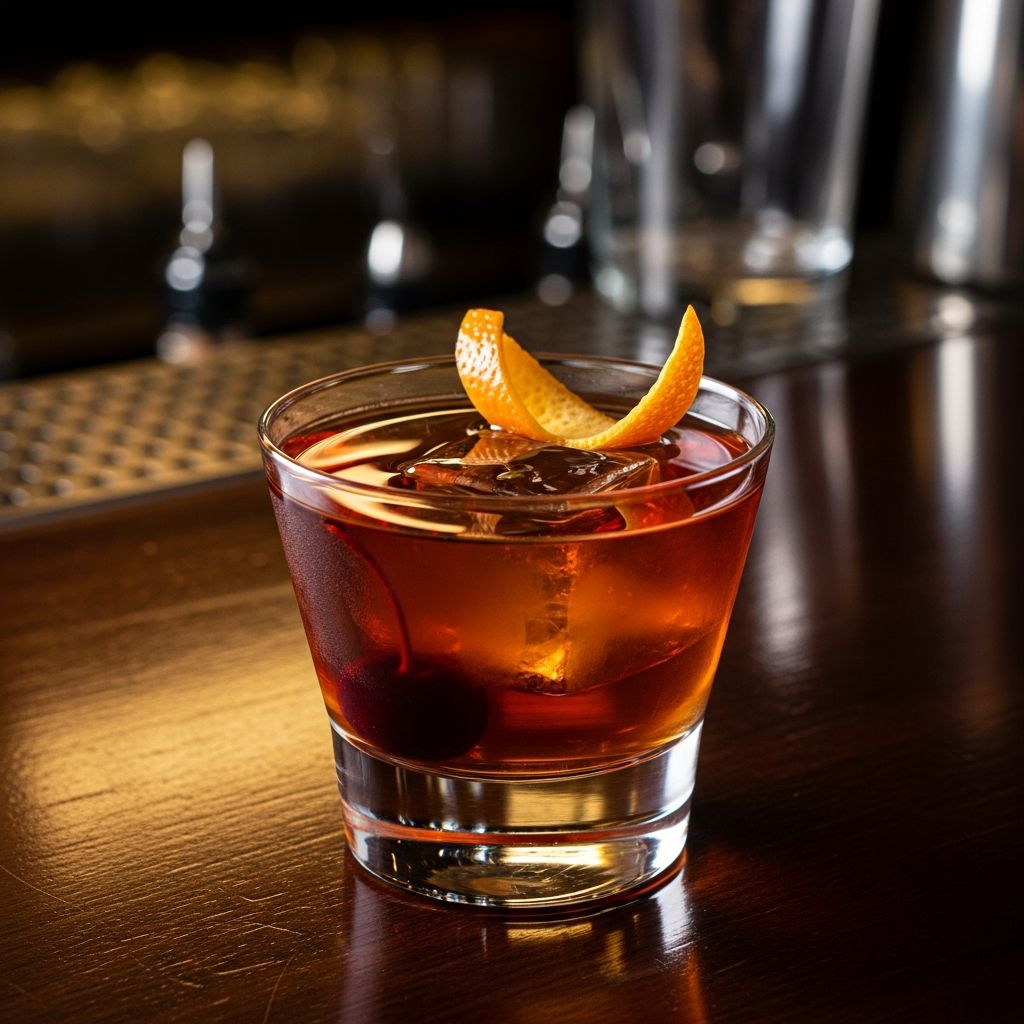
The Manhattan stands as one of the most revered cocktails in mixology history, celebrated for its balanced flavors of robust whiskey, herbal vermouth, and aromatic bitters. This elegant drink, typically served in a chilled coupe glass with a cherry garnish, offers a perfect harmony of sweet, bitter, and spicy notes, making it an ideal choice for cocktail enthusiasts and novices alike.
Tracing the Roots of the Manhattan
The origins of the Manhattan cocktail remain shrouded in legend, with the earliest printed recipes appearing in the 1880s. One of the first documented versions comes from O.H. Byron’s The Modern Bartenders’ Guide in 1884, which lists two variants: one featuring French vermouth, whiskey, Angostura bitters, and gum syrup, and another with Italian vermouth, whiskey, Angostura bitters, and Curacao. By 1891, William Schmidt’s The Flowing Bowl refined it further, incorporating gum syrup, bitters, absinthe, whiskey, and vermouth in precise proportions.
Over time, the recipe evolved, shedding elements like absinthe and gum syrup while standardizing around rye or bourbon whiskey, sweet vermouth, and Angostura bitters. This transformation reflects changing ingredient availability and bartender preferences, solidifying the Manhattan as a staple by the early 20th century. Legends attribute its creation to New York City’s Manhattan Club in the 1870s, possibly for a political event, though no definitive proof exists.
Core Ingredients That Define the Manhattan
At its heart, the classic Manhattan requires just three primary components, allowing each to shine while creating depth.
- Whiskey (2 oz): Traditionally rye for its spicy edge, though bourbon offers sweeter, caramel notes. Rye was likely the original choice, but bourbon gained popularity for its smoother profile.
- Sweet Vermouth (1 oz): This fortified wine adds herbal sweetness and complexity, balancing the whiskey’s boldness. Italian-style sweet red vermouth is standard.
- Angostura Bitters (2-3 dashes): These provide spicy, aromatic undertones essential for tying the drink together.
Garnish: A Luxardo or maraschino cherry perched on the rim enhances the fruity finish, while a lemon or orange twist offers citrus brightness.
Step-by-Step Guide to Mixing the Perfect Manhattan
Crafting a Manhattan emphasizes precision and technique, favoring stirring over shaking to maintain clarity and silkiness.
- Chill a coupe or martini glass in the freezer for 10-15 minutes.
- Fill a mixing glass with ice cubes.
- Add 2 ounces whiskey, 1 ounce sweet vermouth, and 2-3 dashes Angostura bitters.
- Stir gently for 20-30 seconds until well-chilled and diluted—avoid over-stirring to prevent dilution.
- Strain into the chilled glass.
- Garnish with a cherry or twist.
Serve immediately for optimal temperature and aroma. This method yields about 3-4 oz of cocktail.
Exploring Manhattan Variations
The Manhattan’s versatility has inspired countless twists, each tweaking ratios or substitutes for unique profiles.
| Variation | Key Ingredients | Distinct Feature |
|---|---|---|
| Dry Manhattan | 2.5 oz whiskey, 1 oz dry vermouth, 2-3 dashes bitters, lemon peel | Lighter, less sweet with herbal dryness |
| Perfect Manhattan | 2 oz rye, 0.5 oz dry vermouth, 0.5 oz sweet vermouth, 2 dashes bitters | Balanced sweet-dry harmony |
| Sweet Manhattan | 2 oz bourbon, 1 oz sweet vermouth, dash bitters, maraschino syrup | Extra sweetness for dessert-like sip |
| Black Manhattan | 2 oz rye, 1 oz Averna amaro, dashes Angostura & orange bitters | Bitter, herbal depth from amaro |
| Brandy Manhattan (Metropolitan) | 2 oz brandy, 1 oz sweet vermouth, 2 dashes bitters | Smoother, fruitier alternative |
| Rob Roy | 2 oz Scotch, 0.75 oz sweet vermouth, 3 dashes bitters | Smoky Scotch twist |
These adaptations allow personalization—experiment with ratios like 4:1 whiskey-to-vermouth for a drier style or 2:1 for bolder sweetness.
Choosing the Right Whiskey for Your Manhattan
Whiskey selection dramatically influences the drink’s character. Rye whiskey, with its peppery spice and dry finish, honors tradition and cuts through vermouth’s richness. Bourbon, conversely, brings vanilla, toffee, and oak, appealing to those preferring milder warmth.
- Recommended Ryes: Rittenhouse or Wild Turkey 101 for bold spice.
- Recommended Bourbons: Maker’s Mark or Woodford Reserve for balanced sweetness.
- Avoid: Heavily peated or overly young whiskeys, which overpower the ensemble.
Opt for 90-100 proof spirits to ensure proper dilution during stirring.
Essential Tools and Techniques for Home Bartenders
Minimal equipment yields professional results:
- Mixing glass or Boston shaker.
- Bar spoon for stirring.
- Jigger for measurements.
- Hawthorne strainer.
- Chilled coupe glasses.
Key technique: Stirring preserves texture—30 rotations clockwise, 30 counterclockwise. Taste-test dilutions; ideal Manhattan feels velvety, not watery. Store vermouth refrigerated post-opening, as it oxidizes quickly.
Pairing the Manhattan with Food and Occasions
This cocktail’s robust profile pairs excellently with charcuterie, aged cheeses, dark chocolate, or grilled steaks. Its pre-dinner aperitif quality stimulates the palate without overwhelming. Ideal for intimate gatherings, holiday parties, or quiet evenings—its sophistication elevates any setting.
Common Mistakes and Pro Tips
Avoid these pitfalls for Manhattan success:
- Shaking instead of stirring: Creates foam; stir for clarity.
- Poor vermouth quality: Use fresh, reputable brands like Carpano Antica.
- Over-garnishing: One cherry suffices.
Pro tips: Add a rinse of absinthe for historical flair, or experiment with orange bitters for citrus lift. Batch for parties by scaling ingredients and storing in glass bottles.
Frequently Asked Questions (FAQs)
What glass is best for a Manhattan?
A chilled coupe or Nick & Nora glass showcases elegance and concentrates aromas.
Can I use vodka instead of whiskey?
No—vodka lacks the depth; stick to whiskey for authenticity.
How long does opened vermouth last?
1-2 months refrigerated; replace if flavors dull.
Is rye or bourbon better for beginners?
Bourbon’s sweetness eases newcomers into the classic profile.
What’s the alcohol content of a Manhattan?
Approximately 30% ABV, depending on proof of ingredients.
Why the Manhattan Endures
Its simplicity belies profound balance, adaptability, and storied past. Whether classic or varied, the Manhattan invites endless refinement, cementing its place in cocktail lore.
References
- The History of the Manhattan Cocktail — TASTE cocktails. 2023. https://tastecocktails.com/the-history-of-the-manhattan-cocktail/
- The Definitive Manhattan Cocktail History & Ingredients Guide — NIO Cocktails. 2023. https://niococktails.co.uk/blogs/news/the-definitive-manhattan-cocktail-history-ingredients-guide
- Cocktail History: The Manhattan — Spirit of York. 2023. https://spiritofyork.com/blogs/spirit-of-york/cocktail-history-the-manhattan
- The Manhattan Drink: What’s In It, How To Make It & More — Drink Haus. 2023. https://drink.haus/blogs/news/the-manhattan-drink-whats-in-it-how-to-make-it-more
- Manhattan cocktail history — Difford’s Guide. 2023. https://www.diffordsguide.com/g/1221/manhattan-cocktail/history
- The Story of the Manhattan Cocktail — Revelry Tours. 2023. https://revelry.tours/cocktails/manhattan/
- Manhattan (cocktail) — Wikipedia. 2026. https://en.wikipedia.org/wiki/Manhattan_(cocktail)
Similar Articles





Read full bio of medha deb