From Subfloor to Showcase: A Complete Guide to Installing a Tile Floor
Plan, prepare, and install a durable tile floor like a pro.
Installing a tile floor is one of the most impactful upgrades you can make to a kitchen, bathroom, entryway, or mudroom. With careful planning and a methodical approach, a motivated DIYer can achieve a professional-looking, long-lasting tile surface that stands up to everyday use.
Why Choose Tile for Your Floors?
Tile flooring is prized for its durability, moisture resistance, and wide range of styles, making it suitable for both high-traffic spaces and design-focused rooms. It resists dents, stains, and scratches better than many other flooring types and offers excellent compatibility with radiant heat systems.
Beyond practicality, tile allows for nearly limitless design flexibility, including patterns such as herringbone, brick, or diagonal layouts, as well as creative border designs and insets. When installed correctly over a stable subfloor, a tile floor can last for decades with minimal maintenance.
Planning Your Tile Floor Project
Before purchasing any material, spend time planning the layout, checking your existing floor structure, and estimating the total cost. Good planning reduces waste, avoids awkward partial tiles in highly visible areas, and keeps the project on schedule.
Key questions to answer before you start
- Which room or rooms will be tiled, and are they prone to moisture (bathrooms, laundry rooms, entryways)?
- What tile size and pattern fit the scale of the room and your skill level (large-format, mosaics, or standard squares)?
- Is the existing subfloor flat, solid, and structurally sound enough to support a rigid tile surface?
- How will the new tile transition to adjacent flooring like hardwood or carpet?
Answering these questions allows you to choose appropriate materials, set an accurate budget, and decide whether to tackle all the work yourself or hire help for specific tasks like subfloor repairs.
Tools and Materials Checklist
Gathering the right tools and materials in advance makes the installation smoother and helps you maintain a steady workflow. You do not need top-of-the-line equipment, but you do need tools capable of making clean cuts and spreading mortar evenly.
Essential tools
- Measuring tape, carpenter’s pencil, and chalk line
- 4-foot level or straightedge to check flatness
- Notched trowels (size matched to your tile)
- Rubber mallet and rubber grout float
- Tile spacers in the width you want for grout joints
- Manual tile cutter and/or wet saw; tile nippers for small notches
- Bucket, mixing paddle, and drill for mortar and grout
- Knee pads, utility knife, and margin trowel
- Sponge and clean rags for cleanup
Common materials
- Floor tile (ceramic, porcelain, or natural stone)
- Cement backer board or other tile-approved underlayment (if needed)
- Thin-set mortar or tile adhesive appropriate for your substrate and tile type
- Grout (sanded or unsanded, depending on joint width)
- Backer board screws and fiberglass mesh tape
- Primer, leveler, or patching compound for uneven areas
- Silicone caulk for movement joints at walls and tubs
- Sealer (if required for your tile or grout)
Understanding Subfloors and Underlayments
Tile is rigid and cannot flex without cracking, so the supporting layers beneath the tile are critical. A solid, flat, and properly prepared subfloor provides the foundation needed to prevent cracked tiles and failed grout lines.
| Subfloor Type | Typical Material | Tile Considerations |
|---|---|---|
| Wood joist floor | OSB or plywood | Often requires cement backer board or a decoupling membrane to reduce movement and provide a stable surface. |
| Concrete slab | Poured concrete | Must be clean, level, and free of cracks; may need crack isolation products in problem areas. |
| Existing tile | Ceramic or porcelain | Can sometimes be tiled over if firmly bonded and flat, but height and adhesion must be evaluated. |
Many installations benefit from a tile underlayment such as cement backer board or a membrane that separates the tile from small movements in the structure. Follow the specific instructions for the underlayment you choose, including fastening schedules and joint treatment.
Step 1: Remove Old Flooring and Inspect the Base
Start by removing existing flooring such as vinyl, laminate, carpet, or damaged tile. Carefully pull baseboards or shoe molding so you can reinstall them after tiling for a cleaner finished look. As you remove materials, watch for signs of moisture, rot, or structural damage.
Once the old floor is up, vacuum and sweep thoroughly so you can see the condition of the subfloor. Tighten any squeaky areas with screws into the joists, replace sections of subfloor that are soft or swollen, and address any moisture issues before proceeding.
Step 2: Flatten and Prepare the Subfloor
Use a long level or straightedge to check for high and low spots across the room. Most tile manufacturers allow only a small variance in flatness, so take time to correct irregularities now instead of fighting them while laying tile.
- High spots can often be sanded or planed down if you are working over wood.
- Low spots may need to be filled with a patching compound or self-leveling underlayment compatible with tile.
- Concrete slabs should be checked for cracks; repair as directed by the patching product and consider crack isolation membranes if needed.
After flattening, ensure the surface is free of dust, oil, and debris so that the underlayment or mortar bonds correctly. Some surfaces may require a primer before applying leveler or thin-set.
Step 3: Install Backer Board or Underlayment (If Required)
On wood subfloors, a cement backer board or similar underlayment helps create a stable, moisture-resistant surface for tile. Cut panels to size, stagger joints, and leave a small gap around the perimeter of the room as recommended.
- Spread thin-set mortar with a notched trowel where each panel will sit.
- Lay the backer board into the fresh mortar and press firmly.
- Fasten with corrosion-resistant screws according to the manufacturer’s spacing guidelines.
- Cover panel joints with fiberglass mesh tape and a thin layer of mortar, then let it dry.
Whether using board or a membrane, the goal is a continuous, stable surface with no loose spots or deflection when you walk on it.
Step 4: Plan the Tile Layout
A thoughtful layout makes the difference between a floor that looks custom and one that looks like an afterthought. Instead of starting in a random corner, use reference lines to center the layout and balance cut tiles along walls.
Establish reference lines
- Measure and mark the midpoint of opposite walls.
- Snap chalk lines between these points to create a cross through the center of the room.
- Use a framing square or measure diagonals to ensure the lines form a right angle.
Dry-lay sample rows
Place tiles (with spacers) along the reference lines without mortar to see how they fall near the walls and doorways. Adjust the position of the lines slightly if you end up with thin slivers of tile in visible areas, aiming to keep cut tiles at least half-width where possible.
Step 5: Mix and Spread Thin-Set Mortar
Thin-set mortar is the adhesive that bonds the tile to the underlayment. Follow the mixing instructions closely, typically adding powder to clean water and blending with a mixing paddle until creamy with no dry lumps. Let the mortar rest (slake) if specified, then remix briefly.
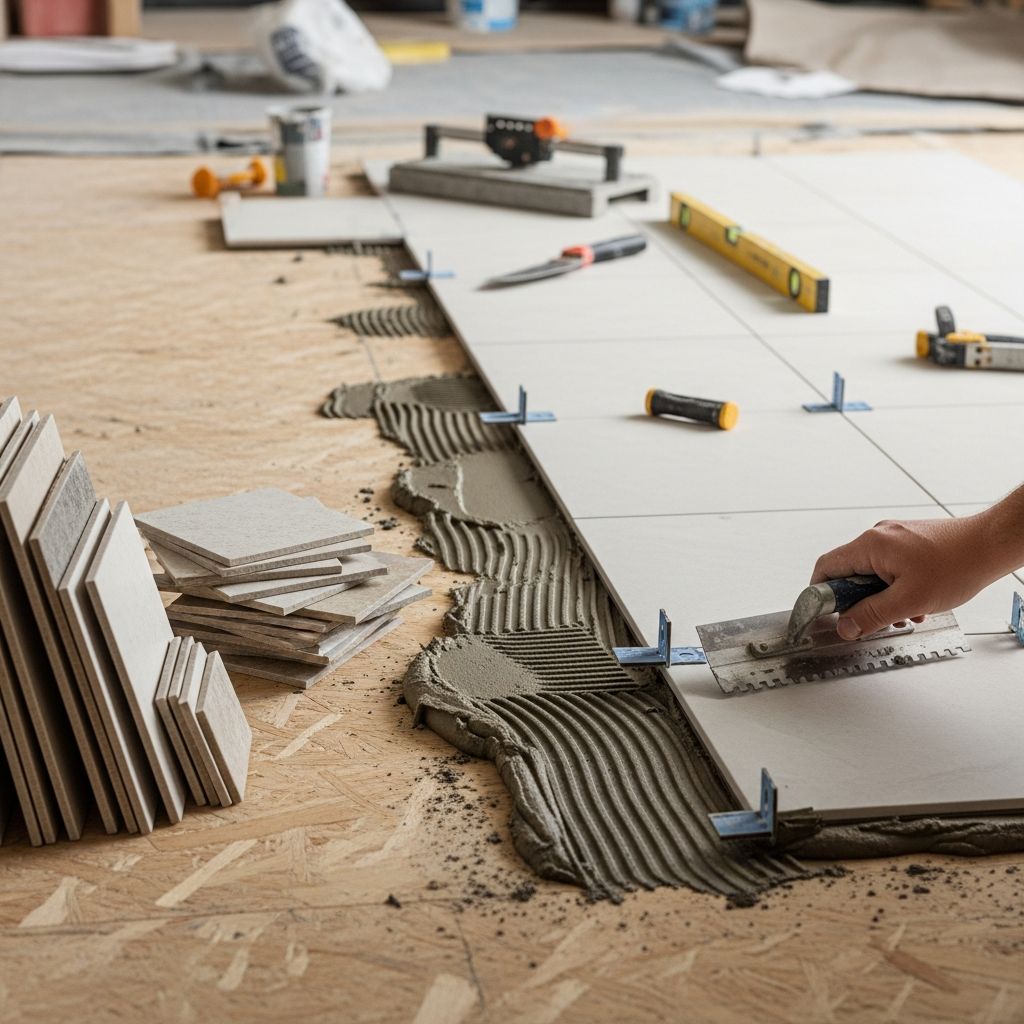
Work in sections small enough that the mortar does not skin over before you can set tiles. Use the flat side of the trowel to key the mortar into the surface, then comb in straight lines with the notched side held at a consistent angle for even ridges.
Step 6: Set the Tiles
Begin at your chosen starting point, usually where the reference lines intersect in the center of the room or at a highly visible threshold. Press the first tile into the mortar and give it a slight back-and-forth motion to collapse the ridges beneath it.
- Place spacers between tiles to maintain consistent grout joints.
- Check frequently with a level and straightedge to ensure tiles are both flat and aligned.
- Use a rubber mallet and a 2×4 or beating block to gently tap tiles into plane when needed.
For very large tiles or natural stone, back-buttering (spreading a thin layer of mortar on the back of each tile) can improve coverage and help prevent voids. Scrape away excess mortar from joints before it hardens so the grout can fill evenly later.
Step 7: Measure, Cut, and Fit Edge Tiles
Once the main field of tiles is in place, you will likely have gaps along walls, around doorways, or near fixtures such as toilets and cabinets. These areas require careful measuring and cutting to maintain clean lines and proper expansion gaps.
Best practices for cutting
- Measure each space individually rather than assuming identical cuts.
- Mark cut lines clearly and double-check orientation before cutting.
- Use a manual cutter for straight cuts and a wet saw for precise or angled cuts.
- Use tile nippers for small notches around obstacles such as pipe penetrations.
Remember to leave a narrow gap at walls and fixed structures, which will be covered by baseboards or caulk and allow for minor movement without stressing the tile.
Step 8: Allow Mortar to Cure
After all tiles are set and spacers are removed, allow the mortar to cure fully before grouting or walking on the floor. The exact time depends on the product and conditions, but many installations require at least 24 hours.
During this curing period, avoid placing heavy loads or kneeling on the tiles, as movement can disturb the bond and cause tiles to shift slightly out of alignment.
Step 9: Grout the Joints
Grout fills the spaces between tiles, locks them together, and helps prevent debris from collecting in the joints. Choose sanded grout for wider joints and unsanded grout for narrow ones, following the recommendations on the packaging.
- Mix grout to a thick, creamy consistency with no dry pockets.
- Apply using a rubber float held at a diagonal angle to the joints.
- Press grout firmly into gaps, working a small section at a time.
- Remove excess grout by pulling the float across the tiles at a steep angle.
- After a brief haze forms, wipe the surface with a damp sponge, rinsing frequently.
Once the grout has started to harden, buff off any remaining haze with a soft, dry cloth. Avoid using harsh cleaners until the grout has fully cured.
Step 10: Seal and Finish the Floor
Some tile and many cement-based grouts benefit from sealing to resist staining and make cleaning easier. Follow the guidance for your specific materials, as some porcelain tiles require only grout sealing, while natural stone may need both tile and grout sealed.
After sealing (if required), reinstall baseboards or shoe molding, apply flexible caulk where the tile meets tubs or walls that may move, and add any transition strips at doorways. At this stage, your floor is ready for gentle use and regular cleaning.
Common Mistakes to Avoid
Even careful DIYers can run into problems when installing tile for the first time. Recognizing common pitfalls in advance helps you avoid costly rework and ensures a more professional result.
- Skipping subfloor preparation and tiling over surfaces that are not flat, clean, or structurally sound.
- Using the wrong trowel size, which can lead to poor mortar coverage and hollow-sounding tiles.
- Failing to maintain consistent grout joints, resulting in a visually uneven pattern.
- Not cleaning excess mortar from joints and tile surfaces before it hardens.
- Walking on the tile or grouting too soon, before the mortar has cured.
Basic Maintenance for Long-Lasting Tile Floors
Proper maintenance keeps your new tile floor looking sharp and performing well for years. Fortunately, routine care is straightforward, especially with glazed ceramic or porcelain tile.
- Sweep or vacuum regularly to remove abrasive grit that can dull the finish.
- Clean with a pH-neutral tile cleaner or mild soap solution; avoid harsh acids or oil-based products.
- Wipe up spills promptly, especially on lighter grout, to reduce staining.
- Reapply grout sealer as recommended by the manufacturer, usually every one to three years in high-use areas.
FAQs About Installing a Tile Floor
Do I need to remove old vinyl or laminate before tiling?
In most cases, removing resilient flooring is best because it allows you to inspect and repair the subfloor. Tiling over old materials can trap moisture and may not provide the rigid, well-bonded surface tile requires.
How flat does the floor need to be?
While exact tolerances vary, the general goal is a surface with only minor variation over several feet. Pronounced humps or dips can cause tiles to rock, crack, or create uneven lippage between pieces, so invest time in flattening the floor before setting tile.
Can I install tile directly on plywood?
Direct bonding to plywood is sometimes possible under strict conditions, but many pros prefer cement backer board or a decoupling membrane for better long-term performance. These products provide a more forgiving surface and help isolate the tile from slight movement in the wood structure.
How long does the whole project usually take?
The timeline depends on room size, complexity, and your experience level, but many homeowners spend several days on preparation and layout, one to two days setting tile, and another day for grouting and finishing. Drying and curing times for mortar and grout add additional time before heavy use.
Is large-format tile harder to install?
Larger tiles highlight any unevenness in the subfloor, so they demand a flatter base and more attention to mortar coverage. With good preparation and patience, however, even large-format tile can be installed successfully by careful DIYers.
Similar Articles





Read full bio of Sneha Tete