Concrete vs Cement: Understanding the Key Differences
Learn the critical differences between concrete and cement for your next project.
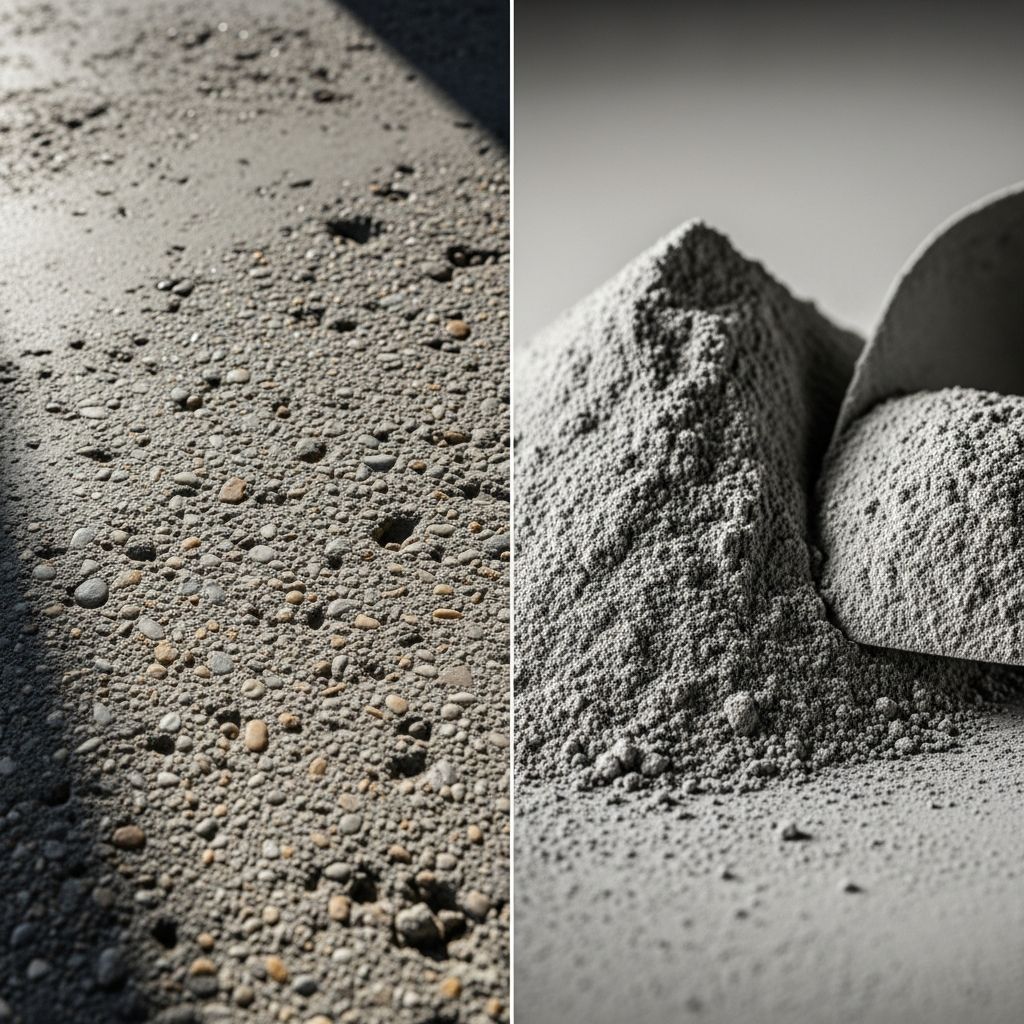
Many homeowners and DIY enthusiasts use the terms “concrete” and “cement” interchangeably, but these two materials are not the same. Understanding the distinction between them is crucial for any construction or renovation project. Whether you’re planning to pour a driveway, repair a foundation, or patch a concrete surface, knowing the difference will help you select the right material and achieve the best results.
What Is Cement?
Cement is a binding agent and a key ingredient in concrete. It’s a fine powder made from limestone, clay, shells, and silica sand that are heated together in a kiln at extremely high temperatures. This heating process, called calcination, breaks down the raw materials into clinker, which is then ground into a fine powder to create cement.
The most common type of cement used in construction is Portland cement, which was developed in England in the 19th century and remains the industry standard worldwide. Portland cement is the primary binding ingredient in most concrete mixes.
Key Characteristics of Cement:
- Fine powder form
- Acts as a binding agent
- Not usable on its own for structural applications
- When mixed with water, it undergoes a chemical reaction called hydration
- Available in different types, including Type I, Type II, and Type III Portland cement
What Is Concrete?
Concrete is a composite material made by combining cement, water, aggregates (sand and gravel), and sometimes additional additives. It’s the finished product that results from mixing these ingredients together. Concrete is what you see on driveways, sidewalks, patios, and building foundations.
The cement in concrete acts as the glue that binds the sand and gravel together, creating a solid, durable material. When water is added to the cement, a chemical reaction occurs, and the mixture gradually hardens into a strong, stone-like substance.
Key Characteristics of Concrete:
- Composite material made from multiple ingredients
- Ready-to-use material for structural applications
- Can be customized with different aggregates and additives
- Gains strength over time through the hydration process
- Durable and long-lasting when properly installed
- Available in various strengths and compositions
Composition Breakdown
To better understand these materials, let’s examine what goes into each one:
Cement Composition:
Portland cement, the most widely used type, contains:
- Limestone (calcium carbonate) – approximately 60-67%
- Silica – approximately 17-25%
- Alumina – approximately 3-8%
- Iron oxide – approximately 0.5-6%
- Gypsum – added during grinding to control setting time
Concrete Composition:
A typical concrete mix consists of:
- Cement – approximately 10-15% by weight
- Water – approximately 15-20% by weight
- Sand (fine aggregate) – approximately 25-30% by weight
- Gravel or coarse aggregate – approximately 40-50% by weight
- Additives (optional) – air entrainment, plasticizers, or coloring agents
How They’re Made
Cement Manufacturing:
Cement production is an industrial process that involves several steps. Raw materials including limestone, clay, silica sand, and iron ore are extracted from quarries and mines. These materials are crushed and blended, then heated in a kiln at temperatures exceeding 1400 degrees Celsius. This high-temperature process transforms the raw materials into clinker. The clinker is then cooled and ground into a fine powder with the addition of gypsum to create finished Portland cement.
Concrete Production:
Concrete is created by mixing cement with water and aggregates. This can be done on-site in a portable mixer for small projects, or it can be ordered as ready-mix concrete from a concrete supplier. In ready-mix operations, all ingredients are batched and mixed in a truck en route to the construction site. Once the ingredients are combined, the cement begins to hydrate, and the concrete starts its curing process.
Differences in Application and Use
Understanding when to use cement versus concrete is essential for successful construction projects.
When to Use Cement:
- Grouting applications
- Mortar for brickwork and masonry
- Plaster finishes on walls
- As a binding ingredient in concrete mixes
- Bonding existing concrete surfaces
When to Use Concrete:
- Driveways and parking lots
- Sidewalks and walkways
- Patios and outdoor surfaces
- Foundation work and footings
- Basement floors and slabs
- Structural columns and beams
- Decorative surfaces and countertops
Strength and Durability
While cement is a crucial ingredient, it cannot be used alone for load-bearing applications. Concrete, on the other hand, is designed to support significant weight and withstand various environmental conditions. The strength of concrete depends on several factors, including the water-to-cement ratio, the quality of aggregates, proper mixing, and adequate curing time.
Concrete typically reaches approximately 70% of its final strength after 7 days of curing and continues to gain strength for up to 28 days. Different concrete mixes can achieve different strength levels, ranging from 2,500 psi (pounds per square inch) for general applications to 4,000 psi or higher for demanding applications.
Cost Considerations
The cost difference between cement and concrete varies based on several factors. Pure Portland cement is relatively inexpensive compared to ready-mix concrete, but cement alone cannot be used for most structural applications. Concrete costs depend on the mix design, local availability, delivery fees, and the thickness of the application. For most homeowners, ordering ready-mix concrete is more practical than mixing concrete from scratch, though it typically comes with minimum order requirements.
Common Misconceptions
Misconception 1: Cement and Concrete Are the Same Thing
This is the most common mistake. Cement is an ingredient; concrete is the finished product. It’s similar to the difference between flour and cake – flour is an ingredient, but cake is what you get after combining multiple ingredients and processing them.
Misconception 2: You Can Use Cement for All Projects
While cement has important uses, it should not be used alone for structural applications like driveways or patios. These applications require the strength and durability of concrete.
Misconception 3: All Concrete Is the Same
Concrete can be customized with different aggregates, additives, colors, and strengths to meet specific project requirements. The type of concrete used depends on the intended application and environmental conditions.
Curing and Setting Times
Both cement and concrete go through curing and setting processes, but the timeline varies.
Cement Setting: When cement is mixed with water, it begins to set within minutes. Initial set occurs around 30-45 minutes, while final set occurs around 8-10 hours, though the material continues to gain strength long after that.
Concrete Curing: Concrete has a longer curing timeline. It becomes hard enough to walk on after 24-48 hours, can support light traffic after 7 days, and continues to cure for up to 28 days or longer. For the first week, concrete should be kept moist to ensure proper curing, as dry conditions can affect its final strength.
Environmental Factors
Both cement and concrete are affected by environmental conditions. Cement should be stored in a dry location, as moisture can cause it to harden prematurely. Concrete is affected by temperature, humidity, and exposure to chemicals or salt. In cold climates, concrete can suffer damage from freeze-thaw cycles, while in regions with salt exposure, proper concrete design and maintenance are essential to prevent deterioration.
Selecting the Right Material for Your Project
When planning a construction or repair project, consider the following factors:
- Project Type: Determine whether your project requires a binding agent (cement) or a structural material (concrete)
- Load Requirements: Structural projects require concrete’s strength
- Environmental Conditions: Consider climate, exposure to salt, and moisture levels
- Budget: Compare costs for different material options
- Professional Help: For significant projects, consult with a contractor or engineer
Frequently Asked Questions
Q: Can I use cement instead of concrete for a driveway?
A: No. Cement alone is not suitable for driveways. You need concrete, which uses cement as a binding ingredient combined with sand and gravel. Concrete provides the strength and durability required for vehicle traffic.
Q: How long does concrete take to cure?
A: Concrete typically reaches usable strength after 7 days and continues to cure for up to 28 days. However, it hardens enough to walk on after 24-48 hours. The exact timeline depends on temperature, humidity, and concrete mix design.
Q: What is Portland cement?
A: Portland cement is the most common type of cement used in construction. It’s made by heating limestone and clay at high temperatures, creating clinker that is then ground into fine powder. It’s the primary binding agent in most concrete mixes.
Q: Can I add color to concrete?
A: Yes. Concrete can be customized with integral colorants, surface stains, or dyes to achieve various decorative effects. This allows for creative design options while maintaining concrete’s durability.
Q: How do I know if my concrete is properly cured?
A: Properly cured concrete should not change color or feel damp to the touch. After 7 days, it should support light traffic, and after 28 days, it should reach its design strength for normal applications.
Q: What’s the difference between concrete and mortar?
A: Mortar is a mixture of cement, sand, and water used to bind bricks and stones together. Concrete contains larger aggregates (gravel) in addition to sand and is used for structural applications. Mortar is more flexible, while concrete is stronger.
Q: Is cement waterproof?
A: Cement itself is not waterproof, though concrete has varying degrees of water resistance depending on its density and mix design. Sealers can be applied to concrete surfaces to enhance water resistance and protect against staining and damage.
References
- Portland Cement Association: Cement and Concrete Basics — Portland Cement Association (PCA). 2024. https://www.cement.org/
- USGS: Cement Statistics and Information — United States Geological Survey. 2024. https://www.usgs.gov/faqs/what-difference-between-cement-and-concrete
- Standard Specification for Portland Cement (ASTM C150) — ASTM International. 2023. https://www.astm.org/
- ACI 308: Guide to Curing Concrete — American Concrete Institute. 2022. https://www.concrete.org/
- Ready-Mix Concrete: Production and Quality Specifications — National Ready-Mix Concrete Association. 2024. https://www.nrmca.org/
Similar Articles








Read full bio of Sneha Tete