Cooling Towers Explained
Discover how cooling towers function, their key types, components, and vital role in efficient HVAC and industrial cooling systems.
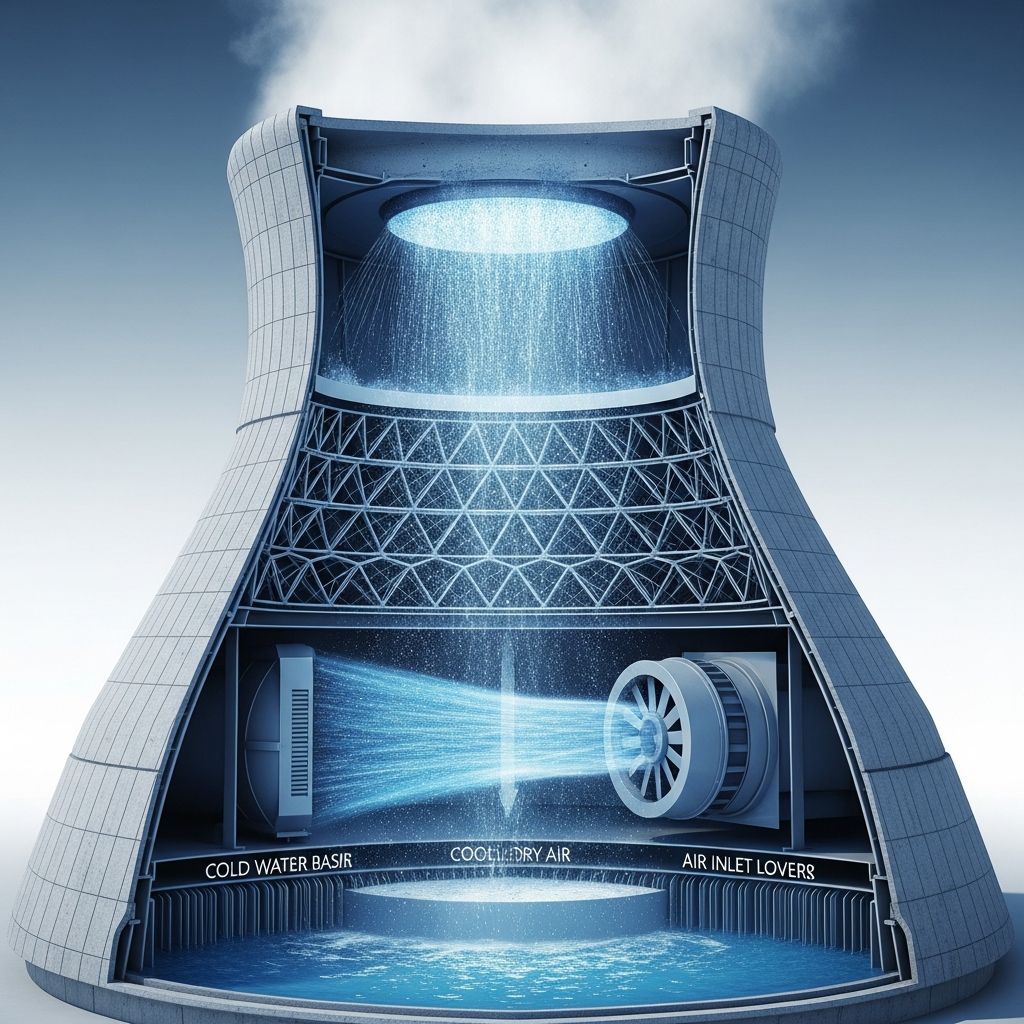
Cooling towers serve as critical heat rejection devices in large-scale HVAC systems, power plants, and industrial processes by transferring excess heat from water to the atmosphere primarily through evaporation.
The Fundamental Role of Cooling Towers in Modern Systems
In heating, ventilation, and air conditioning (HVAC) setups, cooling towers enable efficient operation of chillers by dissipating the heat absorbed from buildings or machinery. Unlike air-cooled systems that rely on higher ambient dry-bulb temperatures, water-cooled systems using cooling towers achieve lower temperatures close to the wet-bulb level, boosting energy efficiency.
These structures are indispensable in environments generating substantial heat loads, such as data centers, manufacturing facilities, refineries, and commercial high-rises. By cooling recirculating water, they prevent overheating, maintain process temperatures, and support continuous operations.
Core Principles Behind Heat Rejection
Cooling towers exploit evaporative cooling, where a small portion of water evaporates, absorbing significant latent heat and lowering the temperature of the remaining water. Hot water from chillers or processes enters the tower, contacts air over specialized fill media, and cools via evaporation and direct heat transfer.
Airflow, either natural or mechanically induced, enhances this exchange. The cooled water collects in a basin and pumps back to the system, forming a closed loop that minimizes water loss while maximizing thermal performance.
Essential Structural and Mechanical Components
Cooling towers integrate various parts for structural integrity, water distribution, airflow management, and heat transfer optimization. Understanding these elements aids in selection, maintenance, and troubleshooting.
- Fill Media: Increases contact surface area between water and air, promoting efficient evaporation and sensible heat transfer. Materials range from splash grids to high-efficiency films.
- Water Distribution System: Nozzles and headers evenly spray hot water over the fill, ensuring uniform coverage and preventing dry spots that reduce efficiency.
- Fans and Drive Systems: In mechanical draft towers, axial or centrifugal fans, powered by electric motors via gearboxes or belts, generate airflow. Speed reducers optimize torque for large blades.
- Drift Eliminators: Capture water droplets entrained in exhaust air, reducing loss to under 0.0005% of circulation rate and minimizing environmental impact.
- Cold Water Basin: Reservoir at the base collects cooled water for recirculation, often with strainers to protect pumps.
- Framework and Casing: Corrosion-resistant materials like galvanized steel, fiberglass, or concrete provide weatherproof enclosure and support.
Classification by Airflow Generation Methods
Cooling towers divide into categories based on how they induce air movement, influencing size, efficiency, and application suitability.
Natural Draft Towers
These rely on buoyancy: warm, moist air rises through a tall stack, drawing in cooler ambient air without fans. Hyperbolic shapes, common in power plants, enhance draft via stack effect. They excel in large-scale, continuous operations but require significant height and initial investment.
Mechanical Draft Towers
Fans actively move air, offering compact designs and reliable performance across varying conditions. Subtypes include:
- Forced Draft: Fans at the base push air upward. Compact and protected from weather, but prone to hot air recirculation if not spaced properly. Suited for indoor or space-limited installs.
- Induced Draft: Top-mounted fans pull air through the tower, discharging moist air high and away to avoid recirculation. Quieter and more efficient, ideal for most commercial HVAC.
Flow Configurations: Crossflow vs. Counterflow
Independent of draft type, towers classify by air-water interaction direction, affecting efficiency, footprint, and maintenance.
| Aspect | Crossflow | Counterflow |
|---|---|---|
| Air/Water Flow | Air horizontal, water vertical down | Air vertical up against water down |
| Efficiency | Good; gravity-aided | Higher; intimate contact |
| Footprint/Height | Larger base, shorter | Smaller base, taller |
| Pump Power | Lower (gravity helps) | Higher |
| Freeze Resistance | Moderate | Better |
| Applications | HVAC, general industrial | High-demand processes |
Operational Cycle Step-by-Step
1. Hot condenser water (e.g., 95°F) pumps to the tower’s distribution headers.
2. Water sprays over fill media, maximizing air contact.
3. Fans induce airflow; evaporation cools water to approach wet-bulb temp (e.g., 85°F).
4. Cooled water drains to basin.
5. Basin pumps return water to chiller; makeup compensates evaporation (1-2% of flow).
Approach (cooled water temp minus wet-bulb) and range (inlet minus outlet temp) measure performance. Optimal towers maintain 7-11°F approach.
Applications Across Industries
- Commercial HVAC: Roof-mounted induced draft crossflow towers cool chillers in offices, hospitals, hotels.
- Power Generation: Massive natural draft towers handle steam cycle cooling in fossil and nuclear plants.
- Industrial Processes: Petrochemical, manufacturing use counterflow for precise temp control.
- Data Centers: Forced or induced draft ensure server uptime via reliable cooling.
Maintenance Best Practices for Longevity
Regular upkeep prevents efficiency loss, scaling, and microbial growth like Legionella.
- Inspect/clean fill, nozzles quarterly to avoid blockages.
- Monitor water chemistry: control pH (7.5-8.5), conductivity; use biocides.
- Check fan belts, bearings, motors annually; balance blades.
- Winterize: drain or use antifreeze basins in cold climates.
- Performance test: measure wet-bulb, flows, temps.
Energy Efficiency and Sustainability
Modern towers incorporate variable frequency drives (VFDs) on fans, reducing power by 30-50% at part loads. Low-drift designs and fill materials cut water use. Compared to air-cooled, they save 50-70% energy in chillers.
Legislation like EU F-Gas rules favors low-GWP refrigerants paired with efficient towers.
Selecting the Right Cooling Tower
Consider thermal duty (tons), wet-bulb temp, space, water quality, redundancy. Consult ASHRAE standards for sizing. Lifecycle costs favor induced draft counterflow for most.
Frequently Asked Questions (FAQs)
What is the main purpose of a cooling tower?
It rejects heat from process water to air via evaporation, enabling efficient chiller operation in HVAC and industrial systems.
How much water evaporates in a cooling tower?
Typically 1-2% of recirculated flow, or about 1.8 gal/ton-hour of cooling.
What are the most efficient cooling tower types?
Induced draft counterflow offers superior heat transfer; crossflow excels in ease of maintenance.
Do cooling towers require water treatment?
Yes, to prevent scale, corrosion, fouling; regular chemical dosing and blowdown essential.
Can cooling towers freeze in winter?
Counterflow resists better; use basin heaters, enclosures for protection.
References
- What is a Cooling Tower? Function, Types & Importance — Kilgore Industries. 2023. https://kilgoreind.com/cooling-towers-explained-how-they-work-why-theyre-essential-for-hvac-systems/
- Types, Principles, Parts and Applications of Cooling Towers — IQS Directory. 2024. https://www.iqsdirectory.com/articles/cooling-tower.html
- 5 Types of Cooling Towers You Need to Know — WINT. 2023. https://wint.ai/blog/5-types-of-cooling-towers-you-need-to-know/
- The Different Types Of Cooling Towers — Chardon Labs. 2024. https://www.chardonlabs.com/resources/types-of-cooling-towers/
- How Cooling Towers Work — The Engineering Mindset. 2022. https://theengineeringmindset.com/how-cooling-towers-work/
- How Cooling Towers Work (Working Principle) — YouTube (Engineering Video). 2023. https://www.youtube.com/watch?v=sWJCWDpY9is
- Cooling Tower — Wikipedia (citing ASHRAE/engineering standards). 2026. https://en.wikipedia.org/wiki/Cooling_tower
Similar Articles





Read full bio of Sneha Tete