Crafting Lightweight Concrete: A Complete Guide
Discover how to create lightweight concrete at home or on-site, using simple materials for stronger, lighter builds in modern projects.
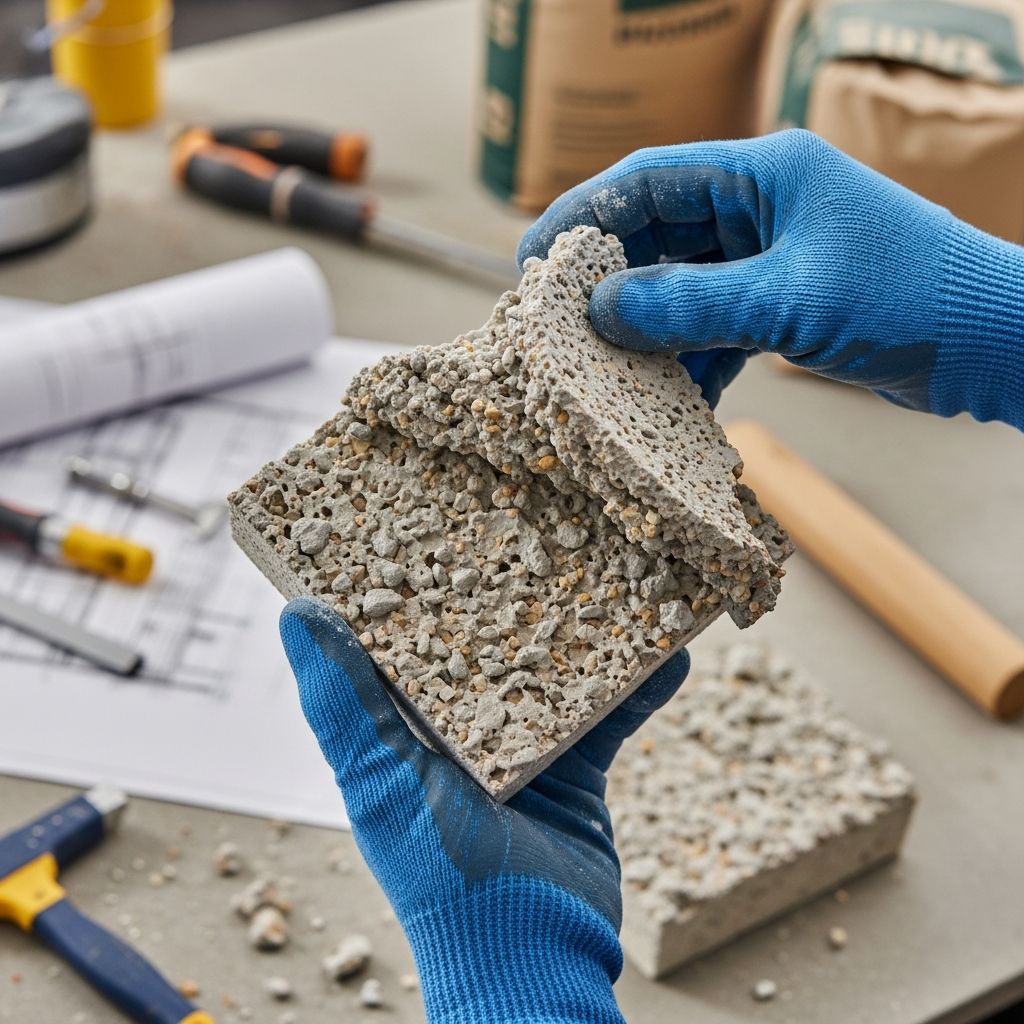
Lightweight concrete offers a practical solution for builders seeking to minimize structural weight while preserving essential strength and durability. By incorporating specialized aggregates and precise mixing methods, this material achieves densities typically between 1120 and 1920 kg/m³, far lighter than traditional mixes.
Understanding the Fundamentals of Lightweight Concrete
At its core, lightweight concrete replaces dense natural stone aggregates with porous alternatives, resulting in a product that weighs 20-30% less than normal-weight concrete (NWC), which ranges from 2300-2400 kg/m³. This reduction stems from materials like expanded clay, shale, or pumice, which contain internal voids that lower overall mass without sacrificing performance.
Structural lightweight concrete (SLC), defined by standards such as ACI 213R-14, requires a minimum compressive strength of 17 MPa and equilibrium densities in the 1120-1920 kg/m³ range. For non-structural uses, densities can dip as low as 800 kg/m³, enabling applications in insulation-focused projects.
Key Materials for Producing Lightweight Concrete
Selecting the right components is crucial for success. Here’s a breakdown:
- Portland Cement: The binding agent, typically Type I or II, provides the hydraulic reaction with water.
- Lightweight Aggregates (LWA): Core to weight reduction; options include rotary-kiln expanded shale, clay, slate (ESCS), pumice, or byproducts like fly ash. These must meet bulk density limits: under 880 kg/m³ for coarse and 1120 kg/m³ for fine per ASTM C330.
- Fine Aggregates: Often normal-weight sand to balance workability, though full LWA mixes are possible.
- Water: Adjusted for LWA’s high absorption (up to 25%), pre-wetting aggregates prevents mix dehydration.
- Admixtures: Air-entraining agents for freeze-thaw resistance, superplasticizers for flow, or foaming agents for cellular varieties.
| Material | Density Range (kg/m³) | Key Benefit |
|---|---|---|
| Expanded Shale/Clay | 300-1100 | High strength-to-weight |
| Pumice | 250-900 | Natural porosity |
| Fly Ash/Slag | 400-800 | Sustainable byproduct |
| Normal Sand | 2600 | Improves workability |
Step-by-Step Process for Mixing Lightweight Concrete
Producing lightweight concrete demands careful proportioning to account for aggregate absorption and avoid over-crushing delicate LWA. Use a compulsory mixer with plastic-lined blades to minimize fragmentation, which can increase density by 5-10%.
- Prepare Aggregates: Pre-soak LWA for 24-48 hours to saturate pores, reducing in-mix water demand. Drain excess to achieve surface-dry condition.
- Measure Proportions: A basic DIY mix: 1 part cement, 3-4 parts LWA, 1-2 parts sand, water to achieve 100-150mm slump. For 0.1 m³: 300kg cement, 600kg coarse LWA, 300kg fine LWA/sand.
- Dry Mix First: Combine cement, sand, and LWA for 1-2 minutes to coat aggregates evenly.
- Add Water Gradually: Introduce 70-80% water initially, mix 3 minutes, then remainder. Total mix time: 5-8 minutes. Target fresh density: 1200-1800 kg/m³.
- Check Workability: Slump test; adjust with superplasticizer if sticky or harsh.
- Pour and Cure: Place immediately; cover and moist-cure 7 days minimum for strength gain.
For foamed lightweight concrete, blend pre-formed foam into cement slurry at 20-50% volume for ultra-low densities under 800 kg/m³.
Advanced Techniques for Optimal Performance
Beyond basics, consider internal curing: LWA pores release stored water during hydration, lowering permeability and cracking risk compared to NWC. This yields a lower modulus of elasticity (30-50% less), reducing shrinkage stresses.
In labs or sites, limit LWA crushing by gentle handling; fragmented particles absorb more water, raising density. For structural grades, aim for 25-40 MPa strength via higher cement content or silica fume.
Benefits Driving Lightweight Concrete Adoption
- Reduced Dead Load: 30% lighter than NWC, enabling longer spans, shallower beams, and smaller foundations—ideal for high-rises and bridges.
- Superior Insulation: Lower thermal conductivity (0.5-1.0 W/mK vs. 1.5-2.0 for NWC) enhances energy efficiency.
- Durability Edge: Better sulfate resistance and freeze-thaw performance due to internal curing and pore structure.
- Cost Savings: Less material transport, smaller steel reinforcement (up to 20% less).
Practical Applications Across Construction
Lightweight concrete shines in demanding scenarios:
- High-rise floors: Cuts foundation loads by 25%.
- Bridge decks: Improves fatigue resistance with lighter weight.
- Precast panels: Faster production, better insulation.
- Roof slabs: Reduces seismic forces in prone areas.
- Insulating walls: Monolithic systems without added layers.
Common Challenges and Solutions
High water demand from LWA can stiffen mixes; counter with pre-wetting and plasticizers. Lower elasticity demands adjusted rebar spacing per codes like ACI 318. Testing is key: Verify density (ASTM C567), strength (C39), and absorption (C642).
| Challenge | Solution | Expected Improvement |
|---|---|---|
| Poor Workability | Pre-soak + Superplasticizer | 20-30% better flow |
| Low Strength | Increase Cement/LWA Ratio | +10 MPa |
| Cracking | Internal Curing | 50% less shrinkage |
Frequently Asked Questions (FAQs)
What density classifies concrete as lightweight?
Typically 1120-1920 kg/m³ for structural use, per ACI standards; non-structural can be 800-2240 kg/m³.
Can I make lightweight concrete for load-bearing walls?
Yes, with SLC achieving 20-50 MPa; use ESCS aggregates for optimal strength.
How does it compare to normal concrete in cost?
Initial material costs 10-20% higher, but savings from reduced steel/transport offset this.
Is special equipment needed?
Standard mixers work; plastic blades prevent LWA damage.
What’s the cure time for full strength?
28 days standard, but 70% strength at 7 days with moist curing.
Safety and Best Practices
Wear PPE: gloves, masks, goggles. Work in ventilated areas. Dispose waste per local regs. Test small batches first for project-specific tweaks.
References
- Lightweight Concrete vs. Normal Weight Concrete — Wagner Meters. 2023. https://www.wagnermeters.com/concrete-moisture-test/concrete-info/lightweight-concrete-vs-normal-weight-concrete/
- Lightweight Concrete Topic — American Concrete Institute. 2024. https://www.concrete.org/topicsinconcrete/topicdetail.aspx?search=lightweight+concrete
- Lightweight Concrete—From Basics to Innovations — PMC/NCBI. 2020-01-27. https://pmc.ncbi.nlm.nih.gov/articles/PMC7084983/
- What is Structural Lightweight Concrete? And Why You Should Use It — Expanded Shale, Clay and Slate Institute (ESCSI). 2024. https://www.escsi.org/what-is-structural-lightweight-concrete-and-why-you-should-use-it/
- What is Lightweight Concrete? — Kreo. 2024. https://www.kreo.net/glossary/lightweight-concrete
- Lightweight Concrete – Properties & Demolition — Darda GmbH. 2023. https://www.darda.de/en/knowledge/lightweight-concrete
- Lightweight Concrete — Concrete Centre. 2024. https://www.concretecentre.com/Specification/Special-Concrete/lightweight-concrete.aspx
Similar Articles





Read full bio of medha deb