Custom Cutting Memory Foam: Complete DIY Guide
Master precise memory foam cutting techniques for mattresses, toppers, pillows, and crafts with safe, effective tools and methods.
Memory foam offers versatile comfort for bedding, seating, and crafts, but achieving perfect custom sizes requires the right approach to avoid uneven edges or material damage. This guide provides detailed instructions, tool recommendations, and safety measures drawn from proven techniques for slicing through dense foams without compression or fraying.
Why Customize Memory Foam?
Adapting memory foam allows homeowners to refresh old mattresses, create bespoke toppers, or fabricate supportive cushions for furniture and vehicles. Unlike rigid materials, foam’s viscoelastic properties demand gentle handling to preserve its contouring abilities. Precise cuts ensure a professional finish that integrates seamlessly with covers and frames, extending the material’s lifespan in high-use areas.
Common projects include resizing full slabs for platform beds, trimming layers for lumbar supports, or shaping pieces for pet beds. With basic preparation, anyone can produce clean results rivaling commercial products, saving costs on replacements.
Essential Tools for Precision Foam Cutting
Gathering the correct equipment upfront prevents mishaps and delivers smooth outcomes. Focus on items that minimize tearing while handling foam’s elasticity.
- Measuring tape or ruler: Ensures accurate dimensions with flexibility for curves.
- Straightedge (metal ruler or yardstick): Guides blades for straight lines on large pieces.
- Permanent marker or fabric chalk: Creates visible lines that won’t smudge during work.
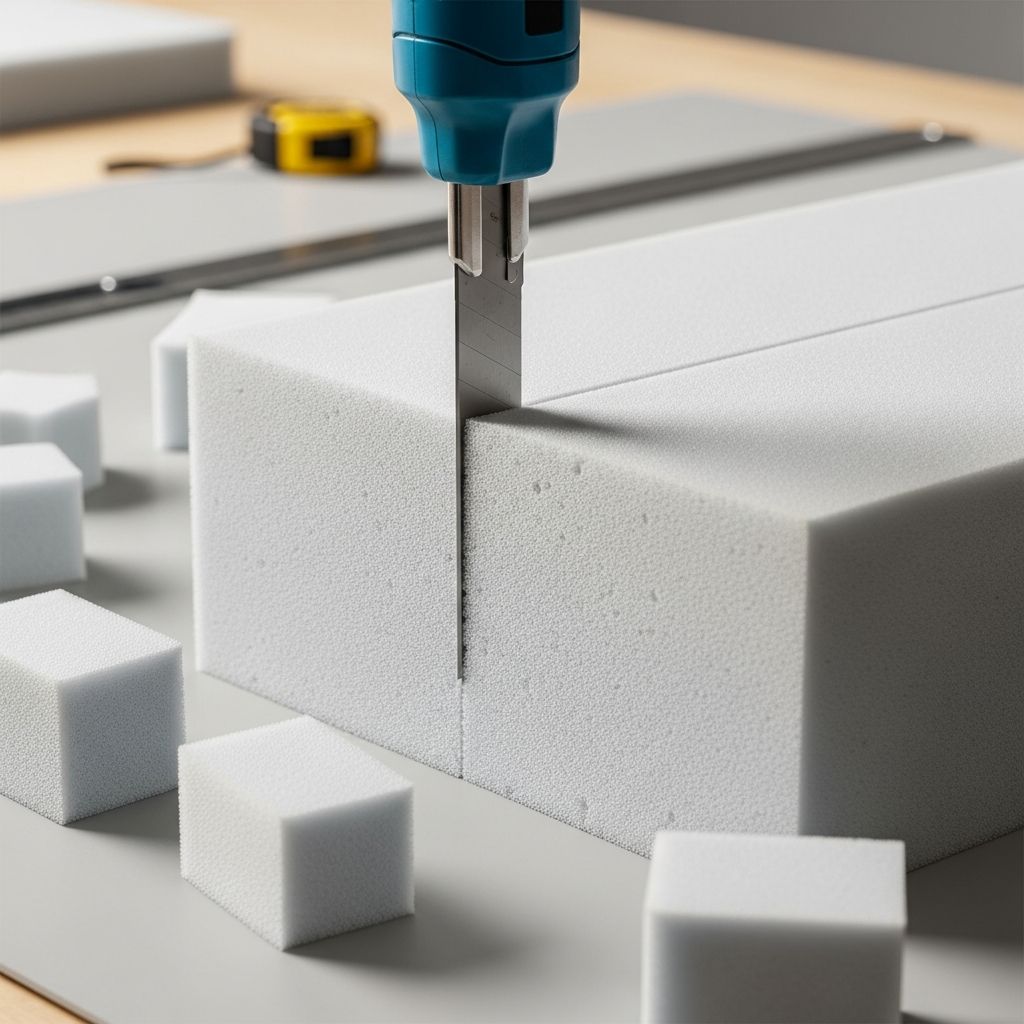
- Electric carving knife: Ideal for dense memory foam, mimicking a saw’s motion without pressure.
- Utility knife with fresh blades: Suitable for thinner sections; replace blades often to combat dulling.
- Protective gloves and eyewear: Shields against slips and fine particles.
- Cutting mat or sturdy workbench: Provides a stable, non-slip base.
For advanced shaping, consider a hot knife tool for polystyrene variants, though it’s unsuitable for polyurethane-based memory foam due to fume risks. Lubricants like silicone spray extend blade life on sticky surfaces.
Preparation Steps: Measuring and Marking
Accuracy starts with meticulous planning. Begin by determining your project’s exact requirements, such as matching a bed frame or pillow sham.
- Assess the source foam: Note thickness, density (e.g., 3-5 lbs/ft³ for standard memory foam), and any covers to remove.
- Take measurements: Record length, width, and height, adding 1/4 inch (0.64 cm) allowance for trimming irregularities. Verify against the target item twice.
- Mark guidelines: Place dots at intervals along edges using a marker. Connect with a straightedge for continuous lines, visible on all sides for thick blocks.
- Double-check alignment: Use a square tool to confirm perpendicularity, preventing trapezoidal errors.
For irregular shapes like wedges, employ templates from cardboard. This phase prevents waste, as errors compound during cutting.
Mastering the Cutting Process
Position foam on a flat surface to avoid distortion. Support overhanging sections to maintain stability.
Straight Cuts with Electric Knife: Hold at 90 degrees, using slow, full strokes along the line. The oscillating blade slices cleanly through memory foam’s density without compressing cells. Avoid sawing motions that tear fibers.
Manual Slicing Technique: For utility knives, employ shallow passes with a slicing pull, angling slightly for control. Fresh blades reduce friction; wax them for glide.
Curved or Sculpted Edges: Freehand with scissors for thin EVA-style foams or flex a hacksaw blade for upholstery depths, pulling towards you for satisfaction and precision.
Work in a ventilated area, especially with electric tools generating minor heat. Pause to clear debris, ensuring visibility.
Refining Edges and Finishing Touches
Post-cut, inspect for burrs. Trim excesses with fine scissors or a fresh razor, feathering lightly for seamless covers.
For exposed edges in upholstery, apply foam-safe adhesive tape or heat-seal (EVA only) to prevent crumbling. Reattach covers by hand-stitching or zippers, matching original seams for durability.
Test fit immediately; minor sanding with fine-grit paper smooths minor imperfections without altering shape.
Foam Types and Tailored Cutting Strategies
Not all foams respond identically; select methods per composition to optimize results.
| Foam Variety | Best Tools | Key Tips |
|---|---|---|
| Memory (Viscoelastic Polyurethane) | Electric knife, sharp utility blade | Slow slices; lubricate blade; avoid compression |
| Standard Polyurethane (Upholstery) | Utility knife, serrated saw, CNC | Multiple passes for thickness; steady pressure |
| Polystyrene (Styrofoam) | Hot wire cutter, fine saw | Melts edges cleanly; ventilate fumes |
| EVA (Crafting/Cosplay) | Rotary cutter, scissors | Heat gun for sealing; easy shearing |
| Acoustic Panels | Long utility blade | Prevent tearing on soft textures |
Memory foam’s slow recovery demands non-aggressive tools, distinguishing it from rigid insulation scored and snapped.
Safety Protocols and Common Pitfalls
Prioritize protection: Gloves mitigate slips, masks filter particles, and stable footing prevents topples. Dull blades cause binding; swap proactively.
Avoid pitfalls like over-pressure (compresses foam), rushing (jagged lines), or inadequate support (wavy cuts). For thick slabs over 6 inches, cut in layers.
Project Ideas to Inspire Your Cuts
- Bed Topper Resize: Trim to non-standard frame sizes for improved sleep alignment.
- Pillow Fabrication: Layer densities for neck support; cover with breathable fabrics.
- Seat Cushions: Contour for chairs or benches, enhancing ergonomics.
- Pet Bedding: Wedge shapes for orthopedic relief in animal crates.
- Upholstery Refresh: Replace worn sofa inserts with custom densities.
These applications leverage foam’s durability, customizing comfort economically.
Frequently Asked Questions
Can I cut memory foam with regular scissors?
Only for very thin pieces under 1 inch; thicker requires knives to avoid mangling.
Will cutting release harmful fumes?
No from knives, but hot wire on polyurethane does—stick to cold methods.
How do I store leftover foam?
Wrap in plastic, store flat in dry areas to prevent deformation.
What’s the best knife for beginners?
Electric carving knife for effortless, clean slices on memory foam.
Can I wash cut foam pieces?
Spot clean with mild soap; full immersion risks cell breakdown.
Advanced Tips from Pros
For ultra-precision, use CNC foam cutters for repeats. Layer multiple thin sheets, adhering post-cut. Experiment with densities: Firmer for support, softer for plushness.
Maintain tools post-use: Clean blades with isopropyl alcohol, store dry.
References
- How to Cut a Memory Foam Mattress — Ecoy. 2023. https://ecoy.com.au/blogs/snooze/how-to-cut-a-memory-foam-mattress
- How to Cut Foam: A Comprehensive Guide — UWI Foam. 2024. https://uwinfoam.com/how-to-cut-foam/
- Foam Cutting Hacks Every DIY Upholsterer Should Know — YouTube (Upholstery Channel). 2022-10-15. https://www.youtube.com/watch?v=NvcjcemrYLI
Similar Articles







Read full bio of Sneha Tete