Determining Heat Pump Tonnage: Complete Guide
Master the essentials of heat pump sizing: decode tonnage from model numbers, estimate needs accurately, and avoid common pitfalls for optimal efficiency.
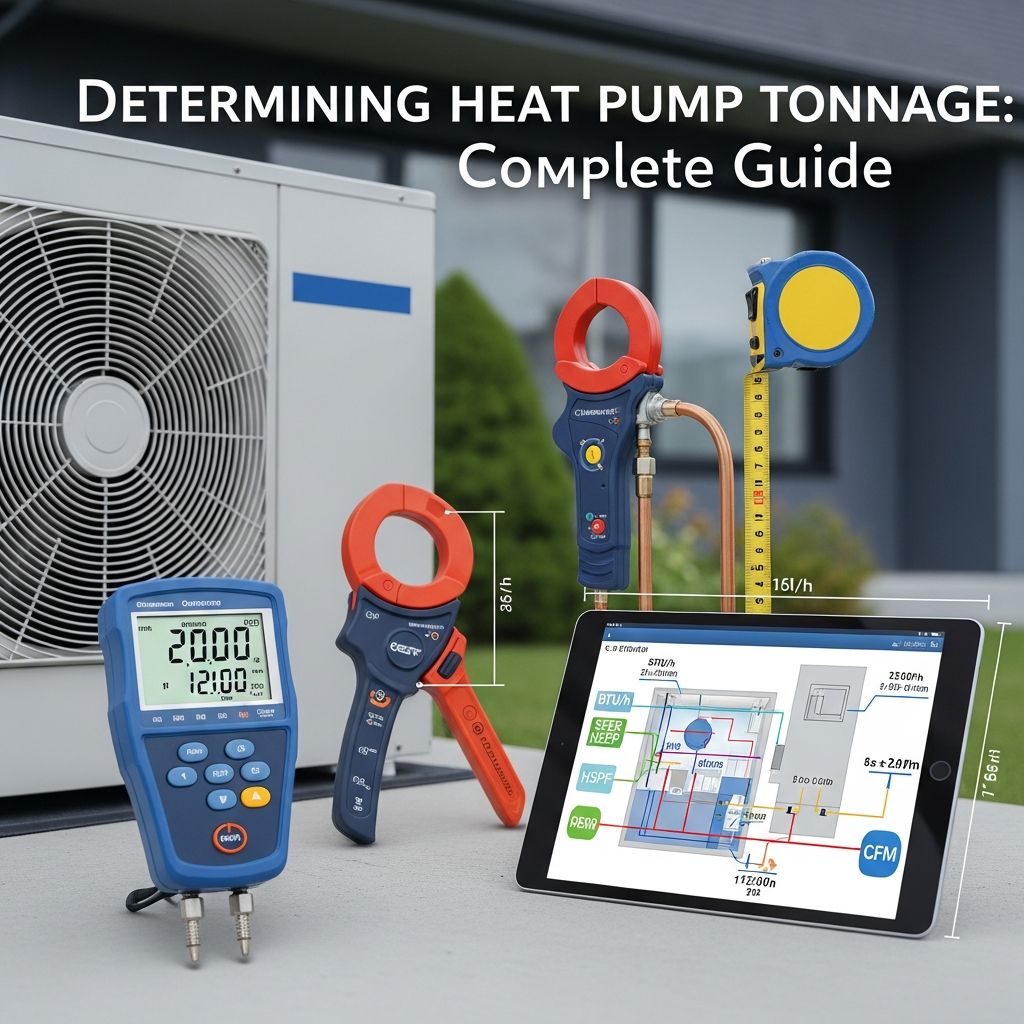
Heat pump tonnage measures cooling and heating capacity, where one ton equals 12,000 BTUs per hour, originating from the energy needed to melt one ton of ice daily. Understanding your unit’s tonnage ensures efficient operation, proper maintenance, and informed upgrades. This guide explores identification techniques, sizing principles, and professional assessment methods to optimize your system’s performance.
Understanding Tonnage in Heat Pump Systems
Tonnage quantifies a heat pump’s ability to remove or add heat, not its physical weight. A 3-ton unit handles 36,000 BTUs hourly, ideal for moderate spaces. Mismatched sizing leads to inefficiency: undersized units overwork, while oversized ones short-cycle, wasting energy and humidity control.
Heat pumps reverse roles seasonally—cooling in summer, heating in winter—making versatile sizing critical. Modern inverter models adjust output dynamically, forgiving minor sizing errors better than fixed-speed units.
Quick Identification: Decoding Model Numbers
Most manufacturers encode tonnage in model numbers via two- or three-digit BTU indicators. Locate the label on the outdoor unit, often on the side or back panel.
- Spot even numbers like 18, 24, 30, 36, 42, 48, or 60—these represent thousands of BTUs.
- Divide by 12 for tonnage: 24 ÷ 12 = 2 tons; 36 ÷ 12 = 3 tons.
- Three-digit codes starting with ‘0’ (e.g., 024) follow the same rule: 024,000 BTUs ÷ 12,000 = 2 tons.
For example, a model like GSX140241K indicates 24 in the sequence, equating to 24,000 BTUs or 2 tons. Half-ton increments appear as 30 (2.5 tons) or 42 (3.5 tons).
| Model Number Digits | BTU Capacity | Tonnage |
|---|---|---|
| 18 | 18,000 | 1.5 tons |
| 24 | 24,000 | 2 tons |
| 30 | 30,000 | 2.5 tons |
| 36 | 36,000 | 3 tons |
| 42 | 42,000 | 3.5 tons |
| 48 | 48,000 | 4 tons |
| 60 | 60,000 | 5 tons |
Consult the manufacturer’s manual if codes vary, as formats differ slightly by brand.
Estimating Required Tonnage for Your Space
Rough estimates use square footage rules, but precision demands more. Traditional guidelines suggested 500 sq ft per ton; modern insulation pushes 600–1,000 sq ft per ton.
| Home Size (sq ft) | Recommended Tonnage | BTU Capacity |
|---|---|---|
| 1,200 | 2 tons | 24,000 |
| 1,800 | 3 tons | 36,000 |
| 2,400 | 4 tons | 48,000 |
| 3,000 | 5 tons | 60,000 |
Adjust for climate: hotter regions need higher tonnage per square foot. Online calculators factor square footage, ceiling height, sun exposure, and kitchen presence for ballpark figures.
Regional multipliers refine estimates. For well-insulated homes in moderate zones, multiply square footage by 0.40 BTUs per sq ft, then convert to tons.
The Gold Standard: Manual J Load Calculations
Professional sizing relies on ACCA Manual J, analyzing 20+ variables for exact BTU needs. Key inputs include:
- Square footage and layout
- Ceiling height and insulation R-values
- Window/door count, orientation, and glazing
- Occupancy and appliance heat output
- Local climate data and air infiltration
- Landscaping shading effects
Free tools like CoolCalc (ACCA-approved) or DOE’s BEOpt automate this, requiring R-value knowledge. Technicians use software for site-specific reports, ensuring systems match peak loads without excess.
For heating-focused pumps, prioritize coldest-day capacity; cooling on hottest days. Inverter tech modulates for balanced performance.
Cost Insights by Tonnage
System costs scale with capacity, averaging $14,000–$37,000 pre-incentives for ducted, mini-split, or hybrid setups. Larger units demand robust electrical and ductwork, inflating installs.
| Capacity (tons) | Avg. Cost (2025, pre-incentives) |
|---|---|
| 1 | $14,260 |
| 2 | $16,242 |
| 3 | $16,438 |
| 4 | $22,277 |
| 5 | $16,113 |
| 6–9 | $20,667–$36,988 |
Factors like efficiency ratings (SEER2, HSPF2) and zoning add 10–30% to base prices. Incentives via IRA can cut costs 30%+.
Common Mistakes and Efficiency Tips
Avoid rules-of-thumb alone—they ignore insulation advances and often oversize by 20–50%. Undersizing strains compressors; oversizing spikes bills and humidity issues.
- Verify existing tonnage before replacements to match or right-size.
- Pair with proper ducts: undersized ducts reduce effective tonnage by 20%.
- Annual tune-ups maintain rated capacity; dirty coils drop efficiency 15–25%.
- Upgrade to variable-speed for 20–40% savings over fixed units.
Track runtime: frequent cycling signals mismatch. Use smart thermostats for data insights.
Frequently Asked Questions (FAQs)
What does heat pump tonnage really mean?
Tonnage rates heat removal/addition capacity: 1 ton = 12,000 BTUs/hour, based on ice-melting equivalence.
How do I find tonnage without the model number?
Check data plate for BTU ratings or use square footage estimates, but confirm via Manual J for accuracy.
Is a larger heat pump always better?
No—oversizing causes short-cycling and poor dehumidification; proper sizing via load calc is key.
Can I calculate tonnage myself?
Yes, with tools like CoolCalc, but pros ensure precision considering all variables.
How much does a 3-ton heat pump cost?
Around $16,438 installed pre-incentives, varying by type and efficiency.
Next Steps for Optimal Performance
Inspect your unit’s label today, run a basic calc, then schedule Manual J. Right-sizing yields 20–30% energy savings, better comfort, and longer life. Consult certified techs for installs matching your home’s unique profile.
References
- What Is HVAC Tonnage? — One Hour Heating & Air Conditioning. 2023. https://www.onehourheatandair.com/expert-tips/general-hvac/what-is-hvac-tonnage/
- What ‘Tonnage’ Means For Your AC or Heat Pump System — Casey Services HVAC. 2024. https://caseyserviceshvac.com/blog/what-tonnage-means-for-your-heat-pump-and-ac-system/
- AC Tonnage Size Calculator — AC Direct. 2024. https://www.acdirect.com/ac-package-unit-learning-center-ac-sizing-calculator
- What Size Heat Pump Do I Need? — Trane. 2025. https://www.trane.com/residential/en/resources/troubleshooting/heat-pumps/what-size-heat-pump-do-i-need/
- Heat Pump Sizing Guide — EnergySage. 2025. https://www.energysage.com/heat-pumps/heat-pump-size-guide/
- The Ultimate Inverter Heat Pump Sizing Guide — InverterCool. 2025. https://www.invertercool.com/blogs/the-ultimate-heat-pump-sizing-guide-how-to-choose-the-best-fit-for-your-home
Similar Articles








Read full bio of medha deb