Transform Your Closet: Creative DIY Door Ideas for Every Space
Upgrade any closet with stylish, space-smart DIY doors that are easy to build, install, and customize.
DIY Closet Door Ideas and Installation Guide
Closet doors do more than hide clutter; they shape how a room looks, feels, and functions. With a free weekend and basic tools, you can replace tired builder-grade doors with custom DIY options that match your style and make better use of every inch of space.
Why Update Your Closet Doors?
Updating closet doors is one of the fastest ways to refresh a bedroom, hallway, or entry without a full remodel. A new door style can make a cramped room feel larger, improve access to storage, and even add sound and light control.
- Improve function by choosing a door type that suits how you actually use the space.
- Boost resale appeal with clean, modern finishes and hardware that matches the rest of the home.
- Express your style through paint, trim details, panels, glass inserts, or fabric.
Choosing the Right Closet Door Style
The best closet door is the one that fits your space and your habits. Before buying materials, think about clearance, traffic patterns, and how often you need full access to the interior.
| Door Style | Best For | Key Advantages | Potential Drawbacks |
|---|---|---|---|
| Sliding (bypass) | Wide closets, tight rooms | Saves floor space; simple hardware | Never see full closet at once |
| Bifold | Reach-in closets | Good access; compact swing | More moving parts and adjustments |
| Traditional hinged | Small to medium closets | Full opening; easy to build | Needs clear swing area |
| Barn-style sliding | Feature walls, tall openings | Decorative focal point | Needs wall space beside opening |
| Fabric or curtain panels | Very small rooms, rentals | Lowest cost; flexible | Less sound and light control |
Use this table as a quick checklist: compare your room size, ceiling height, and wall layout to decide whether a swinging, folding, or sliding system makes the most sense.
Planning Your DIY Closet Door Project
Good planning prevents extra trips to the store and frustrating rework. Start with accurate measurements and a basic sketch of your opening and surrounding walls.
- Measure width at top, middle, and bottom of the opening; use the smallest number to size your doors.
- Measure height on both sides and in the center; note any difference that might require shimming or trimming.
- Check that the floor is reasonably level and the side jambs are plumb; small variations can be corrected during installation.
From there, choose materials based on budget and skill level. Prefinished hollow-core doors are light and affordable, while solid wood or plywood panels give more room for customization.
Essential Tools and Materials
Most DIY closet door projects can be completed with common household tools, supplemented by a few simple hardware kits. Gather everything before you start so the installation flows smoothly.
- Measuring tape, pencil, and level for layout and alignment.
- Circular saw or handsaw for trimming doors and cutting tracks or guides.
- Drill/driver, drill bits, and screw assortment for hinges, tracks, and hardware.
- Wood filler, sandpaper, primer, and paint or stain for finishing.
- Closet door hardware kit (sliding track, bifold hardware, or hinges and catches).
DIY Sliding Closet Doors (Bypass Style)
Sliding bypass doors ride on a track and overlap each other, making them ideal for shallow rooms or areas where a swinging door would hit furniture or a bed. Two or more panels can span wide closets without needing extra floor space.
Step-by-Step Overview
- Prepare the opening. Remove old doors and hardware, then patch and sand any damage on the jambs or header.
- Mark track location. Use a level to mark where the upper track will sit, centered in the opening and set back evenly from the front edge.
- Cut and mount the top track. Trim the track to length if needed, pre-drill, and fasten into solid framing with appropriate screws.
- Install the bottom guide. Depending on the kit, this may be a small plastic or metal guide that keeps the doors from swinging forward.
- Hang the doors. Attach the hanging hardware to the top of each door, then lift the panels into the upper track and set them in the floor guide.
- Fine-tune alignment. Adjust rollers or hanging brackets so gaps are even and doors glide smoothly.
When building your own sliding panels, consider using plywood with a simple frame of 1×3 or 1×4 trim to create a clean, modern look that is lighter than full solid wood.
DIY Bifold Closet Doors
Bifold doors fold in the center, offering wide access with a smaller footprint than traditional swinging doors. They are especially useful for hallway closets, laundry alcoves, and narrow bedrooms.
Key Steps for Bifold Installation
- Remove existing doors and hardware. Clean up the jambs and floor to give the new track and brackets a solid base.
- Install the top track. Center it in the opening, level it, and fasten it securely to the header.
- Mount pivot and guide brackets. One side will hold a fixed pivot pin; the other supports a sliding guide in the track.
- Insert pivot pins. Most bifold doors arrive with top and bottom pins that fit into pre-drilled holes on the door edges.
- Hang and adjust the doors. Place the top pivot into the bracket, then drop the bottom pivot into the floor or side bracket, and finally engage the top guide.
- Add pulls and stops. Install knobs or handles at a comfortable height and adjust stops so the doors close flush.
For a custom look, you can transform plain bifold slabs with added trim to mimic shaker panels, then paint them to match baseboards or built-ins.
Traditional Hinged Closet Doors
Hinged doors swing out on one side, similar to standard interior doors. They work best where there is enough floor space for the swing or where you want the option to mount hooks on the back of the door.
Installation Basics
- Use at least two hinges on shorter doors and three on taller or heavier panels.
- Position hinges a few inches from the top and bottom edges, with any middle hinge centered between them.
- Pre-drill screw holes to avoid splitting the door edge or jamb.
- Check reveals (gaps) around the door; they should be even from top to bottom, adjusting with shims if necessary.
Two narrow swinging doors can replace a single wide one, reducing the required swing radius and making it easier to walk past in tight hallways.
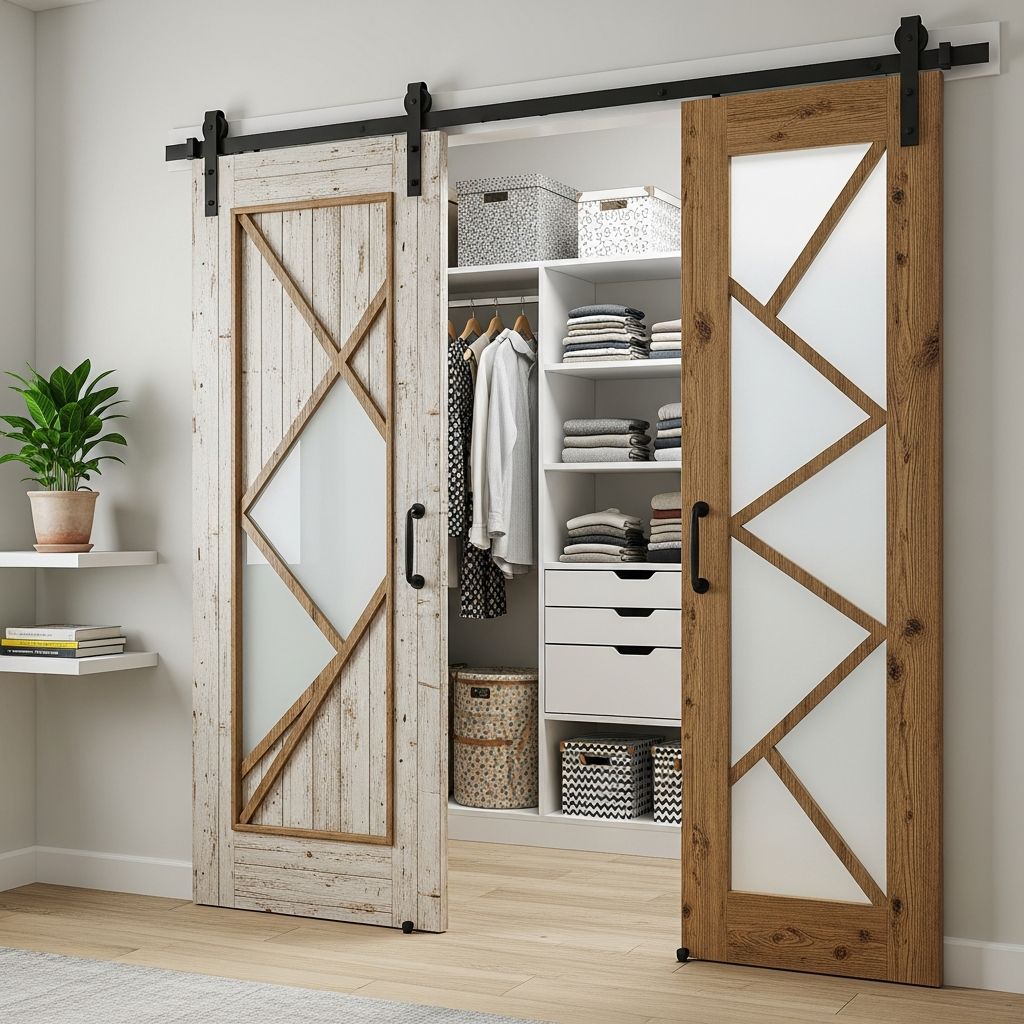
Decorative Barn-Style Closet Doors
Barn-style doors slide on a visible track mounted above the opening, turning the closet into a design feature. They suit farmhouse, industrial, or modern interiors depending on the panel style and hardware finish.
- Ensure there is enough clear wall space to one or both sides of the closet for the door to slide fully open.
- Mount the track into wall studs or a continuous header board for strength and safety.
- Use door guides at the base to keep the panel from swinging away from the wall.
Build a barn-style door from plywood or tongue-and-groove boards framed with decorative battens, then finish it with stain, paint, or a weathered effect.
Low-Cost and Space-Saving Alternatives
Not every project needs a full framed door. For rentals, dorms, or extremely tight rooms, soft or lightweight options can be surprisingly effective.
- Fabric panels or curtains: Mount a ceiling track or decorative rod and hang full-length curtains to hide closet contents.
- Accordion doors: Vinyl or lightweight folding doors install with a simple track and take up minimal space when open.
- Open concept: For extremely tidy closets, you may skip doors entirely and frame the opening with trim for a built-in look.
These approaches require fewer tools and can be reversed later, making them ideal for temporary or budget-conscious makeovers.
Finishing Touches: Paint, Hardware, and Trim
Details like color, knobs, and trim determine whether your DIY doors look homemade or intentionally custom. Take time at this stage; it has the biggest visual payoff.
- Sand surfaces smooth, fill nail holes, and prime before painting to prevent flashing and uneven sheen.
- Choose hardware that matches existing hinges, doorknobs, and lighting finishes for a cohesive look.
- Add casing or simple trim around the opening to hide gaps, shims, and track edges.
Consider bold color on closet doors in kids’ rooms or offices, while sticking with neutral tones in shared spaces for long-term flexibility.
Common Mistakes to Avoid
Most closet door problems trace back to skipped measurements or rushed installation. Paying attention to a few critical points can save hours of adjustment later.
- Skipping level and plumb checks before installing tracks or hinges.
- Forgetting to allow for carpet or rugs when measuring door height.
- Using the wrong screws or failing to anchor into solid framing.
- Hanging doors before finishing, leading to drips, runs, or difficult touch-ups.
Working slowly and double-checking measurements at each step is more efficient than having to pull everything down to fix a single misalignment.
FAQs About DIY Closet Doors
Do I need advanced carpentry skills?
Most closet door projects are suitable for beginners who are comfortable using a drill, level, and saw. Following step-by-step instructions and taking accurate measurements are far more important than advanced joinery skills.
How long does a typical project take?
Replacing existing doors with a pre-made kit can often be done in a few hours. Building custom panels, adding trim, and painting usually stretches a project across a full weekend to allow for drying time between coats.
Can I install new closet doors over carpet?
Yes, but you may need to add a thin wood strip beneath floor-mounted guides or brackets to provide a solid base. Always check clearances to ensure the doors do not drag on the carpet pile.
What if my opening is not square?
Uneven openings are common in older homes. Use shims behind tracks, guides, and hinges to align the doors visually, then cover these adjustments with trim for a neat, professional appearance.
Should I choose hollow-core or solid doors?
Hollow-core doors are lighter and easier to handle, making them excellent for large sliding systems. Solid or semi-solid doors feel more substantial, offer better sound control, and accept deeper hardware or decorative routing.
Final Thoughts on DIY Closet Doors
With a bit of planning and a few basic tools, you can transform a plain closet into a polished feature that works better for your everyday life. Whether you choose sliding, bifold, hinged, or barn-style doors, customizing the design and finish helps the entire room feel more intentional and organized.
Similar Articles








Read full bio of Sneha Tete