DIY Concrete Apron: A Complete Homeowner’s Guide
Build a durable concrete apron that protects your driveway, improves drainage, and boosts curb appeal.
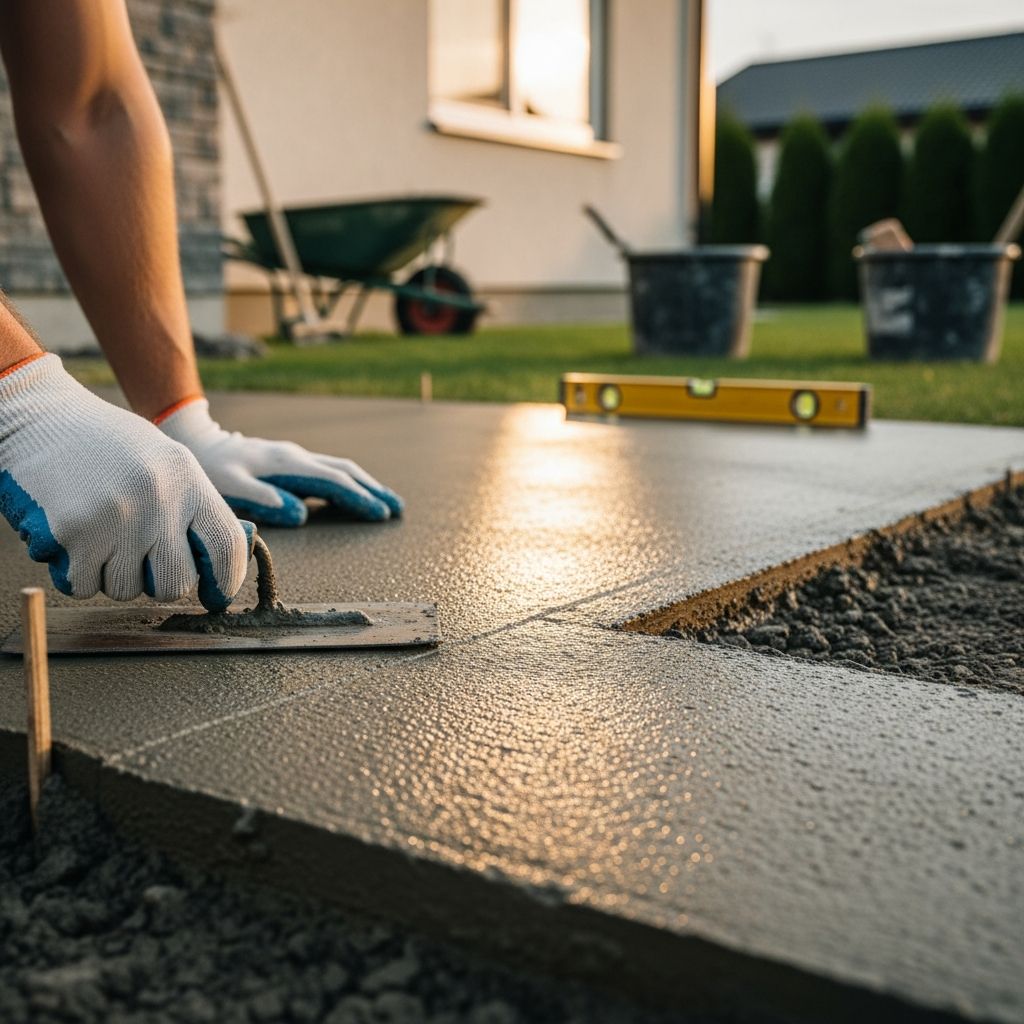
How to Build a Concrete Apron for Your Driveway or Garage
A well-built concrete apron creates a smooth transition between surfaces, protects edges from damage, and keeps water away from your foundation. It is one of the most useful small concrete projects a homeowner can take on, combining structural function with a big boost in curb appeal.
This guide walks through planning, layout, excavation, forming, pouring, finishing, and curing a concrete apron. It is written for DIYers who are comfortable with basic tools and are willing to work methodically and safely.
What Is a Concrete Apron?
A concrete apron is a slab of concrete placed at a transition point, most often where a driveway meets the street or where a garage floor meets an exterior driveway. It spreads out loads, stiffens the edge, and helps direct water away from buildings.
Typical locations for an apron
- At the entrance to a garage to bridge between a higher interior slab and the exterior driveway.
- Where a driveway meets the street or alley to strengthen the edge that takes vehicle impact.
- Along the front of a shed, barn, or shop to provide a clean, hard surface at doors.
- Beside a driveway where vehicles occasionally drive off the main slab.
In all of these spots, the apron acts as a reinforced transition that keeps edges from chipping, reduces ruts, and sheds water in a controlled way.
Planning Your Concrete Apron
Thoughtful planning determines how well the apron performs. Before picking up a shovel, define the purpose, size, thickness, slope, and reinforcement strategy.
Key design decisions
- Load expectations: Will the apron carry passenger cars only, or heavier trucks and equipment?
- Width and depth: How far should the apron extend to comfortably support tires and protect the edge?
- Drainage path: Where do you want water to go—toward the street, away from the building, or into a drain?
- Connection type: Will you tie into existing concrete, asphalt, gravel, or soil?
Recommended dimensions
| Use | Minimum Depth (from edge) | Recommended Thickness | Notes |
|---|---|---|---|
| Garage entrance | 3–4 ft | 4 in (light vehicles) / 5–6 in (heavier) | Match or slightly exceed garage slab thickness. |
| Driveway to street | 4–6 ft | 5–6 in | Designed for repeated wheel impact and turning. |
| Shed or shop front | 2–3 ft | 4 in | Sufficient for lawn equipment and light trailers. |
Tools and Materials Checklist
Gathering tools and materials before starting helps keep the pour day running smoothly. Many items can be rented, especially larger equipment.
Tools you will need
- Measuring tape, builder’s level or laser level, and string line.
- Wood stakes and marking paint or chalk for layout.
- Shovels, digging bar, and a wheelbarrow for excavation.
- Plate compactor (rental) or hand tamp for compacting base material.
- Circular saw or handsaw for cutting form boards.
- Hammer and screws or duplex nails for assembling forms.
- Bolt cutters or rebar bender/cutter for reinforcement.
- Concrete mixer (rental) or access to ready-mix delivery.
- Screed board (straight 2×4), magnesium float, steel trowel.
- Edger, groover (for control joints), and broom.
- Safety gear: gloves, eye protection, hearing protection, rubber boots.
Materials you will need
- Concrete mix of appropriate strength (often 3,000–4,000 psi for residential use).
- Crushed stone or gravel base (typically 3/4 in minus or similar road base).
- Form boards (usually 2×4 or 2×6, depending on slab thickness).
- Wood stakes or form pins to hold the forms in place.
- Reinforcement: rebar grid, welded wire mesh, or fiberglass-reinforced mix.
- Form release oil or light coating of vegetable oil to help strip forms.
- Curing compound or plastic sheeting to retain moisture during curing.
- Expansion material if the apron will butt tightly against another slab or structure.
Layout and Marking
Good layout ensures the apron ends up where it should, with consistent thickness and proper slope. Take your time in this stage; fixing mistakes later is difficult.
Steps for accurate layout
- Define the edges: Decide how far out from the building or driveway you want the apron, and how wide it should be. Use a tape measure to mark corners on the ground.
- Set stakes: Drive wood stakes at the corners and along the sides every 2–3 feet. These stakes will support the form boards.
- Run string lines: Stretch string between stakes at the finished height of the concrete. Maintain a consistent slope away from structures for drainage.
- Confirm elevations: Use a level or laser to verify that the strings drop slightly away from the building or garage—typically about 1/8 to 1/4 inch per foot.
- Mark cut lines: If joining existing concrete or asphalt, mark any cuts that need to be made for a clean edge using chalk or spray paint.
Excavation and Base Preparation
A strong, uniform base is critical to a long-lasting apron. Skimping here is one of the fastest ways to create cracks and settling later.
Excavation depth and process
- Determine total depth by adding slab thickness plus 3–6 inches of compacted gravel.
- Excavate soil to this depth throughout the apron footprint, staying 2–4 inches beyond the forms to allow room to work.
- Remove all organic material, soft spots, and loose fill; replace with compactable material if necessary.
- Use a flat shovel to square up edges and maintain a relatively even subgrade.
Installing and compacting the base
- Spread a uniform layer of gravel or crushed stone, usually in 2–3 inch lifts.
- Compact each lift thoroughly with a plate compactor or hand tamper until it feels firm and does not shift under foot.
- Check the base elevation with a straight board and level to maintain your planned slope.
- Fill low spots and recompact until the base is flat, well-supported, and matches the intended grade.
Building Strong, Straight Forms
Forms define the final shape of the apron. They must be straight, braced, and set to the correct height and slope.
Form installation steps
- Cut form boards to length, allowing for joints where needed. Use thicker boards for thicker slabs.
- Attach boards to stakes using screws or duplex nails so they can be adjusted and later removed.
- Align the top of each form board with the string line, checking level and slope frequently.
- Brace the outside of the forms with additional stakes or kickers to prevent movement when concrete is placed.
- Apply a light coat of form release or oil to the inside faces to ease removal.
Tips for tying into existing structures
- When butting an apron against a garage slab, install expansion material along the joint to allow slight movement.
- For a more rigid connection, some builders drill and epoxy rebar dowels into the existing slab so the new apron cannot settle away.
- At an asphalt edge, consider cutting a straight edge and forming right against it for a clean appearance.
Reinforcement and Joint Planning
Concrete is strong in compression but relatively weak in tension. Reinforcement and control joints help manage this weakness by directing where cracks form and limiting their movement.
Choosing reinforcement
- Rebar grid: Commonly used for higher loads. Bars are placed in a grid pattern (for example, 12 or 16 inches on center) and supported on chairs so they sit in the lower third of the slab.
- Welded wire mesh: Suitable for light-duty aprons if kept near mid-depth of the slab and properly supported, not left lying on the base.
- Fiber reinforcement: Added to the concrete mix itself to reduce micro-cracking and improve toughness. Often used along with steel in more demanding applications.
Control and isolation joints
- Plan control joints at intervals about 2–3 times the slab thickness in feet (for a 4-inch slab, joints about 8–12 feet apart).
- Joints can be formed with a groover while the concrete is still plastic or cut later with a saw as soon as the surface is firm enough.
- Provide isolation joints where the apron meets fixed structures (such as a garage foundation) to let them move independently.
Mixing or Ordering Concrete
For small aprons, bagged concrete mixed in a portable mixer can work. Larger aprons are usually easier and more consistent with ready-mix delivery from a concrete supplier.
Factors when selecting concrete
- Strength rating: For residential aprons, mixes rated between 3,000 and 4,000 psi are common.
- Air content: In freeze-thaw climates, air-entrained concrete helps resist damage from moisture and ice.
- Slump (workability): Concrete should be workable enough to place and finish, but not so wet that it segregates or shrinks excessively.
- Additives: Retarders, accelerators, or plasticizers may be used depending on weather conditions and scheduling needs.
Pouring and Screeding the Slab
The actual pour is the most time-sensitive part of the job. Have enough helpers on hand so concrete can be placed, leveled, and finished efficiently.
Step-by-step pouring process
- Moisten the base lightly just before placement; it should be damp, not muddy or standing in water.
- Place concrete starting at one end, working across the width in manageable sections.
- Use a shovel or rake to pull concrete into corners and around reinforcement without disturbing the base.
- Overfill slightly above the forms, then drag a straight screed board across the top edges in a sawing motion to level the surface.
- Fill low spots as you screed and repeat until the surface is flat and at the correct height.
Finishing Techniques for Traction and Appearance
Finishing is where the apron gains its final texture and look. The goal is a surface that is smooth enough for easy cleaning but textured enough to prevent slipping.
Initial finishing
- After screeding, allow bleed water to rise and evaporate; do not trowel while water is still on the surface.
- Use a bull float or magnesium float to embed aggregate slightly and bring up fine paste for finishing.
- Reshape edges with an edging tool along all exposed sides to prevent chipping.
Broom finish and joints
- Once the surface firms up slightly, drag a broom across perpendicular to the direction of travel to create fine traction lines.
- Use a groover to cut control joints to the planned depth, usually about one-quarter the slab thickness.
- Check that the surface remains uniformly sloped toward the intended drainage path.
Curing and Early-Age Protection
Concrete gains strength over time through curing. Proper curing significantly improves durability and helps prevent early cracking.
Curing methods
- Cover the surface with plastic sheeting, sealing edges to retain moisture.
- Apply a liquid curing compound with a sprayer once the surface can be walked on carefully.
- In hot, dry, or windy weather, mist the slab periodically and keep it covered to avoid rapid drying.
Traffic restrictions
- Allow at least 24 hours before walking on the apron lightly.
- Keep vehicles off the slab for a minimum of 5–7 days, or longer if the mix or weather conditions require.
- Avoid de-icing salts during the first winter, as young concrete is more vulnerable to chemical damage.
Long-Term Care and Maintenance
With basic maintenance, a concrete apron can last for decades. Periodic inspection and simple upkeep prevent minor issues from becoming major repairs.
Maintenance tasks
- Inspect annually for cracks, spalling, or settlement and address issues early.
- Clean off automotive fluids promptly to avoid staining and chemical damage.
- Reseal the surface every few years if you use a concrete sealer, especially in harsh climates.
- Keep joints free of debris so they can move and drain as designed.
Common Mistakes to Avoid
Many apron problems trace back to avoidable mistakes. Being aware of them ahead of time can save money and frustration.
Frequent errors
- Pouring on a poorly compacted base, which allows settling and cracking.
- Making the mix too wet for easier placement, leading to weakness and scaling.
- Skipping control joints or placing them too far apart, resulting in random cracking.
- Finishing while bleed water is still present, trapping moisture beneath a weak surface layer.
- Neglecting curing, especially during hot, windy, or very cold conditions.
Safety Considerations
Concrete work involves heavy materials, power tools, and chemical exposure. Treat the project with the same respect you would give any construction jobsite.
Safety best practices
- Wear gloves, eye protection, and sturdy footwear when handling concrete and tools.
- Use hearing protection around saws, compactors, and mixers.
- Lift materials with your legs, not your back, and get help with heavy bags or form boards.
- Keep children and pets away from the work area during excavation, pouring, and curing.
- Follow manufacturer instructions for all rental equipment and power tools.
FAQs About Concrete Aprons
How thick should a driveway or garage apron be?
For most residential driveways carrying passenger vehicles, a thickness of about 4 inches is common. Areas that see heavier trucks, RVs, or equipment benefit from 5–6 inches of thickness for added strength.
Do I need reinforcement in a small apron?
Even small slabs are less likely to crack severely when reinforced. Light aprons may perform acceptably with fiber-reinforced concrete alone, but adding steel mesh or a simple rebar grid improves durability, especially in climates with freeze-thaw cycles or where soil movement is expected.
Can I pour an apron directly against wood or siding?
Concrete should not be in direct contact with building materials that can absorb moisture or decay. Use isolation material, maintain clearance between the slab and siding, and follow local building recommendations to keep wood safely above grade.
Is this project suitable for a first-time DIYer?
A small apron is within reach of a careful beginner who is willing to plan thoroughly, recruit a couple of helpers, and rent the right equipment. The key challenges are working efficiently during the pour and finishing the concrete before it sets, so practicing on a very small pad or sidewalk section first can build confidence.
How long will a concrete apron last?
With proper base preparation, appropriate thickness, good reinforcement, and consistent curing, a residential apron can last several decades. Regular maintenance—such as sealing, cleaning, and addressing minor cracks early—helps it achieve its full lifespan.
Similar Articles





Read full bio of medha deb