Lawn Mower Tire Replacement: Step-By-Step DIY Guide
Master the essential steps to replace lawn mower tires safely and efficiently at home.
Mastering Lawn Mower Tire Replacement: A Homeowner’s Complete Guide
Maintaining your lawn mower keeps your yard looking pristine and extends the lifespan of your equipment. One of the most essential maintenance tasks involves replacing worn or damaged tires. Whether you’re dealing with flat tires, reduced tread, or slow leaks, learning to replace lawn mower tires yourself can save you significant money and downtime. This comprehensive guide walks you through everything you need to know about the tire replacement process, from preparation to final inflation.
Understanding When Your Lawn Mower Tires Need Replacement
Recognizing the signs that your lawn mower tires require replacement is the first step in proper maintenance. Tires that have visible cracks, bulges, or significantly worn tread patterns should be replaced immediately. If you find yourself constantly reinflating tires before each mowing session, this often indicates a slow leak or structural damage that warrants replacement. Additionally, tires that have been in service for several years may have hardened rubber that no longer provides adequate traction or cushioning, reducing mower performance and increasing operator fatigue.
Essential Tools and Materials for Tire Replacement
Before beginning your tire replacement project, gather all necessary tools to ensure a smooth, efficient process. Having everything prepared prevents interruptions and makes the work safer.
- Hydraulic or floor jack — Essential for safely lifting your mower off the ground. Some homeowners use concrete blocks as an alternative, though a proper jack provides better stability and control.
- Jack stands — Absolutely critical for safety. Never work under a mower supported only by a jack, as equipment can shift or collapse.
- Socket wrench set — Used to loosen and tighten the bolts or nuts securing wheels to the axle.
- Tire spoons or pry bars — Specialized tools designed to separate the tire from the rim without causing damage to either component.
- Pliers — Helpful for removing cotter pins, retaining clips, or e-rings that may secure the wheel assembly.
- Lubricant — Dish soap mixed with water or commercial tire lubricant significantly eases tire installation by reducing friction between the tire bead and rim.
- Valve stem tool — Necessary only if you’re replacing the valve stem along with the tire.
- Air pump — Required for inflating the new tire to the manufacturer’s recommended pressure.
- Pressure gauge — Ensures you inflate to the correct specification, which affects mower performance and safety.
Critical Safety Considerations Before You Begin
Safety should always be your primary concern when performing maintenance on powered equipment. Begin every tire replacement project by disconnecting the spark plug wire from the spark plug. This single action prevents accidental engine starts that could cause serious injury. Additionally, ensure your work surface is completely level and stable. Working on uneven ground can cause your mower to shift, potentially trapping limbs or causing the machine to collapse. Always wear work gloves to protect your hands from sharp edges, and consider wearing safety glasses to shield your eyes from debris or splashing lubricant.
Selecting the Correct Replacement Tires for Your Mower
Purchasing the wrong tire size or type is a common mistake that can compromise mower functionality. The correct specifications appear on the sidewall of your current tires and in your owner’s manual. Look for information including tire width, overall diameter, and rim diameter. For example, a typical lawn mower tire might be marked as 20×8.00-8, indicating a 20-inch diameter, 8-inch width, and 8-inch rim diameter.
| Tire Specification | What It Means | Why It Matters |
|---|---|---|
| Tire Size (e.g., 20×8.00-8) | Overall diameter, width, and rim size | Incorrect sizing affects mower handling and engine performance |
| Load Rating | Maximum weight the tire can support | Overloading causes premature wear and safety hazards |
| Tread Pattern | Design of grooves in the tire | Affects traction on different surfaces and weather conditions |
| Ply Rating | Number of material layers in the tire | Higher ply ratings provide durability for heavy-duty use |
Always verify tire specifications before purchasing to avoid expensive returns or performance issues. If you’re uncertain, consult your mower’s manufacturer documentation or contact a lawn equipment specialist.
Step-by-Step Tire Replacement Procedure
Preparing Your Work Area and Mower
Position your mower on a flat, level surface where you have adequate working space. Block the wheels that will remain on the ground using wooden blocks or concrete wedges to prevent any rolling movement. This is especially important for riding mowers, where the weight distribution may shift during the replacement process. Disconnect the spark plug wire before proceeding further to eliminate any possibility of accidental engine startup.
Lifting the Mower Safely
Use your hydraulic or floor jack to gradually lift the mower, placing the jack under a solid structural point as specified in your owner’s manual. Many riding mowers have designated jack points on the frame. Once elevated, immediately place jack stands under the mower frame to provide additional support. The jack should remain in place during your work as a backup safety measure, but never rely on it alone.
Removing the Wheel Assembly
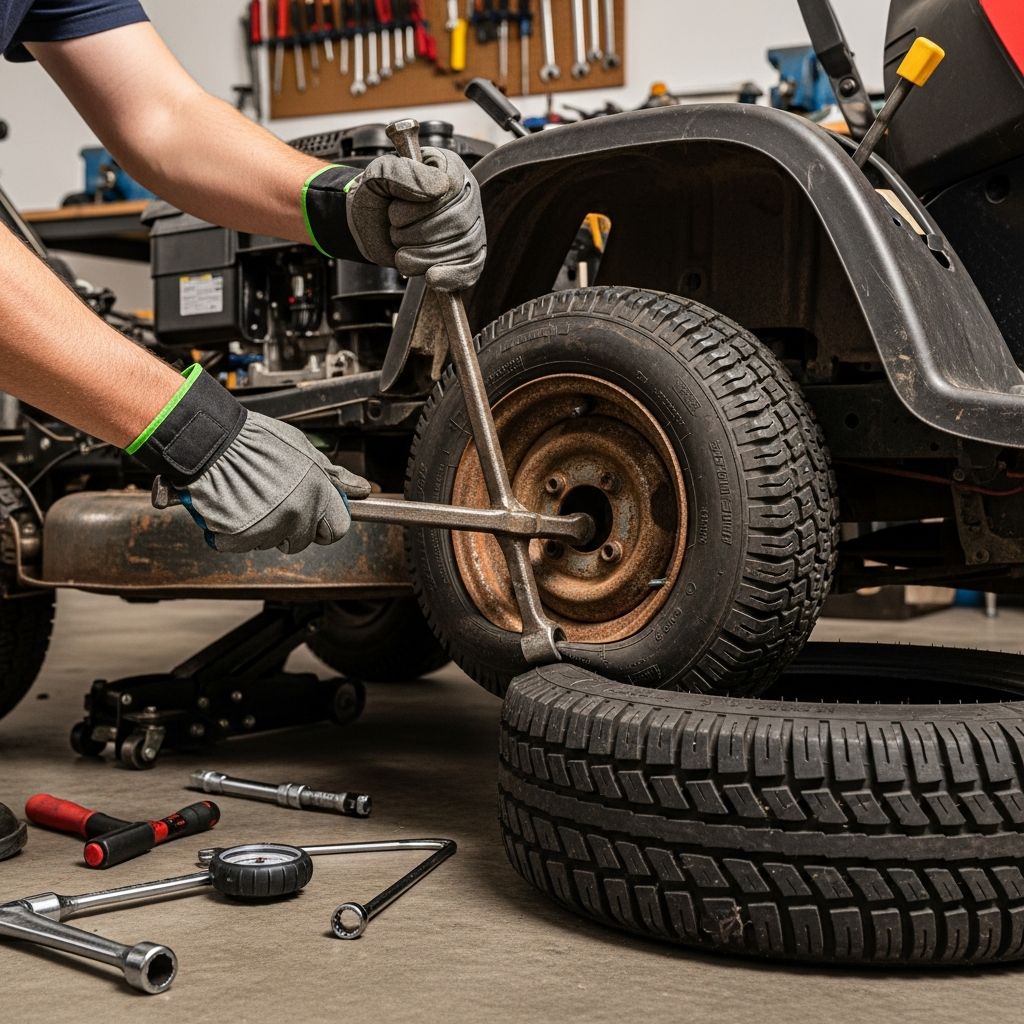
Start by removing any hubcap or cosmetic cover that may be present. Look for a cotter pin or e-ring securing the wheel, and carefully remove it using pliers. You may need to remove a washer underneath. Using your socket wrench, loosen the axle nut in a counterclockwise direction. Once loose, remove the nut completely and carefully pull the wheel straight toward you, sliding it off the axle. Be gentle to avoid damaging the axle or bearing.
Separating the Old Tire from the Rim
Before beginning tire removal, deflate any remaining air from the old tire by removing the valve stem cap and pressing the valve to release air. Next, you need to break the bead—the seal between the tire and rim. Using a tire spoon or pry bar, work your way around the tire, carefully prying the bead away from the rim. This requires patience and leverage; rushing can damage the rim. Once one side is free, flip the wheel and repeat on the other side.
After breaking the bead, lubricate the tire bead with dish soap and water. This significantly reduces friction and makes separation easier. Using your tire spoons, position one under the tire bead and lift upward, then work another spoon under an adjacent section of the bead. Gradually work your way around the wheel, popping the tire off the rim in sections. This methodical approach prevents rim damage that could make the wheel unusable.
Mounting the New Tire
Before installing the new tire, clean the rim thoroughly with a cloth to remove any dirt, rust, or debris. A clean rim ensures proper seating of the tire bead and optimal performance. Lubricate the rim and the new tire bead generously with your soap solution. Position the new tire on the rim and begin working one bead onto the rim using your tire spoons, starting at the valve stem. Use a rocking motion to gradually work the tire onto the rim, moving around the wheel systematically. Once one bead is fully seated, repeat the process for the opposite bead.
Installing the Valve Stem
If you’re reusing the old valve stem, ensure it’s clean and functional. If replacing with a new valve stem, insert it through the rim hole and secure it according to the valve stem type. Some valve stems include a nut that tightens from the inside of the rim.
Inflating and Balancing
With the tire mounted on the rim, use your air pump to inflate to the pressure recommended on your mower’s documentation, typically found on a placard near the operator’s seat or in the owner’s manual. Begin with lower pressure to ensure the tire bead properly seats on the rim, then gradually increase to full pressure. Check that both tire beads are fully seated against the rim before reaching final pressure.
Reinstalling the Wheel Assembly
Carefully align the wheel with the axle, then slide it back into position. Replace the washer and hand-tighten the axle nut. If you removed a cotter pin or e-ring, reinstall it to secure the nut. Using your socket wrench, tighten the axle nut firmly in a clockwise direction, but avoid over-tightening, which can damage threads or bearings.
Completing the Replacement and Testing
Lower the mower gradually using the jack, ensuring the wheel contacts the ground evenly. Remove the jack stands and then the jack itself. Before operating the mower, walk around it and visually inspect all wheels to ensure they’re properly seated and securely fastened. Reconnect the spark plug wire. If you’ve replaced multiple tires, repeat the process for each wheel.
Before mowing, take the mower for a slow test drive on flat ground, checking for any unusual pulling to one side, vibration, or noise. These symptoms might indicate improper installation or incorrect tire pressure. Make any necessary pressure adjustments and retest until the mower performs smoothly.
Common Mistakes to Avoid
Many homeowners encounter preventable problems during tire replacement. Purchasing incorrect tire sizes remains the most frequent mistake, resulting in poor handling and potential equipment damage. Failing to properly lubricate the tire bead during installation can lead to rim damage or incomplete bead seating. Neglecting to disconnect the spark plug before work creates unnecessary safety hazards. Over-tightening the axle nut can strip threads or damage bearings, while under-tightening risks the wheel coming loose during operation. Finally, failing to verify proper tire inflation after installation compromises both performance and safety.
Frequently Asked Questions
How often should lawn mower tires be replaced?
Tire lifespan depends on usage frequency and storage conditions. Most lawn mower tires last 3-5 years under normal use. Inspect tires annually and replace them when tread depth becomes minimal, cracks appear, or performance deteriorates.
Can I replace just one tire on my lawn mower?
Yes, you can replace individual tires. However, for riding mowers used frequently, replacing tires in pairs—front or rear—ensures more consistent handling and performance.
Should I balance lawn mower tires after replacement?
Unlike car tires, lawn mower tires typically don’t require professional balancing. Simply ensure proper inflation and even seating on the rim.
What if the valve stem is damaged or leaking?
Replace the valve stem during tire replacement. Use a valve stem removal tool to extract the old stem and install a new one matching your rim type.
Can I use car tire spoons to remove lawn mower tires?
Car tire spoons may work but could damage the smaller lawn mower rims. Use proper tire spoons designed for lawn equipment to prevent rim damage.
Conclusion
Replacing lawn mower tires is an achievable DIY project that saves money and keeps your equipment in peak condition. By following these detailed instructions, observing safety precautions, and using proper tools, you can successfully complete tire replacement in your driveway. Taking time to select correct tire specifications, properly break the bead, and thoroughly lubricate components ensures a smooth installation that will serve you well for years of trouble-free mowing.
References
- Replacing Lawn & Garden Tires: Easy Tips and Tricks — Tires Easy. https://www.tires-easy.com/blog/replacing-lawn-garden-tires/
- How to Change a Lawn Mower Tire: A Step-by-Step Guide — Mowrator. https://mowrator.com/blogs/lawn-mower/changing-tire
- A Step-by-Step Guide to Replacing Your Lawn Mower Tire — Oreate AI. https://www.oreateai.com/blog/a-stepbystep-guide-to-replacing-your-lawn-mower-tire/
- A Beginner’s Guide To Lawn Mower Tires — PrairieLand Partners. https://www.prairielandpartners.com/blog/a-beginners-guide-to-lawn-mower-tires–30603
Similar Articles








Read full bio of Sneha Tete