Converting Golf Carts from Electric to Gas Power
Complete guide to transforming your electric golf cart into gas-powered vehicle
Converting Golf Carts from Electric to Gas Power: A Comprehensive Technical Guide
Transforming an electric golf cart into a gas-powered vehicle represents one of the more ambitious DIY automotive projects available to enthusiasts. This conversion addresses several motivations: reducing ongoing battery replacement costs, extending operational range, or simply exploring the mechanical differences between power systems. However, the undertaking demands substantial technical knowledge, specialized tools, and careful planning to ensure safety and functionality.
The conversion process fundamentally restructures how your golf cart operates. Rather than drawing power from rechargeable batteries controlled by an electronic system, the converted vehicle will rely on internal combustion engine mechanics, fuel delivery systems, and traditional ignition components. Understanding these differences before beginning work helps establish realistic expectations about timeline, budget, and complexity.
Understanding the Core Differences Between Power Systems
Electric golf carts and their gas-powered counterparts operate on entirely different mechanical principles. An electric system’s elegance lies in its simplicity: batteries store electrical energy, a controller regulates this energy flow, and an electric motor converts electrical current into mechanical motion. This straightforward design produces minimal noise, requires no fuel handling, and demands little maintenance beyond periodic battery care.
Gas-powered systems introduce considerably more complexity. A combustion engine requires fuel storage, delivery through fuel lines and filters, ignition timing through spark plugs, and exhaust management. The engine produces significantly more vibration and noise while demanding regular maintenance including oil changes, filter replacements, and periodic tune-ups. Additionally, gas engines operate at higher temperatures, necessitating cooling systems or enhanced ventilation.
These fundamental differences mean conversion isn’t simply substituting one motor for another. Nearly every system in your golf cart will require modification or replacement to accommodate the new power source. The cart’s frame may need reinforcement, the electrical system must be completely redesigned, suspension components may require upgrading, and safety systems like brakes need enhanced capability.
Evaluating Your Golf Cart and Initial Planning
Before committing resources to a conversion project, honestly assess your golf cart’s current condition and your mechanical capabilities. Converting a cart that’s already showing signs of frame damage, rust, or structural weakness creates additional complications. A solid foundation makes the conversion process more straightforward.
Consider these preliminary questions:
- Does your cart have a structurally sound frame with no significant rust or damage?
- Are you comfortable performing welding, if frame modifications become necessary?
- Do you have access to proper tools including wrenches, sockets, drill press, and potentially welding equipment?
- Can you dedicate significant time to this project without rushing critical steps?
- Have you verified local regulations regarding modified golf carts in your area?
Document your cart’s specifications before starting disassembly. Photograph the original electrical connections, note the wheelbase and frame dimensions, and measure the available space for new components. This reference material proves invaluable when reassembling systems or troubleshooting problems later.
Selecting an Appropriate Engine for Your Cart
Engine selection fundamentally determines whether your conversion succeeds or struggles. The engine must fit within the cart’s physical constraints while providing adequate power for its intended use. Too powerful an engine creates handling challenges, excessive vibration, and potential frame stress. An underpowered engine leaves the cart sluggish and disappointing.
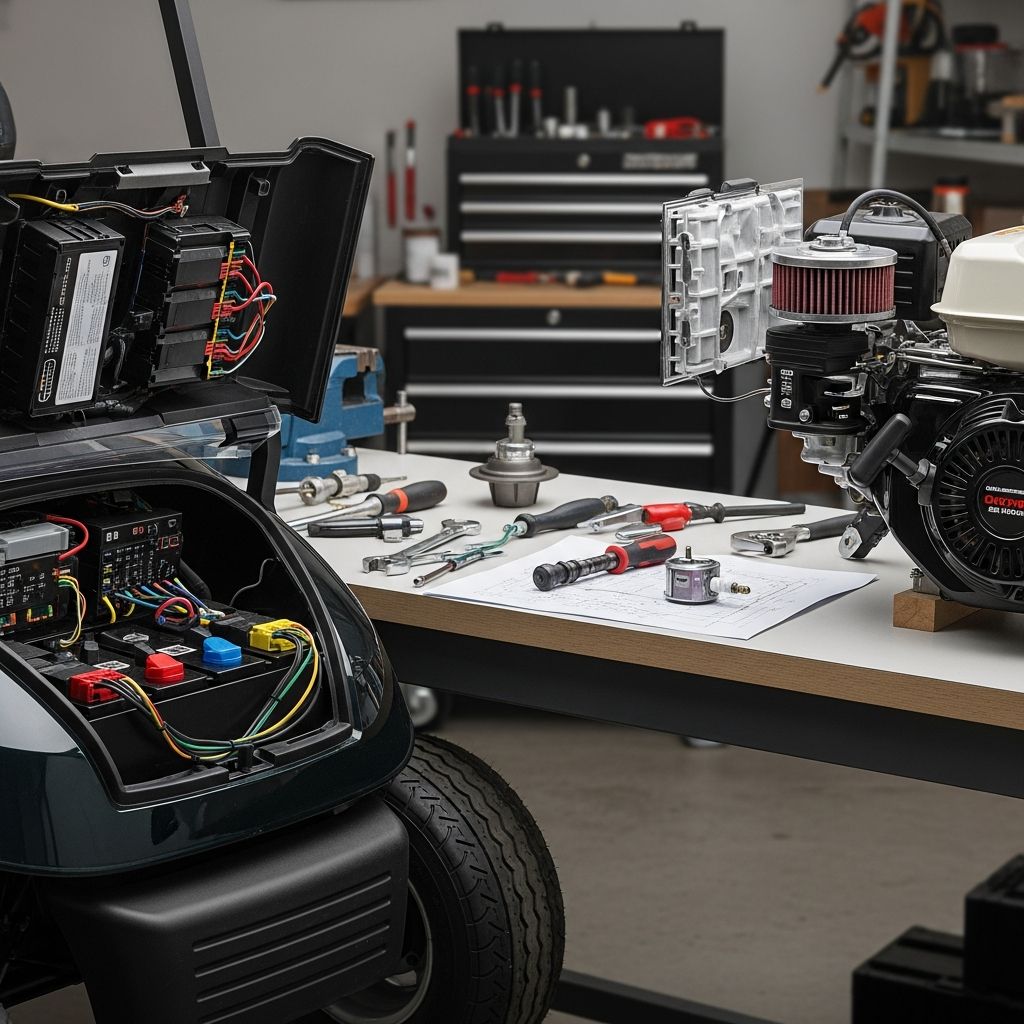
Most successful conversions employ small displacement engines in the 200-420cc range. These sizes balance power output with manageable installation complexity and weight distribution. Popular choices include small Predator brand engines, Honda GX series engines, or comparable Chinese knockoff variants. These engines typically weigh 50-80 pounds and produce 5-15 horsepower depending on displacement and design.
Consider these factors when evaluating engine options:
- Displacement and horsepower: Verify the engine produces sufficient power without exceeding what your cart’s frame and components can safely manage
- Mounting compatibility: Check whether the engine’s mounting provisions align with potential modification points on your cart’s frame
- Fuel type: Confirm availability of the required fuel in your area (gasoline, propane, or alternative fuels)
- Cooling requirements: Determine if the engine includes built-in cooling or requires supplementary cooling system installation
- Availability of parts: Research whether replacement components, filters, and spark plugs are readily obtainable
- Warranty and support: Consider whether the engine manufacturer provides technical support for your project
Purchasing a complete small engine rather than attempting to source individual components separately simplifies the process considerably. New engines cost between $200-$600 depending on displacement and quality, while salvaged units might be cheaper but introduce unknown reliability variables.
Removing Electric Components and Preparing the Frame
Begin your conversion by completely disconnecting and removing all electric system components. Start with the battery pack, which typically consists of six to eight 6-volt or 8-volt batteries connected in series. These batteries are heavy, so use proper lifting techniques and secure adequate help. Disconnect the positive and negative terminals, then systematically remove battery boxes, trays, and mounting hardware.
Next, locate and disconnect the electric motor, which is usually mounted on the rear axle housing. Disconnect all wiring to the motor controller and motor itself. Remove the motor mounting bolts and carefully extract the motor from the cart. You may need to lift the rear of the cart to access these components properly.
Remove the motor controller, which is often mounted under the seat or on the frame side. This electronic component controls power delivery from the batteries to the motor and can be discarded or saved for potential future projects. Additionally, remove any charging ports, onboard chargers, and related electrical infrastructure.
After removing these major components, examine your cart’s frame carefully. Look for rust, cracks, or structural damage that should be addressed before proceeding. Light surface rust can be treated with wire brushing and paint, but significant structural issues require welding repairs. Once you’re satisfied with the frame condition, measure available space and plan mounting locations for new components.
Creating Secure Engine Mounting Infrastructure
Properly mounting your selected engine is absolutely critical. An insecurely mounted engine vibrates excessively, transmits damaging vibrations through the frame, and creates safety hazards. Most conversions require fabricating custom engine mounting brackets from steel angle iron or channel material.
Begin by creating a detailed sketch showing the engine position relative to the cart’s frame and other components. The engine must clear the steering column, front tires during turning, and the operator compartment. Typically, engines are mounted forward of the rear axle but behind the operator area, though actual positioning depends on your cart model.
Fabricate mounting brackets from 2-inch by 2-inch steel angle iron or similar material. Most engines include several mounting holes compatible with standard engine mounting protocols. Your brackets must distribute the engine’s weight across multiple frame points rather than concentrating stress on a single location.
Welding these brackets permanently to your cart’s frame represents a point of no return in the conversion process. Take time to verify alignment before welding by test-fitting the engine with temporary fasteners. Check that the engine’s output shaft aligns properly with your intended driveline connection. Once you’re confident in the position, proceed with welding.
After welding, allow the metal to cool completely before handling. Use a wire brush to remove welding slag, and apply rust-preventative paint to exposed metal. Finally, mount the engine using vibration-isolating rubber mounts between the engine and your fabricated brackets. These isolators reduce vibration transmission and noise.
Installing Fuel System Components
Your gas-powered conversion requires a complete fuel system: a tank, fuel lines, filters, and proper routing to the engine’s carburetor. Unlike electric carts which simply sit on batteries, fuel storage demands careful consideration of safety and accessibility.
Select an appropriate fuel tank with capacity between 2-5 gallons, providing operating range of 20-50 miles depending on engine efficiency and usage patterns. Plastic fuel tanks resist corrosion better than metal tanks but require UV protection. Mount the tank securely to the frame using rubber-lined mounting straps that allow vibration isolation. Position the tank where it’s accessible for refilling but protected from impact and heat.
Route fuel lines from the tank to the engine using approved fuel line hose rated for gasoline. Never use standard rubber hose or vinyl tubing, which deteriorates and can leak gasoline. Install an inline fuel filter between the tank and carburetor to prevent debris from clogging the carburetor’s small jets. Most filters cost $10-$20 and are easily replaceable.
Plan fuel line routing carefully to avoid heat sources, moving belts, and sharp edges. Use clips or clamps every 12-18 inches to secure the lines against vibration. Keep fuel lines away from the muffler and exhaust pipes, which reach temperatures exceeding 400 degrees Fahrenheit. If lines must pass near heat sources, wrap them with heat-shielding material.
Before operating the engine, verify that fuel flows freely from tank through filters to the carburetor. Prime the fuel system by manually turning the engine over several times while monitoring for fuel delivery. Any leaks should be immediately repaired before proceeding.
Modifying the Drive System and Power Transmission
The drive system connecting your new engine to the rear wheels requires careful engineering. Electric carts typically use direct motor-to-axle connections through reduction gearing inside the motor itself. Gas engines require intermediate components to transmit power effectively.
Most successful conversions employ belt-and-pulley or chain-and-sprocket systems connecting the engine to the rear axle. A direct connection without speed reduction would leave your cart overspeeding dangerously. A reducer gear or pulley ratio reduces the engine’s 3000-6000 RPM output to the 500-1500 RPM appropriate for golf cart speeds.
Belt drive systems use a small engine pulley driving a larger rear axle pulley through a serpentine belt, similar to automotive accessory belt arrangements. This approach offers smooth, quiet operation and inherent slip protection if the rear wheels encounter excessive resistance. A 3:1 or 4:1 pulley ratio provides appropriate speed reduction for most small engines.
Chain drive systems employ motorcycle-style roller chain connecting engine sprockets to rear axle sprockets. This approach transmits power more directly than belt systems and handles higher torque loads. However, chain drives require periodic lubrication, maintain more noise, and demand precision alignment for reliable operation.
Whichever system you choose, ensure the engine’s output shaft aligns precisely with your driveline. Misalignment creates excessive wear, vibration, and potential component failure. Use dial indicators to verify alignment before final assembly, making micro-adjustments to engine mount positions as needed.
Designing and Implementing the Throttle Control System
The throttle mechanism directly translates operator pedal input into engine speed changes. Electric carts use electronic sensors converting pedal position into voltage signals. Gas carts require mechanical linkage connecting the pedal to the carburetor throttle body.
Plan your linkage system to maintain the original accelerator pedal location and feel as much as possible. A cable-based system offers straightforward installation: attach one end of a flexible throttle cable to the carburetor’s throttle arm and route the other end to the accelerator pedal.
Install a return spring on the carburetor throttle arm ensuring the throttle closes completely when the pedal is released. This prevents the engine from running away at high speed if your linkage becomes disconnected. Additionally, install a mechanical stop preventing the carburetor throttle from opening beyond its design limits.
Test throttle response before operating the cart. The pedal should move smoothly without binding, and the carburetor throttle should respond proportionally to pedal movement. Any stiffness or inconsistent response indicates linkage problems requiring adjustment.
Implementing Engine Ignition and Electrical Systems
Despite converting to gas power, your cart’s electrical system remains essential. The engine requires an ignition source to create spark, a starter motor for initial rotation, and potentially charging systems for battery maintenance.
Most small engines include magneto ignition systems generating spark without external batteries, simplifying installation considerably. Magneto-equipped engines require only kill switch wiring preventing accidental starting. However, engines without integral magnetos require a 12-volt battery and dedicated ignition module.
If your engine requires battery power, mount a small 12-volt battery on the cart frame, securing it against vibration. Wire the battery through an ignition switch, allowing the operator to control electrical power independently from the engine kill switch. Install an alternator or charging coil on the engine to replenish battery charge during operation, preventing battery depletion over time.
Route all ignition wires away from heat sources and moving components. Use clips to secure wires against vibration-induced chafing. Verify spark plug firing by manually rotating the engine and observing spark at the plug gap, confirming proper ignition system function before attempting engine startup.
Upgrading Braking and Suspension Systems
A gas-powered engine adds significant weight compared to electric motors, and increases available power substantially. Your cart’s original braking system may be inadequate for the new weight and speed capabilities. Similarly, suspension components designed for reduced weight may require reinforcement.
Examine brake pad thickness and rotor condition. Gas-converted carts often benefit from upgraded brake components including larger rotors, improved pad materials, or additional braking surface area. Test braking effectiveness at various speeds, ensuring smooth, responsive stopping without fade or noise.
Suspension springs may require replacement with higher-rate springs accommodating the additional engine weight without excessive sagging. Check for proper ride height and ride quality after engine installation. Uneven suspension can affect handling and increase tire wear.
Testing, Tuning, and Safety Verification
Before operating your converted cart beyond a controlled test area, methodically verify all systems. Check fuel flow, electrical connections, ignition timing, and throttle response. Ensure all bolts are tight, no fuel or oil leaks are evident, and all moving parts move freely without binding.
Start the engine and allow it to warm up while listening for unusual noises, vibration, or warning signs. Let the engine reach operating temperature while monitoring for leaks. Verify that the cooling system (if equipped) functions properly and that the muffler directs exhaust safely away from the operator.
Drive the cart slowly around a parking lot or large open area, testing acceleration, braking, and steering response. Gradually increase speed while confirming handling remains predictable and safe. Make adjustments to throttle linkage, suspension, or brake systems as needed to achieve satisfactory performance.
Tune the engine’s carburetor by adjusting the fuel-air mixture for smooth idle and progressive acceleration without hesitation or backfiring. Most small engines require minor tuning adjustments after initial operation as components settle and wear patterns establish.
Understanding Legal and Regulatory Requirements
Before operating your converted golf cart on public roads or in regulated areas, research local requirements. Many jurisdictions classify modified golf carts as vehicles requiring registration, insurance, or specific equipment like lights and mirrors. Regulations vary dramatically between municipalities and counties.
Some areas prohibit golf cart operation on public roads entirely, while others permit it with proper equipment and licensing. Conversion from electric to gas may change your cart’s classification under local law, potentially affecting where you can legally operate it. Contact your local vehicle registration authority to understand specific requirements in your area.
Environmental regulations in some regions restrict combustion engines for recreational vehicles, so verify compliance before proceeding with a conversion project.
Troubleshooting Common Conversion Issues
Successful conversions occasionally experience problems requiring troubleshooting. Engine hesitation during acceleration often indicates fuel delivery problems: check fuel filter condition and ensure fuel flows freely. Excessive vibration usually points to loose engine mounts or misaligned drive systems: tighten all mounts and verify alignment.
Brake fade or poor stopping suggests brake system inadequacy: verify pad thickness and rotor condition, and consider upgraded components. Steering difficulty may indicate suspension settling or steering component binding: inspect the steering linkage and suspension components for obstructions or damage.
Comparing DIY Conversion to Alternative Options
Before undertaking a complete conversion project, consider whether alternatives better serve your needs. A simple battery replacement extends electric cart life affordably if battery cost was your primary motivation. Purchasing a used gas cart eliminates conversion complexity, though it provides no mechanical learning experience.
Pre-made conversion kits are available for popular cart models, providing matched components engineered for compatibility. These kits cost more than assembling components independently but reduce planning and troubleshooting requirements.
References
- How To Convert Electric Golf Cart To Gas — 10L0L. 2023-09-26. https://10l0l.com/blogs/blog/how-to-convert-electric-golf-cart-to-gas
- How To Convert Electric Golf Cart To Gas — Hartville Golf Carts. https://hartvillegolfcarts.com/how-to-convert-electric-golf-cart-to-gas/
- Electric to gas golf cart conversion using a predator 212 in an ezgo — YouTube. https://www.youtube.com/watch?v=twa3EnzlGWU
- Electric Golf Cart Conversion Kits Explained — Big Horn Golfer. https://bighorngolfer.com/blogs/a/electric-golf-cart-conversion-kits-explained
Similar Articles








Read full bio of Sneha Tete