Fix Squeaky Mobile Home Floors: 3 DIY Methods That Work
Discover proven DIY methods to silence annoying floor squeaks in manufactured homes without major renovations.
Fix Squeaky Mobile Home Floors
Squeaking floors in mobile homes often stem from loose subfloor connections to joists or shifting structural elements common in manufactured housing. These noises can be fixed through targeted DIY approaches that secure flooring without full tear-outs.
Understanding Floor Squeaks in Manufactured Homes
Mobile homes feature unique construction with wood or OSB subfloors nailed or screwed to I-beam joists or wood trusses, often covered by carpet or vinyl. Over time, vibrations from movement, settling foundations, or inadequate initial fasteners cause friction and squeaks. Key culprits include gaps between subfloor panels and joists, loose lag bolts securing the frame to piers, or weakened connections at marriage lines in double-wides.
Unlike site-built homes, mobile home floors rest on a steel chassis with cross-members, making underbelly access essential for many repairs. Identifying the squeak’s location by walking and marking helps pinpoint issues above or below.
Preparation and Safety Essentials
Before repairs, gather tools: drill with bits, screw kits like Squeak-No-More, stud finder, flashlight, half-inch ratchet, safety glasses, dust mask, and gloves. Inspect the underbelly for vapor barrier integrity to prevent moisture damage during work.
- Locate squeaks by having someone walk while you listen from below.
- Check for access panels or crawl space entry.
- Ensure stable foundation; avoid work on uneven piers.
- Use magnetic stud finders for joist detection through subfloors.
Method 1: Tightening Frame Lag Bolts from Below
A frequent fix for widespread squeaks involves checking lag bolts that anchor the mobile home’s wooden frame to metal I-beams or chassis. These can loosen over years, transmitting vibrations to floors.
Crawl under the home near the noisy area. Use a half-inch ratchet to snug bolts—often 1/2-inch diameter—without over-tightening to avoid stripping. Test floors after each adjustment; many report instant quieting.
| Tool | Purpose | Tips |
|---|---|---|
| Half-inch ratchet | Tighten lags | Apply steady pressure; half-turns suffice |
| Flashlight | Inspect bolts | Check for rust or wear |
| Socket set | Fit variations | Match bolt heads precisely |
Method 2: Securing Subfloor with Specialized Screw Kits
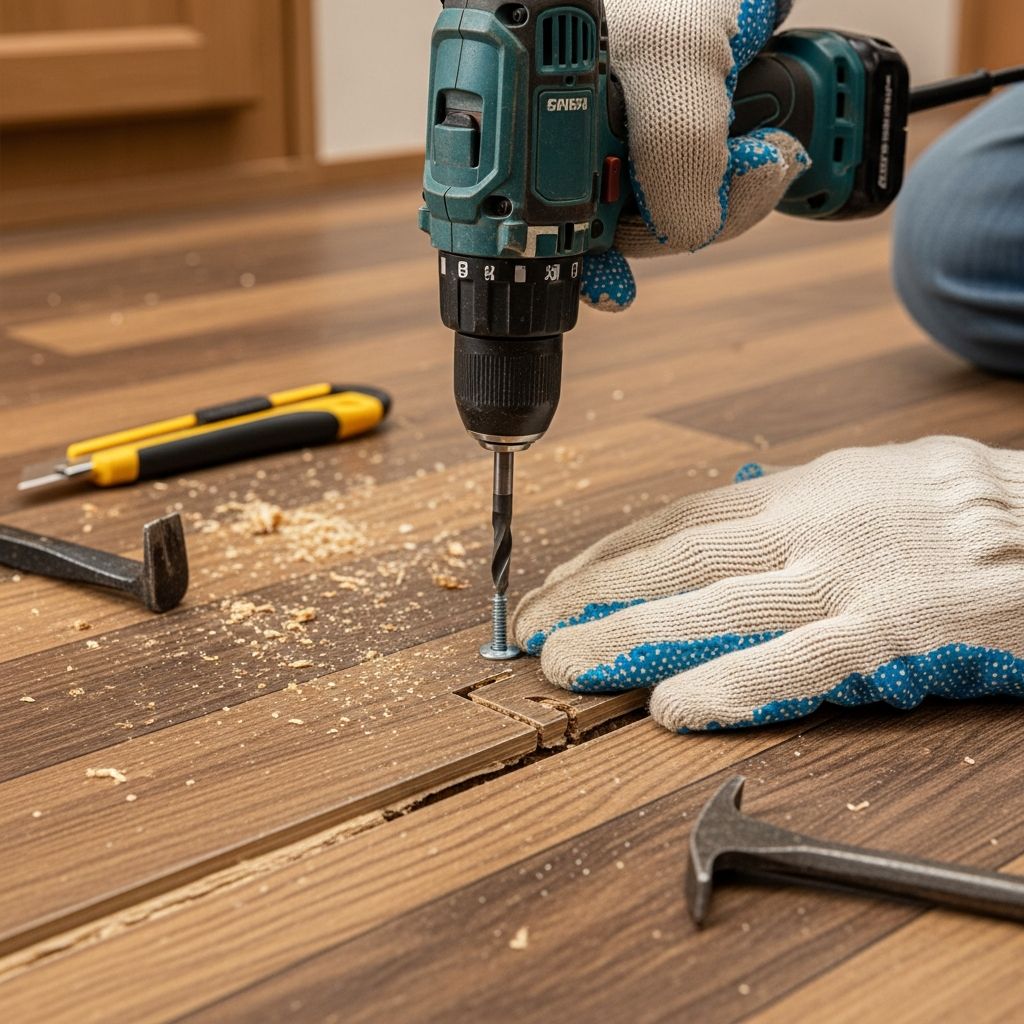
For targeted squeaks, kits like Squeak-No-More drive trim-head screws through carpet or flooring into joists, snapping off flush for invisibility. These work on carpeted, hardwood, or vinyl surfaces.
Steps:
- Locate joist with stud finder or by drilling pilot holes.
- Insert kit’s collar-stop bit into drill.
- Drive screw until collar hits floor; excess shank breaks off.
- Repeat 2-3 per joist section.
On carpet, use the provided tool to part fibers without damage. For hardwood, opt for finishing screws and wood putty filler.
Method 3: Underbelly Joist Reinforcements
Access the underside to add screws directly from below, ideal for persistent issues without surface disruption. Use #8 or #10 wood screws long enough to penetrate subfloor fully.
- Identify joist and subfloor gap visually.
- Pre-drill to prevent splitting.
- Drive screws at angles for maximum hold.
- Seal holes with caulk if needed.
This method shines in double-wides at center seams where halves join.
Advanced Fixes for Persistent Squeaks
If basics fail, consider shimming gaps with composite shims or construction adhesive applied via syringe under subfloor edges. For warped joists, sistering with new lumber provides strength.
In high-moisture areas, replace vapor barriers and treat wood with borate for longevity. Professional leveling may be needed if foundation shifts cause misalignment.
Tools and Materials Comparison
| Method | Cost | Difficulty | Best For |
|---|---|---|---|
| Lag Bolt Tightening | Low ($20) | Easy | Widespread noise |
| Screw Kit | Medium ($30) | Moderate | Carpeted areas |
| Underbelly Screws | Low ($15) | Moderate | No surface damage |
| Shimming/Adhesive | Medium ($40) | Hard | Gaps/shrinking |
Preventing Future Floor Squeaks
Maintain even humidity with dehumidifiers, as wood expansion/contraction exacerbates issues. Regularly inspect underbelly for loose fasteners during annual checks. When adding furniture, distribute weight evenly.
For new mobile homes, request extra subfloor screws during setup. Retighten lags after transport stresses.
Common Mistakes to Avoid
- Over-driving screws, causing visible dimples.
- Ignoring joist locations, risking weak holds.
- Skipping safety gear in dusty underbellies.
- Neglecting moisture control, leading to rot.
Frequently Asked Questions (FAQs)
Can I fix squeaks without going underneath?
Yes, screw kits from above work well on carpeted floors without belly access.
How long do repairs last?
Most hold 5-10 years; recheck annually.
Is professional help needed for warranty?
Minor DIYs rarely void warranties; consult manufacturer.
What if squeaks return quickly?
Check foundation level or joist damage; call a pro.
Are these fixes safe for single-wides?
Absolutely; same principles apply across manufactured homes.
References
- Fixing creaky floor in a manufactured home — YouTube (cubecompmtdx). 2022-09-30. https://www.youtube.com/watch?v=nXXLCLeVKr0
- How To Repair a Squeaky Floor In Minutes With The Squeek No More Kit — YouTube. N/A. https://www.youtube.com/watch?v=ky-j0WmS8YE
- Squeaking Floors In A Mobile Home…FIXED — GON Forum. N/A. https://forum.gon.com/threads/squeaking-floors-in-a-mobile-home-fixed.593668/
- Floor squeaks in doublewide — NC Woodworker Forum. N/A. https://ncwoodworker.net/forums/index.php?threads/floor-squeaks-in-doublewide.39701/
Similar Articles




Read full bio of Sneha Tete