Mounting Chandeliers on Suspended Ceilings
Master the art of safely installing elegant chandeliers on drop ceilings with our detailed step-by-step instructions and expert tips.
Mounting Chandeliers on Suspended Ceilings: A Complete Guide
Suspended ceilings, also known as drop or acoustic ceilings, offer flexibility in office, basement, or commercial spaces. Adding a chandelier elevates the aesthetic while requiring careful planning due to the lightweight grid system. This guide provides original, detailed steps to ensure secure installation without compromising the ceiling’s integrity.
Understanding Suspended Ceiling Basics
Suspended ceilings consist of a metal grid suspended by wires from the structure above, holding lightweight tiles typically 2×2 or 2×4 feet. Standard grids support minimal weight, around 5-10 pounds per tile, making direct chandelier mounting risky for heavier fixtures. Chandeliers over 15 pounds demand reinforcement to prevent sagging or collapse. Key considerations include ceiling height, room purpose, and access to the plenum space above for wiring and bracing.
- Grid Types: Exposed grids are common in commercial settings; concealed grids appear sleeker but complicate modifications.
- Tile Materials: Mineral fiber, fiberglass, or metal tiles vary in fire ratings and weight capacity.
- Plenum Access: Ensure 4-6 inches of drop for maintenance and fixture clearance.
Assessing Your Chandelier and Space
Before purchasing tools, evaluate the fixture’s specifications. Check the manufacturer’s weight rating and dimensions. For dining areas, position the chandelier 30-36 inches above the table; in foyers, maintain 7 feet minimum from floor level. Measure ceiling height: standard 8-10 feet works well, but higher vaults need chain extensions.
| Room Type | Recommended Height Above Surface | Max Chandelier Weight |
|---|---|---|
| Dining Room Table | 30-36 inches | 25-50 lbs with brace |
| Foyer/Entry | 7 ft from floor | 10-30 lbs |
| Office/Conference | 84 inches from floor | 15-40 lbs |
Use a stud finder extended above tiles to locate joists for optimal support points.
Essential Tools and Materials Checklist
Gather these items for a smooth process. Prioritize safety gear like gloves and eye protection.
- Ladder or stable scaffolding tall enough for reach without strain
- Voltage tester, wire strippers, cutters, and pliers for electrical work
- Screwdriver set (Phillips and flathead), drill with bits for grid and joist
- Support brace or adjustable ceiling bar (for weights over 10 lbs)
- Junction box rated for fixtures, mounting bracket, electrical tape, wire nuts
- Fish tape or wire coat hanger for routing cables through plenum
- Jack chain, anchors (e.g., MOLLY for plasterboard), or toggle bolts
Optional: Chandelier hoist for heavy pieces over 30 pounds to avoid solo lifting risks.
Preparing the Installation Site
Turn off power at the breaker and verify with a voltage tester—no exceptions. Remove the ceiling tile directly below the install spot. Inspect the grid for damage; reinforce weak T-bars with cross-bracing if needed. Center the location using a plumb bob for perfect alignment. If no existing junction box exists, plan to add one compliant with NEC standards for fan-rated or fixture support.
Installing Structural Support
The grid alone cannot bear chandelier weight. For fixtures up to 35 pounds, install a fan brace or chandelier bar across joists.
- Locate joists above using a magnetic stud finder or tapping method.
- Feed the expandable brace through the tile opening, twist to extend between joists until secure.
- Attach the junction box to the brace per instructions, ensuring level positioning.
- For plasterboard sub-ceilings, use heavy-duty anchors like MOLLY, which expand to hold 50+ pounds.
Secure loosely first, then tighten while checking for grid pressure. Test by applying gradual weight.
Running Electrical Wiring Safely
Access the plenum and run NM-B cable (Romex) from the nearest outlet or panel to the site. Avoid stapling to grid; use approved clips.
- Grounding: Connect bare copper to green screw on box first.
- Hot/Neutral Matching: Black to black, white to white; cap with wire nuts and tape.
- Strain Relief: Leave 6 inches of slack in the box for connections.
Tuck wires neatly to prevent shorts. If extending chain, thread wires through before hanging.
Mounting the Chandelier Step-by-Step
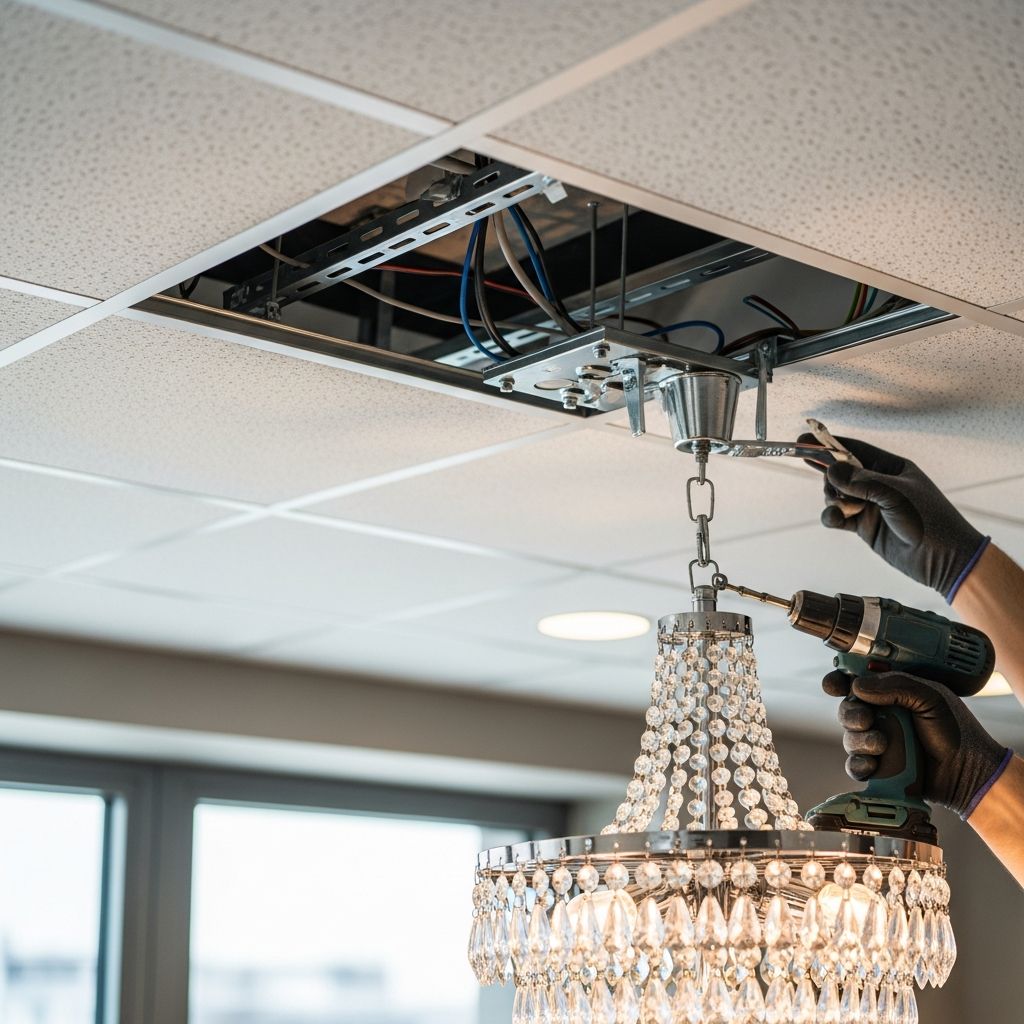
Assemble the fixture on the floor per manual: attach arms, crystals, and canopy.
- Secure the mounting bracket to the junction box with provided screws.
- Lift and hook the chandelier loop onto the bracket nipple; secure with locknut.
- Adjust chain length for desired drop, ensuring no tile interference.
- Install bulbs (LED recommended for heat reduction), then shades.
- Slide canopy up to cover box, tightening set screw.
Have a helper steady the fixture during wiring to minimize ladder time.
Safety Protocols and Code Compliance
Local codes mandate licensed electricians for exposed wiring or loads over 50 pounds. Use UL-listed components. Minimum drop: 3 inches for tiles, 4 inches under drywall. Fire-rated assemblies require specific penetrations. Test stability by shaking gently post-install; restore power only after visual inspection.
Common Pitfalls and Troubleshooting
Avoid overloading unsupported grids, ignoring voltage checks, or miswiring phases. If the fixture sways, add chain stabilizers to building structure. Dimming issues? Verify compatible bulbs and transformer.
| Issue | Solution |
|---|---|
| Flickering Lights | Check loose wire nuts; secure ground. |
| Grid Sagging | Install additional hanger wires to joists. |
| Height Too Low | Shorten chain; re-level box. |
| No Power | Reset breaker; test continuity. |
Maintenance and Long-Term Care
Dust monthly with a soft cloth; avoid abrasive cleaners on crystals. Check connections annually, especially in humid areas. LED conversions extend life and reduce heat load on braces.
Frequently Asked Questions
What is the maximum weight for a drop ceiling chandelier without extra support?
Typically 5-10 pounds; anything heavier requires a brace.
Do I need an electrician for this installation?
Recommended for wiring if inexperienced; required by code in many areas for structural mods.
How much ceiling drop is needed for fixtures?
Minimum 3-4 inches, more for recessed lights or deep canopies.
Can I install on a concealed grid ceiling?
Yes, but access plenum first and reinforce similarly.
What if there’s no joist nearby?
Use adjustable toggle anchors or independent beam across multiple joists.
References
- How To Hang A Chandelier From A Drop Ceiling — CountyOffice.org. 2024-10-25. https://www.youtube.com/watch?v=ilIOOZUl1gA
- A Simple Chandelier Installation Guide — Destination Lighting. N/A. https://www.destinationlighting.com/fliptheswitch/the-chandelier-installation-guide/
- The Ultimate Guide on How to Install a Chandelier Like a Pro — Chandeliers Life. N/A. https://chandelierslife.com/blogs/chandeliers/the-ultimate-guide-on-how-to-install-a-chandelier-like-a-pro
- How to install a chandelier in the suspended ceiling — YouTube. N/A. https://www.youtube.com/watch?v=uq9ZBEPZJXg
- How To Install Drop Ceilings — Kanopi by Armstrong. N/A. https://kanopibyarmstrong.com/pages/how-to-install-drop-ceilings
- Installation of chandelier to suspended ceiling — Klimas Wkręt-met. N/A. https://en.klimas.com/knowledge-zone/installation-of-chandelier-to-suspended-ceiling/
- Standard Suspended Ceilings – Assembly and Installation Instructions — Armstrong Ceilings. N/A. https://www.armstrongceilings.com/content/dam/armstrongceilings/commercial/north-america/installation-and-maintenance/suspended-ceilings-installation-instructions.pdf
Similar Articles







Read full bio of Sneha Tete