Install a New Stair Handrail: Complete DIY Guide
Learn how to install a stair handrail safely and securely with our comprehensive step-by-step guide.
How to Install a New Stair Handrail
Installing a new stair handrail is a practical home improvement project that enhances both safety and aesthetics. Whether you’re replacing an old handrail or adding one to your staircase, this comprehensive guide will walk you through every step of the process. With proper planning, the right tools, and attention to building codes, you can achieve professional results that ensure your stairs are safe and visually appealing.
Understanding Handrail Basics and Safety Requirements
Before beginning your handrail installation project, it’s essential to understand why handrails matter and what safety standards apply. Stair handrails provide crucial support and stability, helping prevent falls and injuries. They’re particularly important in homes with children, elderly family members, or anyone with mobility challenges.
Building codes and ADA (Americans with Disabilities Act) standards establish specific requirements for handrail installation. According to ADA railing codes and most building codes, the height of the handrail should be between 34 inches and 38 inches from the walking surface. This range ensures that the handrail is easily accessible for most people, providing necessary support as they navigate the stairs. Additionally, the handrail must have a minimum clearance of 1½ inches from adjacent surfaces. This clearance allows for a firm grip and prevents hands from being caught or scraped against the wall or other obstacles.
Understanding these requirements before you start ensures your finished project meets safety standards and local building codes, potentially saving you from costly corrections later.
Gathering Materials and Tools
Successful handrail installation begins with having all necessary materials and tools on hand. This preparation prevents interruptions during the project and ensures you can work efficiently.
Essential Materials
Your handrail kit should include the following components:
- Newel posts (the vertical posts at the top and bottom of the staircase)
- Balusters (vertical spindles that support the handrail)
- Handrail stock (the actual railing that you’ll grip)
- Handrail brackets and fasteners
- Metal plates for reinforcement
- Screws and bolts rated for stair installations
Required Tools
Gather these tools before starting your installation:
- Drill with appropriate bits for pilot holes
- Level (at least 24 inches long for accuracy)
- Measuring tape (25-foot minimum)
- Saw (miter saw or circular saw for cutting handrail)
- Brackets and mounting hardware
- Stud finder (to locate wall studs for secure mounting)
- Pencil for marking
- Safety equipment (goggles, gloves, dust mask)
Having these tools and materials on hand ensures you can proceed without interruptions. A drill will help you create pilot holes, and a level will ensure your handrail is perfectly aligned. A stud finder is particularly valuable for ensuring your brackets attach to solid framing rather than just drywall.
Measuring and Cutting the Handrail
Accurate measurements are crucial for a successful stair banister installation. This step determines whether your handrail fits properly and functions correctly.
Measuring the Correct Handrail Length
Start by measuring the distance from the top to the bottom of the stairs where the handrail will be installed. Use a measuring tape and note down the precise length needed. It’s important to account for any angles or turns in your staircase. Run the measuring tape along the angle of the stairs, following the path the handrail will take. Ensure you measure twice to avoid any mistakes—measurement errors are among the most common installation problems.
Consider the landing areas and how the handrail connects to newel posts at each end. These connection points affect your total length calculation. If you’re installing handrails on both sides of the stairs, measure each side separately, as they may differ slightly depending on staircase geometry.
Cutting the Handrail to Fit
Once you have your measurements, use a saw to cut the handrail to the correct length. If your handrail is made of solid wood, a miter saw can help you make clean, accurate cuts. For composite or metal railings, follow the manufacturer’s cutting guidelines.
When making cuts, always wear safety gear like goggles and gloves to protect yourself from debris. If your staircase has angles, you may need to make angled cuts where the handrail meets newel posts. A miter saw allows you to adjust the angle precisely. Take your time with these cuts—accuracy here ensures a professional appearance and proper fit.
Sand any rough edges after cutting, particularly on wood handrails. This prevents splinters and gives your installation a more finished appearance.
Installing Newel Posts and Balusters
With your handrail cut to size, the next step involves installing the vertical support structures that hold everything in place.
Securing the Newel Posts
Newel posts are the backbone of your stair banister system. These vertical posts anchor the handrail at the top and bottom of the staircase, bearing most of the weight and stress. Here’s how to secure them properly:
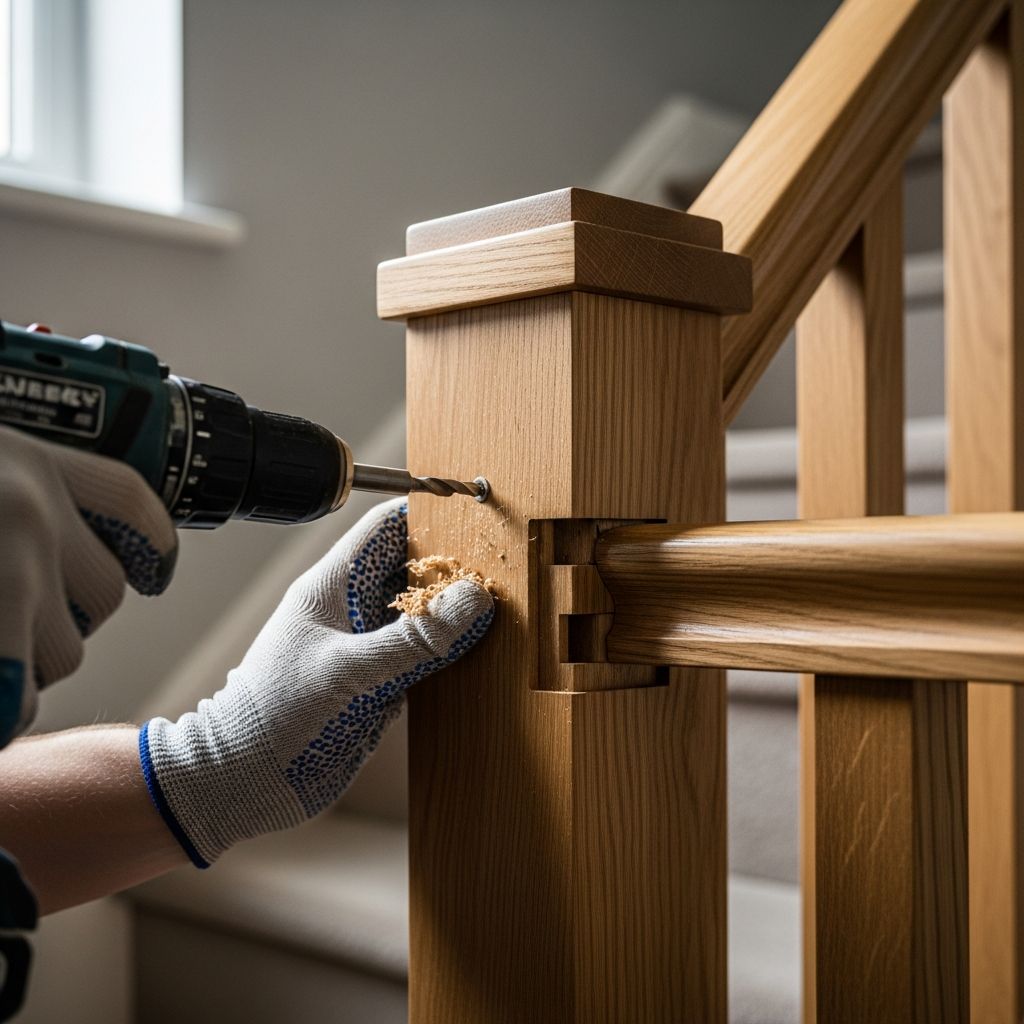
Drill Pilot Holes: Start by drilling pilot holes at the base of each newel post. This makes it easier to screw the posts into place and ensures they remain sturdy. Pilot holes prevent splitting and allow fasteners to seat properly.
Use Metal Plates for Stability: Attach metal plates to the base of each newel post for added stability. This is especially important in areas with high foot traffic or homes with children. Metal plates distribute weight and prevent the post from loosening over time.
Ensure Proper Alignment: Use your level to verify that posts are square and aligned properly. This helps maintain the structural integrity of the entire handrail system. Posts should be perfectly vertical, which you can check by placing a level against multiple sides of each post.
Attaching Balusters
Balusters are the vertical spindles that support the handrail and add to the aesthetic appeal of your staircase. Proper baluster installation ensures safety and visual consistency.
Drilling Holes for Baluster Pins: Drill holes at the marked spots on the stair treads where each baluster will be installed. Most balusters use dowel pins that fit into pre-drilled holes on both the tread and the underside of the handrail. Ensure holes are drilled straight and to the proper depth.
Ensuring Proper Spacing: Make sure the spacing between balusters does not exceed four inches. This is crucial for safety, especially in homes with small children, as it prevents a child’s head from fitting between balusters. Consistent spacing also creates a professional appearance. Most building codes require this 4-inch maximum gap rule.
Installation Process: Insert baluster pins into the tread holes first, then slide the balusters over these pins. Finally, lower the handrail onto the balusters, ensuring all dowels align with their corresponding handrail holes. Once everything is positioned, apply construction adhesive and secure with screws or fasteners as recommended by your handrail system manufacturer.
Attaching the Handrail to Brackets
With the newel posts and balusters in place, the final step involves securely attaching the handrail itself. This step requires precision and attention to detail.
Marking Bracket Locations
Using a level, mark the wall at the appropriate height where the handrail brackets will be installed. Remember that the handrail should be between 34 and 38 inches from the walking surface. Mark your bracket locations along the length of the staircase, typically spacing them 4 to 6 feet apart, depending on the handrail material and your local building codes.
Use a stud finder to locate wall studs where you’ll install brackets. Mounting brackets directly to studs ensures the handrail can support substantial weight and won’t pull away from the wall.
Securing the Brackets
Once locations are marked, drill pilot holes and install brackets using appropriate fasteners for your wall material. For drywall over studs, use lag bolts or heavy-duty screws. For masonry or concrete walls, use concrete anchors or expansion bolts.
Attach the handrail to the brackets using screws. Make sure the handrail is level and securely fastened to the wall or newel posts. Use your level to verify that the handrail is perfectly horizontal along its length. This prevents any wobbling or instability, ensuring the handrail can support weight as needed.
Check that all fasteners are tight by attempting to move the handrail slightly. There should be no movement whatsoever. If any part moves, tighten fasteners further or add additional brackets for support.
Verifying Safety and Building Code Compliance
After installation, verify that your handrail meets all safety requirements and building codes before considering the project complete.
Height Verification
Measure from several points along the handrail to the stair walking surface, ensuring measurements fall between 34 and 38 inches. Measure at least at the top, middle, and bottom of the staircase, accounting for any slope in your stairs.
Clearance and Grip Diameter
Verify that the handrail has minimum 1½-inch clearance from adjacent walls and surfaces. Check that the handrail diameter is suitable for gripping—typically between 1¼ inches and 2 inches for circular railings, allowing most people to maintain a secure grip.
Strength Testing
Apply downward and lateral pressure to the handrail at various points to ensure it’s secure. The handrail should support the weight of an average adult without movement, flex, or noise. This simple test confirms that all fasteners are tight and the installation is structurally sound.
Common Installation Mistakes to Avoid
Learning from common errors can prevent costly corrections and safety issues:
- Incorrect Height: Installing handrails outside the 34-38 inch range makes them less effective and may violate building codes.
- Excessive Baluster Spacing: Spacing greater than 4 inches between balusters creates safety hazards, particularly for children.
- Improper Fastening: Using drywall anchors instead of bolts into studs can result in a handrail that pulls away under weight.
- Skipping Pilot Holes: This causes splitting in wood handrails and makes installation more difficult.
- Ignoring Local Codes: Different jurisdictions may have specific requirements beyond ADA standards.
- Inconsistent Slopes: Failing to account for stair angles results in handrails that aren’t parallel to the staircase.
Adding Finishing Touches
Once your handrail is securely installed, consider these finishing touches:
Filling and Finishing: Fill any screw holes or imperfections with wood filler on wooden handrails. Sand and stain or paint to match your décor. Composite railings typically come pre-finished.
Installing End Caps: Add decorative end caps to handrail ends for a more polished appearance.
Sealing Wood: If using wooden handrails, apply a protective sealant to prevent water damage and extend the life of the installation.
Frequently Asked Questions
Q: What is the standard height for stair handrails?
A: According to ADA standards and most building codes, handrails should be installed between 34 inches and 38 inches from the walking surface. This range accommodates most people and ensures comfortable, safe use.
Q: How far apart can balusters be spaced?
A: Balusters must not be spaced more than 4 inches apart. This spacing requirement prevents children’s heads from fitting between balusters, meeting critical safety standards for residential installations.
Q: Can I install a handrail in drywall without studs?
A: While possible using heavy-duty drywall anchors, it’s not recommended for long-term safety. Brackets should always be bolted directly into wall studs or structural framing for maximum security and weight-bearing capacity.
Q: Do I need a permit to install a stair handrail?
A: This varies by location. Check with your local building department before starting. Some jurisdictions require permits for staircase modifications, while others don’t. Obtaining a permit ensures your installation meets local codes.
Q: What tools are absolutely essential for handrail installation?
A: The most critical tools are a drill, level, measuring tape, and a saw. A stud finder is also highly recommended to ensure brackets attach to solid framing rather than drywall alone.
Q: How do I ensure my handrail can support significant weight?
A: Use proper fasteners (lag bolts or screws rated for your wall material), mount brackets to studs, maintain proper spacing (4-6 feet between brackets), and test by applying downward and lateral pressure before declaring the installation complete.
References
- Accessibility Guidelines for Buildings and Facilities (ADA Standards) — U.S. Department of Justice, Civil Rights Division. 2010. https://www.ada.gov/build.htm
- International Building Code (IBC) – Chapter 10: Means of Egress — International Code Council. 2021. https://www.iccsafe.org/codes-standards/codes/ibc/
- Handrail and Stair Safety Requirements — Occupational Safety and Health Administration (OSHA). U.S. Department of Labor. https://www.osha.gov/
Similar Articles







Read full bio of medha deb