Mastering Masonite Board Cutting Techniques
Complete guide to cutting masonite boards safely and efficiently using various tools and methods.
Understanding Masonite: Properties and Preparation
Masonite, commonly referred to as hardboard, is a compressed wood fiber material manufactured by breaking down wood into individual fibers and then recombining them under heat and pressure. This engineered wood product has become a popular choice for various applications, including painting surfaces, cabinetry backing, underlayment, and craft projects. The material comes in different thicknesses, typically ranging from 1/8 inch to 1/4 inch, with varying densities that affect how it responds to different cutting methods.
Before beginning any cutting project, it is essential to prepare your workspace and understand the specific characteristics of your masonite sheets. The material is relatively uniform in composition, which makes it predictable to cut, but it can produce considerable dust and tends to fray at the edges if not cut with appropriate techniques. Temperature and humidity conditions can also influence the material’s behavior, potentially causing warping in larger pieces, particularly after exposure to moisture or when working with thinner stock.
Taking time to inspect your masonite sheets for damage, checking for warping, and allowing the material to acclimate to your workshop environment before cutting will contribute significantly to achieving superior results. Mark your cutting lines clearly using a mechanical pencil for precision, and ensure all measuring tools are properly calibrated before commencing any work.
Power Tool Methods for Efficient Cutting
Table Saw Approach
The table saw represents one of the most straightforward and popular methods for cutting masonite boards, particularly for rip cuts and cross-cuts. When using a table saw for masonite, blade selection becomes critically important to achieving clean edges and minimizing chipping. A general-purpose carbide-tipped blade with 40 to 50 teeth provides an excellent balance between cutting speed and edge quality. Higher tooth counts produce cleaner cuts with less tear-out, which is especially beneficial when working with hardboard intended for visible applications such as painted panels.
To optimize your table saw cutting experience with masonite:
- Position the masonite with the better side facing down on the saw table, as most blades create more tear-out on the top surface
- Maintain steady, consistent feed rates without forcing the material through the blade
- Use push sticks or other safety devices to keep hands away from the blade during the cutting process
- Support larger sheets adequately to prevent binding or sudden catches that could cause kickback
- Wear appropriate safety equipment including eye protection and a dust mask to manage the fine particles produced
Jigsaw Application
For curved cuts, angular shapes, or detailed pattern work on masonite boards, a jigsaw becomes an invaluable tool. This handheld power saw allows for greater flexibility in following complex cutting lines and making internal cuts without requiring a through-hole. When selecting a blade for jigsaw work on hardboard, opt for a fine-tooth metal-cutting blade rather than standard wood blades. The finer teeth configuration reduces the tendency for the blade to snag or create rough, splintered edges along the cut line.
Position the masonite securely on your work surface with adequate support along the cutting line to prevent vibration. Work at a moderate pace, allowing the saw to do the cutting work rather than forcing it aggressively through the material. For longer, straighter cuts with a jigsaw, consider using a guide or edge to help maintain a consistent path, as freehand cutting often results in minor deviations that can be problematic for precision projects.
Circular Saw Method
Circular saws offer portability and can be particularly useful when cutting large sheets of masonite or when a table saw is unavailable. For optimal results with a circular saw on hardboard, maintain a relatively shallow cutting angle and avoid forcing the tool through the material. Keep the saw close to your work surface to minimize vibration and binding. The key to achieving straight cuts with a circular saw is establishing a solid guide or edge system that the saw can follow consistently throughout the cutting process.
Hand Tool Techniques for Precision Work
Utility Knife Scoring Method
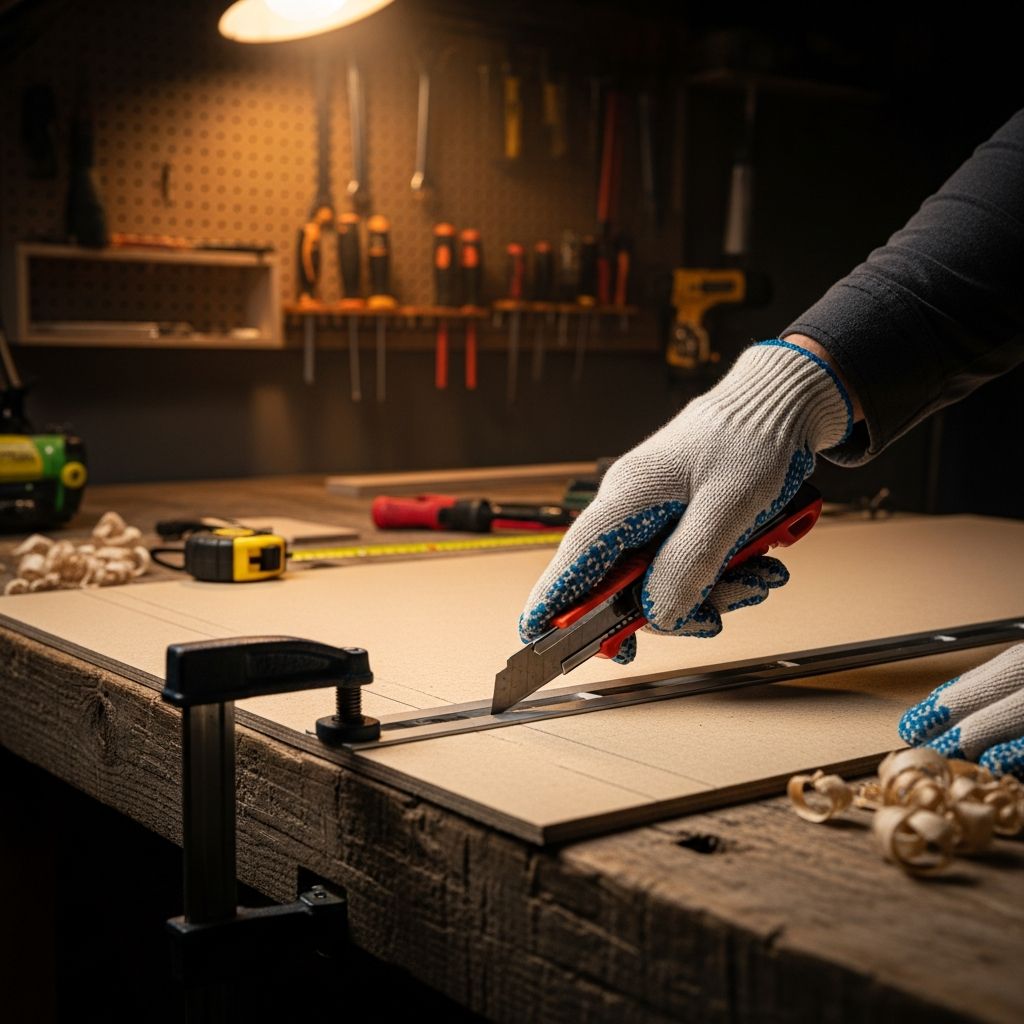
For smaller masonite pieces and painting panels, a utility knife coupled with a straightedge offers surprising effectiveness and precision. This traditional method involves scoring the masonite repeatedly along a marked line using a sharp utility blade guided by a metal straightedge. The key advantages of this technique include minimal dust production, excellent control over the cutting line, and the ability to achieve exceptionally clean edges suitable for finished applications.
The process requires establishing a properly marked cutting line using a calibrated ruler and mechanical pencil to ensure accuracy. Position a metal straightedge or yardstick along your marked line, keeping it firmly in place while making multiple passes with the utility knife. Each pass should apply consistent pressure without forcing the blade through the entire thickness of the material. After several passes, the cut line will penetrate completely through the hardboard, allowing you to snap the piece along the scored line.
Critical safety considerations when using this method include:
- Maintaining exceptionally sharp blades throughout the cutting process
- Angling the blade slightly away from your body to minimize injury risk
- Applying gradual, controlled pressure rather than attempting to cut through in a single pass
- Ensuring the metal straightedge has clean, undamaged edges that the blade can follow reliably
- Working on a stable surface that allows you to use your body weight effectively without losing control
Handsaw Technique
Traditional handsaws work effectively on masonite, particularly for smaller projects or when power tools are unavailable. Select a handsaw with fine teeth to minimize splinting and ensure clean edges. Position the masonite securely against a workbench or similar support structure, supporting it close to the cutting line to eliminate excessive vibration. Use your thumb to initiate the cut along the marked line, creating a small guide channel for the blade before continuing with full strokes. Maintain a relatively shallow angle while cutting, and avoid excessive force that could cause the blade to bind or bend the material.
Specialized Cutting Solutions
Band Saw Advantages
Band saws excel at cutting smaller pieces of masonite with precision and producing minimal waste material. The continuous blade design allows for smooth, controlled cuts and the ability to follow intricate patterns. However, band saws have size limitations determined by their maximum throat depth, typically around 20 inches on standard machines. This constraint makes band saws better suited for smaller project panels rather than full-sheet processing.
Scroll Saw Considerations
Scroll saws provide exceptional control for detailed, intricate cuts on masonite boards. However, they present challenges for certain applications. The relatively small cutting table makes accommodating guide fixtures difficult, and achieving perfectly straight lines or precise circles requires considerable operator skill. Additionally, the fine cutting action can produce slight irregularities in the cut edge even with careful technique, making scroll saws more appropriate for decorative applications where minor variations are acceptable.
Edge Finishing and Refinement
Masonite edges frequently exhibit fraying or roughness regardless of the cutting method employed. Addressing these imperfections after cutting significantly improves the appearance and functionality of your finished project. Hand sanding with progressively finer grits—beginning with 80-grit and advancing to 120 or 150-grit—smooths the edge and removes any fringed fibers. For large-scale production requiring smooth, uniform edges, edge-sanding machines or power sanders accelerate the finishing process considerably.
The direction of sanding matters when working with masonite edges. Sand in the direction of the grain fibers when possible, as this reduces the likelihood of splintering. For painted applications, ensuring completely smooth edges prevents paint from catching on rough spots and provides a more refined final appearance.
Managing Warping and Dimensional Stability
Larger masonite pieces are prone to warping, particularly thin stock exposed to humidity fluctuations or uneven moisture absorption. This warping becomes especially problematic when both sides of the material receive different environmental exposure or when the sheet is not adequately supported. To minimize warping in larger panels:
- Allow masonite sheets to acclimate to your workshop environment before cutting
- Support larger finished pieces on both surfaces, or apply bracing systems that prevent bowing
- Maintain consistent humidity levels in your workspace
- Seal both surfaces of large pieces if they will be exposed to variable moisture conditions
- Consider using thicker gauge masonite for applications requiring dimensional stability
Safety Practices and Dust Management
Working with masonite produces fine dust particles that can be harmful when inhaled regularly. The compressed wood fiber composition releases very fine dust when cut, sanded, or machined. Implementing comprehensive dust management protects your respiratory health and maintains a cleaner workspace. Use a dust mask rated for fine particles when performing any cutting or finishing operations on hardboard.
Additionally, establish firm control over all cutting tools, maintain clear work areas free from tripping hazards, and secure masonite sheets adequately before beginning cuts. Ensure all power tools are properly grounded and maintained according to manufacturer specifications. Remove any jewelry or loose clothing that could catch on rotating tool components. Never reach near or under a cutting tool while it is operating, and always disengage power before making adjustments to tool settings or clearing cut pieces.
Selecting the Appropriate Method for Your Project
Choosing the right cutting technique depends on several project-specific factors. The size and thickness of your masonite, the complexity of the shapes you need to cut, your available tools and workspace, and the finish quality requirements all influence which method proves most efficient and effective.
Small panels with straight edges typically benefit from table saw processing or utility knife scoring. Curved or detailed patterns require jigsaws or scroll saws with operator skill. Large-scale production demands systematic approaches utilizing band saws or industrial equipment. For single pieces requiring exceptional precision and minimal edge preparation, the utility knife method offers surprising advantages despite requiring more time investment than power tool alternatives.
Frequently Asked Questions
Q: What blade type works best for cutting masonite on a table saw?
A: A carbide-tipped blade with 40 to 50 teeth provides the optimal balance of cutting speed and edge quality. Higher tooth counts produce cleaner cuts with minimal tear-out, which is beneficial for visible finished surfaces.
Q: Can I cut masonite with a standard woodworking blade?
A: While standard wood blades can cut masonite, they produce rougher edges and more tear-out than specialty blades. For applications where edge quality matters, investing in a fine-toothed blade designed for hardboard yields superior results.
Q: Is the utility knife method safe for large panels?
A: The utility knife method works best for smaller panels due to control and safety considerations. For panels larger than approximately 12 inches in either dimension, power tools typically offer better control and more predictable results.
Q: How do I prevent my masonite from warping after cutting?
A: Allow the material to acclimate to your workshop before cutting, support large pieces adequately on both surfaces, maintain consistent humidity levels, and consider sealing both sides if the panels will be exposed to variable moisture.
Q: What causes frayed edges on cut masonite?
A: Fraying occurs when individual wood fibers separate at the cutting edge. Using sharp blades, fine-tooth configurations, and post-cutting edge sanding minimizes fraying and produces smoother finished edges.
Q: Is a jigsaw suitable for cutting straight lines in masonite?
A: While jigsaws can cut straight lines, they are not ideally suited for precision straight cuts without guidance systems. Table saws, circular saws with guides, or the utility knife method produce straighter results more consistently.
Q: Can I use a hand saw to cut masonite effectively?
A: Yes, handsaws with fine teeth can cut masonite effectively, particularly for smaller projects. The method requires secure support of the material and careful technique to maintain cutting angle and direction.
References
- How to Cut Hardboard with a Handsaw — YouTube. 2023. https://www.youtube.com/watch?v=N_n4WLlNdAM
- Cut Masonite Painting Panels with a Utility Knife — YouTube. 2020. https://www.youtube.com/watch?v=C_nNuAkko_c
- How to Cut Masonite Board — Sawmill Creek Woodworking Community. 2009. https://sawmillcreek.org/threads/how-to-cut-masonite-board.65797/
- Cutting and Sanding Large Masonite Boards — NC Woodworker Forums. 2011. https://ncwoodworker.net/forums/index.php?threads/cutting-and-sanding-large-masonite-boards.33248/
- How to Cut Masonite — Practical Machinist Forum. 2013. https://www.practicalmachinist.com/forum/threads/how-to-cut-masonite.384968/
Similar Articles








Read full bio of Sneha Tete