Mastering Batter Boards for Precise Construction Layouts
Unlock professional-level accuracy in your building projects with DIY batter boards, ensuring perfect foundations every time.
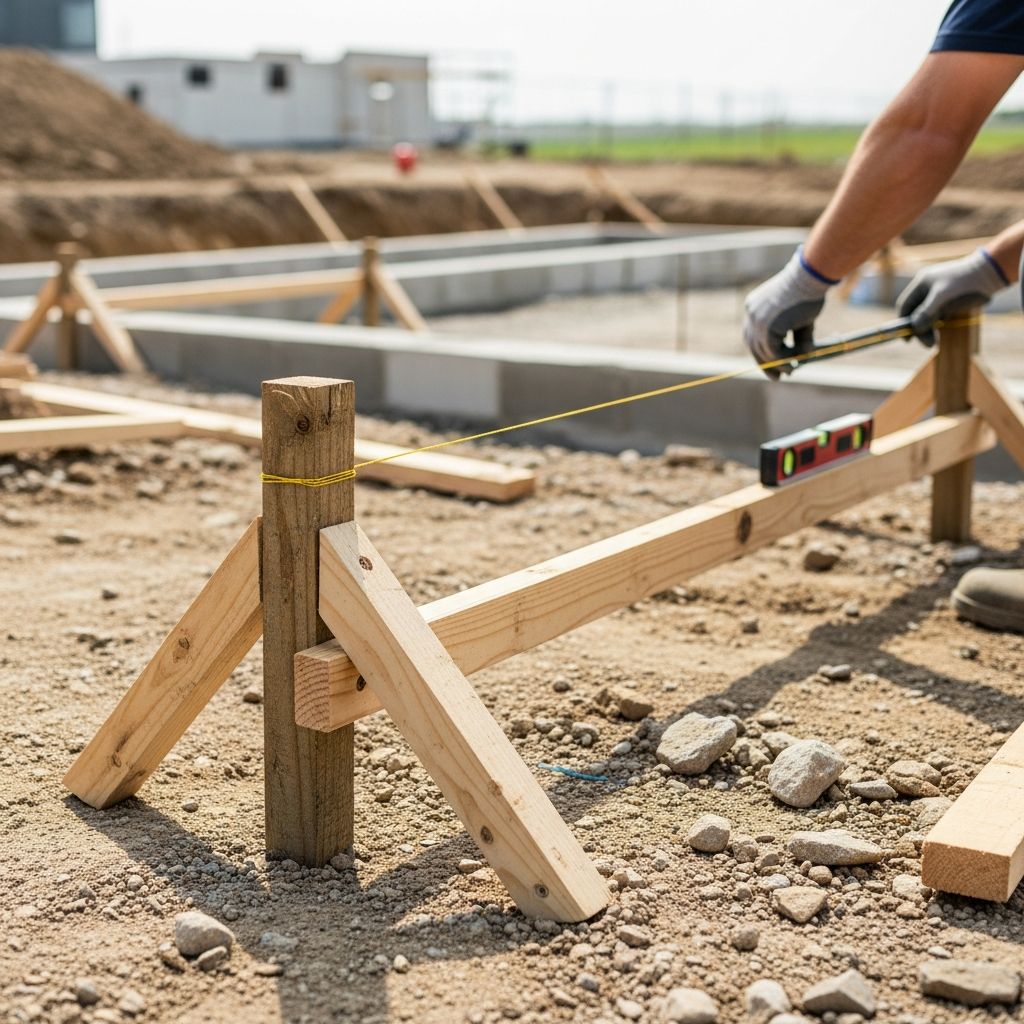
Batter boards serve as essential temporary frameworks in construction, enabling builders to establish exact perimeter lines for foundations using taut strings. These structures, typically made from simple lumber, allow for adjustments without disturbing the ground, making them invaluable for squares, rectangles, and other layouts.
Understanding the Role of Batter Boards in Site Preparation
Before breaking ground on any structure, precise layout is critical to avoid costly errors. Batter boards provide a stable reference system outside the excavation area, supporting strings that define corners and edges. This method ensures squareness via the 3-4-5 rule or Pythagorean theorem, where for a 20×30 foundation, diagonals measure sqrt(20² + 30²) = sqrt(400 + 900) = sqrt(1300) ≈ 36.06 feet.
Positioned about 1-2 feet beyond the planned corners, batter boards use stakes driven deeply for stability, preventing movement under string tension. They accommodate uneven terrain by leveling the crossboards, often starting from the highest point and working downward.
Essential Materials for Building Sturdy Batter Boards
Gather 2×4 or furring strip lumber for stakes and cross pieces, exterior screws for assembly, mason’s line or nylon string, a line level or laser level, hammer or mallet, and measuring tools. Avoid weak materials like roof battens; opt for robust wood treated for outdoor use. Stakes should be 3-4 feet long, sharpened for easy driving.
- Stakes: Three per batter board (two outer, one inner), 2x4s or decking boards.
- Crossboards: 2-foot 2x4s nailed or screwed perpendicular at the top.
- Strings: Durable, non-stretch mason’s line, long enough to span the site.
- Tools: Tape measure, square, plumb bob, string level.
Step-by-Step Guide to Constructing Individual Batter Boards
Begin by cutting stakes to length, sharpening one end of each. For each corner, prepare three stakes: two forming the sides, one for the corner post. Assemble on the ground: screw or nail a horizontal 2×4 across the tops of the two side stakes at a right angle, positioning it to extend beyond the planned corner.
Drive the corner stake first, about 1 foot outside the layout line, to 18-24 inches deep for stability. Attach the pre-assembled frame by driving the side stakes parallel, ensuring the crossboard remains horizontal. Use a 4-foot level on the cross piece.
| Component | Quantity per Corner | Dimensions |
|---|---|---|
| Side Stakes | 2 | 3-4 ft x 2×4 |
| Corner Stake | 1 | 3-4 ft x 2×4 |
| Crossboard | 1 | 2 ft x 2×4 |
| Screws | 4-6 | 3-inch exterior |
Positioning Batter Boards Across the Entire Site
Mark approximate corners with sand or spray paint. Place batter boards 1-2 feet outward from each planned corner, aligning with the building’s sides. For rectangles, ensure parallel placement. Drive stakes vertically using a level on two adjacent sides.
On sloped sites, start at the highest corner. Use a string with line level from this board to mark heights on subsequent stakes, ensuring all crossboards align at the same elevation. This prevents string sags and maintains accuracy.
Achieving Perfect Squareness and Dimensions
With boards in place, stretch strings along the outer edges to define walls. For the first corner, tie string from one board’s nail to the opposite, adjusting for plumb. Measure 3 feet along one string and 4 feet along the adjacent; the diagonal should be 5 feet for 90 degrees.
Verify overall dimensions and diagonals equal. Fine-tune by sliding strings in slots or adding nails. For larger spans, use the Pythagorean theorem: confirm both diagonals match.
Leveling Techniques for Uneven Terrain
Laser levels offer precision, but string lines with line levels suffice for DIY. Hang a weighted string from the highest board, attach a line level, and mark lower boards to match. Repeat around the site. A grade stick can set uniform height from a benchmark.
On steep slopes, taller stakes at high points compensate, keeping crossboards level. Recheck after tensioning strings, as settling may occur.
Running and Securing the Layout Strings
Drive small nails into crossboards at string positions, angled to hold line. Start at one corner, loop string around nail, pull taut to adjacent board, and secure. Repeat for perpendiculars. Use a plumb bob to drop lines to ground level, marking exact corner points.
Double strings for inside/outside walls if needed. Tension prevents drift; replace loose strings immediately.
Common Mistakes and How to Avoid Them
Insufficient stake depth leads to wobble; drive at least 50 cm deep. Non-level crossboards distort measurements—always verify. Over-tensioning snaps strings; use steady pull. Ignoring diagonals results in out-of-square foundations—measure religiously.
- Using flimsy wood: Choose straight, dry lumber.
- Poor verticality: Plumb every stake.
- Uneven heights: Benchmark from high point.
Advanced Tips for Professional Results
For complex layouts, add intermediate batter boards. Pre-cut slots in crossboards for string adjustments. Use rebar sleeves for reusable boards. In windy areas, brace with guy wires. After excavation, leave boards intact as references for forms and footings.
Disassembling and Reusing Batter Boards
Once footings pour, cut strings, remove nails, and dismantle. Salvage lumber for future projects. Proper setup minimizes waste, promoting sustainability.
FAQs
What are batter boards used for?
Batter boards mark precise foundation perimeters, supporting adjustable strings for accurate layouts.
Can I build batter boards on a slope?
Yes, level crossboards using string lines from the highest point downward.
How far from the corner should batter boards be placed?
1-2 feet to allow digging space without disturbance.
Do I need a laser level?
No, a string level works; lasers enhance precision on large sites.
How do I check if my layout is square?
Use 3-4-5 triangles or equal diagonals via Pythagorean theorem.
References
- Making and Using Batter Boards — Lowe’s. Accessed 2026. https://www.lowes.com/n/how-to/making-and-using-batter-boards
- Installing Batter Boards with String Line [Shop Foundation] — YouTube (Video Transcript). 2026. https://www.youtube.com/watch?v=bP8iDuretmU
- Working with batter boards – Do-it-yourself instructions — Buck-Vermessung. Accessed 2026. https://www.buck-vermessung.de/services/batter-board-instructions/
- How To Layout like a PRO with String and Batter Boards — YouTube (Video Transcript). 2026. https://www.youtube.com/watch?v=8m-G9qrDpng
- Set Up Batter Boards: DIY Video Tips — Lowe’s. Accessed 2026. https://www.lowes.com/n/video/building-materials/how-to-make-and-use-batter-boards/73389310
Similar Articles








Read full bio of Sneha Tete