Mastering Millivolt Measurements with Multimeters
Unlock precise low-voltage diagnostics: Complete guide to measuring millivolts using digital multimeters for electronics enthusiasts and professionals.
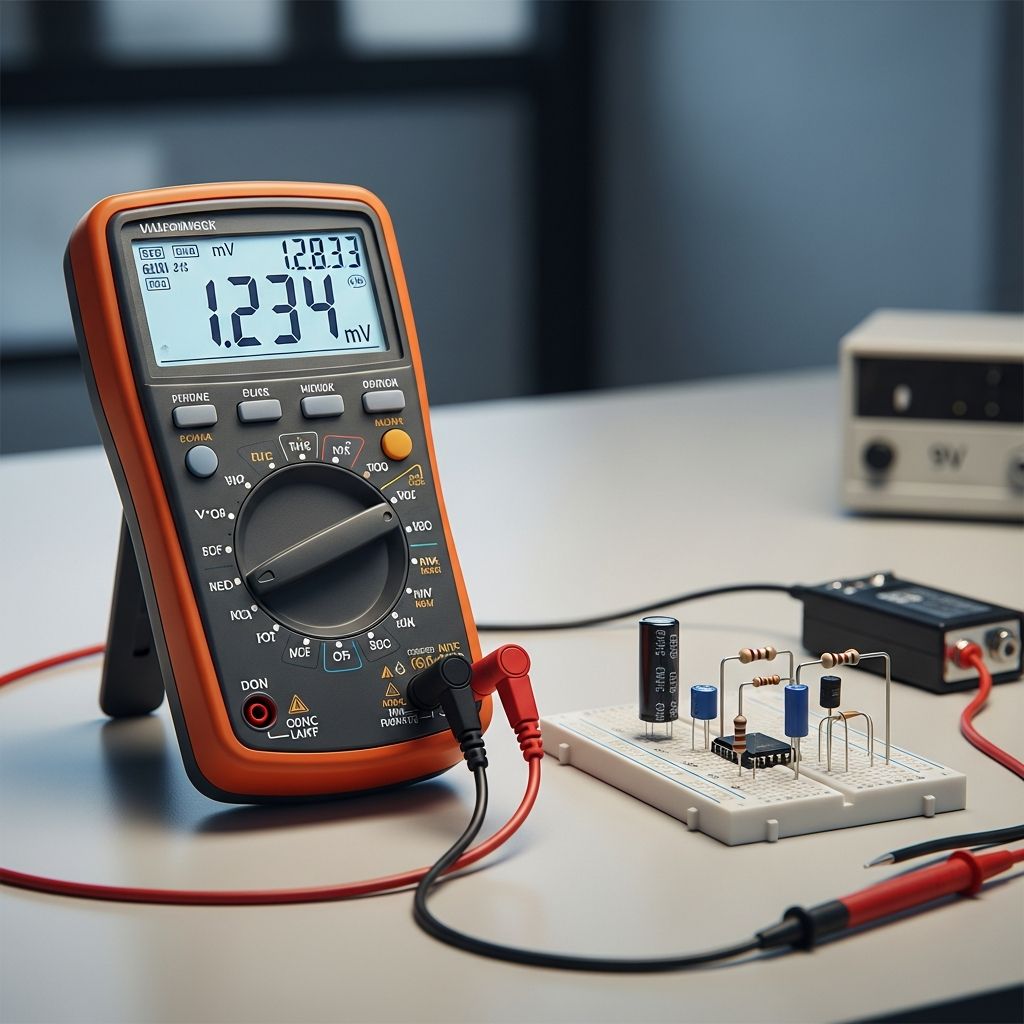
Millivolts, representing one-thousandth of a volt, are crucial for diagnosing subtle voltage drops in sensors, circuits, and low-power devices. Accurate measurement requires understanding multimeter functions, proper setup, and safety protocols to ensure reliable results in electronics work.
Understanding Millivolts in Electrical Testing
A
millivolt (mV)
is 0.001 volts, common in applications like temperature sensors, strain gauges, and battery monitoring where full-volt scales lack sensitivity. Digital multimeters (DMMs) excel here by offering dedicated mV ranges for high-resolution readings.Why measure mV? It reveals issues invisible on standard volt scales, such as minor voltage drops across resistors or thermocouple outputs. For instance, automotive sensors or PCB diagnostics often yield readings under 200 mV, demanding precise tools.
Selecting the Right Multimeter for mV Work
Choose a DMM with explicit mV settings, auto-ranging capability, and high input impedance (>10 MΩ) to avoid loading circuits. Models from reputable brands like Fluke or Keysight provide stability for low-level signals.
- Auto-ranging DMMs: Automatically select scales for ease.
- Manual-ranging: Offer finer control for noisy environments.
- True RMS: Essential for accurate AC mV in non-sinusoidal waveforms.
- Resolution: Aim for 0.1 mV or better on the lowest range.
Verify ports: COM for black probe, V/Ω/mA for red. Avoid current (A) jacks to prevent shorts.
Essential Tools and Accessories
Beyond the DMM, use quality probes with fine tips for tight spaces, alligator clips for hands-free testing, and shielding for EMI-prone areas. Banana-to-shrouded probes enhance safety.
| Accessory | Purpose | Benefit for mV Measurement |
|---|---|---|
| Fine-tip probes | Access small pads | Precise contact without shorts |
| Alligator clips | Secure connections | Stable readings over time |
| Shielded cables | Reduce noise | Cleaner low-mV signals |
| Probe holders | Hands-free setup | Minimize hand-induced noise |
Step-by-Step Guide to DC Millivolt Measurement
DC mV testing suits batteries, sensors, and bias voltages. Follow these steps for accuracy.
- Power off the circuit: Prevent shocks and damage.
- Set dial to DC mV: Look for “mV DC” or lowest V⎓ range (e.g., 200 mV). Manual: Choose next highest expected value.
- Insert probes: Black to COM, red to V/Ω jack.
- Connect parallel: Red to positive, black to negative/ground. Pressure ensures contact.
- Read display: Note units (mV), polarity (- for reversed probes). Use REL for offsets, MIN/MAX for variations.
- Disconnect reverse order: Red first, then black.
Example: Testing a AA battery’s low end shows ~1.2 V (1200 mV); switch to mV for depletion checks.
Measuring AC Millivolts Effectively
AC mV appears in ripple, audio signals, or induced noise. Some DMMs require a function button to toggle AC/DC on mV.
- Select AC mV: Dial to mV AC or press function key (display shows ~).
- Probes same as DC: Polarity irrelevant for AC.
- Touch circuit: Across suspected AC source, like rectifier output.
- Interpret: RMS value; average ~0.707 peak for sines. Capture peaks with MIN/MAX.
Tip: For microvolts (μV), advanced DMMs needed; standard mV handles up to noise floors.
Safety Protocols for Low-Voltage Measurements
Even mV circuits pose risks from high currents or capacitors. Always:
- Verify settings before probing.
- Wear insulated gloves for live work.
- Avoid ghost voltages with low-Z mode.
- Discharge caps first.
- Never exceed CAT ratings (e.g., CAT III for mains-derived).
Common error: Wrong jack insertion blows fuses.
Troubleshooting Common mV Measurement Issues
Unstable readings? Check these:
| Problem | Symptom | Solution |
|---|---|---|
| Fluctuating display | Random mV jumps | Shield probes, average readings |
| Zero or OL | No/low output | Check continuity, range up |
| Negative unexpected | – | Swap probes |
| Noise floor | Baseline drift | Use REL, better DMM |
In voltage dividers, expect proportional drops; e.g., 0.031 V = 31 mV on lower leg.
Practical Applications of mV Measurements
Sensor Calibration
Thermocouples output ~40 μV/°C; aggregate to mV for DMMs. Verify against specs.
Strain Gauge Testing
Bridge outputs drop to mV under load; measure differential for precision.
Audio and Signal Tracing
Line levels ~1 V; preamps may show mV. AC mV reveals distortion.
Battery and Power Diagnostics
Detect IR drops in mV during load tests.
Advanced Techniques for Precision
4-Wire Sensing: Kelvin connections eliminate lead resistance for μV/mV accuracy.
Averaging: Hold or multiple reads smooth noise.
Delta Mode: REL subtracts offsets for differential mV.
For currents implying mV (e.g., via shunt), use mA settings but interpret accordingly.
Frequently Asked Questions (FAQs)
What range for unknown mV signals?
Start at 200 mV DC; auto-range or step up if OL. Highest resolution at lowest scale.
DC vs AC mV difference?
DC for steady signals (batteries); AC for oscillating (ripple). Toggle via button if shared dial.
Why unstable low mV readings?
EMI or poor contact; use shielded probes, ground properly.
Can analog meters measure mV?
Yes, but lower resolution; digital preferred for precision.
Safe max mV input?
Typically 600 V; check manual. mV scales handle low levels safely.
Enhancing Skills with Practice Projects
Build a voltage divider: 10kΩ/1kΩ from 5V yields ~450 mV. Measure to verify theory. Progress to sensor benches for real-world honing.
Mastering mV opens doors to pro diagnostics, from IoT prototyping to industrial maintenance.
References
- How to Read a Multimeter: The Ultimate Guide — Keysight Technologies. 2023. https://www.keysight.com/used/us/en/knowledge/guides/how-to-read-a-multimeter
- Measuring Voltage – How to Use a Multimeter — SparkFun Electronics. 2022-05-15. https://learn.sparkfun.com/tutorials/how-to-use-a-multimeter/measuring-voltage
- How to use a multimeter like a pro! The Ultimate guide — GreatScott!. 2021-03-12. https://www.youtube.com/watch?v=4lAyzRxsbDc
- How to Check AC or DC Millivolts (mV) with a Digital Multimeter — KAIWEETS. 2023-07-20. https://www.youtube.com/watch?v=Vd8OhgK4FfU
- How to Measure DC Voltage with a Digital Multimeter — Fluke Corporation. 2024-01-10. https://www.fluke.com/en-us/learn/blog/digital-multimeters/how-to-measure-dc-voltage-with-a-digital-multimeter
- Help measuring millivolts with this multimeter — All About Circuits Forum. 2022-09-05. https://forum.allaboutcircuits.com/threads/help-measuring-millivolts-with-this-multimeter.190243/
- Using the Multimeter Training Unit (MTU): Millivolts — Purkeys. 2020-11-18. https://www.youtube.com/watch?v=B_XM-VC5cY8
Similar Articles








Read full bio of medha deb