Table Saw Blade Replacement: Step-By-Step Guide
Unlock safe and efficient techniques to swap table saw blades, ensuring precision cuts and prolonged tool life for every project.
Mastering Table Saw Blade Replacement
Replacing the blade on a table saw is a fundamental maintenance task that keeps your cuts clean, accurate, and safe. Whether your current blade is dull, damaged, or unsuitable for the next material, knowing how to perform this swap confidently saves time and prevents accidents. This guide draws from proven methods used across popular models, emphasizing preparation, execution, and post-installation checks.
Why Regular Blade Changes Matter
A sharp blade reduces motor strain, minimizes tear-out on wood, and lowers injury risk from kickback or binding. Dull blades force the saw to work harder, potentially leading to overheating or premature wear on components like the arbor. Inspect blades routinely for chipped teeth, warping, or excessive wear—signs that demand immediate replacement. Switching blades also allows customization for tasks like ripping lumber or crosscutting plywood.
Essential Safety Protocols Before Starting
Safety forms the cornerstone of any blade change. Begin by disconnecting the power source: unplug the saw or flip the breaker to eliminate accidental startups. Wear cut-resistant gloves to protect against sharp carbide tips, safety glasses to shield your eyes from debris, and avoid loose clothing that could snag. Clear the work area of scraps and position the saw on a stable surface. Raise the blade fully to access the arbor easily, but never with power connected.
- Power off and unplug the saw completely.
- Don protective gear: gloves, goggles, and fitted clothing.
- Raise blade to maximum height for better access.
- Remove nearby obstacles to prevent slips or falls.
Gathering the Right Tools and Materials
Most table saws include dedicated wrenches for blade removal, often stored on the saw’s housing. You’ll need two open-end wrenches—one for the arbor nut and one to hold the spindle. A new blade matched to your saw’s specifications (diameter, arbor size, kerf width) is essential. Have a soft cloth for cleaning, a blade storage case to protect teeth, and optionally, a blade stabilizer tool if your model lacks an arbor lock.
| Item | Purpose | Notes |
|---|---|---|
| Two wrenches | Loosen arbor nut | Often included with saw |
| New blade | Replacement cutting edge | Match size: e.g., 8-1/4″ for compact models |
| Cut-resistant gloves | Handle sharp edges | Level 5 ANSI rated |
| Cleaning rag | Wipe arbor and flanges | Non-abrasive |
| Wood block (optional) | Lock arbor if no wrenches | Straight-grained scrap |
Selecting the Perfect Replacement Blade
Blades vary by tooth count, configuration, and material compatibility. For general ripping, choose 24-tooth blades with a full kerf (1/8″). Crosscut blades with 60-80 teeth yield smoother finishes. Thin-kerf options reduce power draw on portable saws. Check your saw’s manual for arbor hole size—typically 5/8″ or 1″—and maximum blade diameter. Premium blades with laser-cut stabilizers cut vibration and noise. Always verify rotation direction via arrows on the blade and saw body.
Detailed Step-by-Step Removal Process
Follow these steps methodically to detach the old blade without damage.
- Clear accessories: Slide the rip fence aside, remove the miter gauge, and lift off the throat plate (insert) by its tabs.
- Detach guards: Unlock and remove the blade guard assembly and riving knife/splitter for unobstructed access.
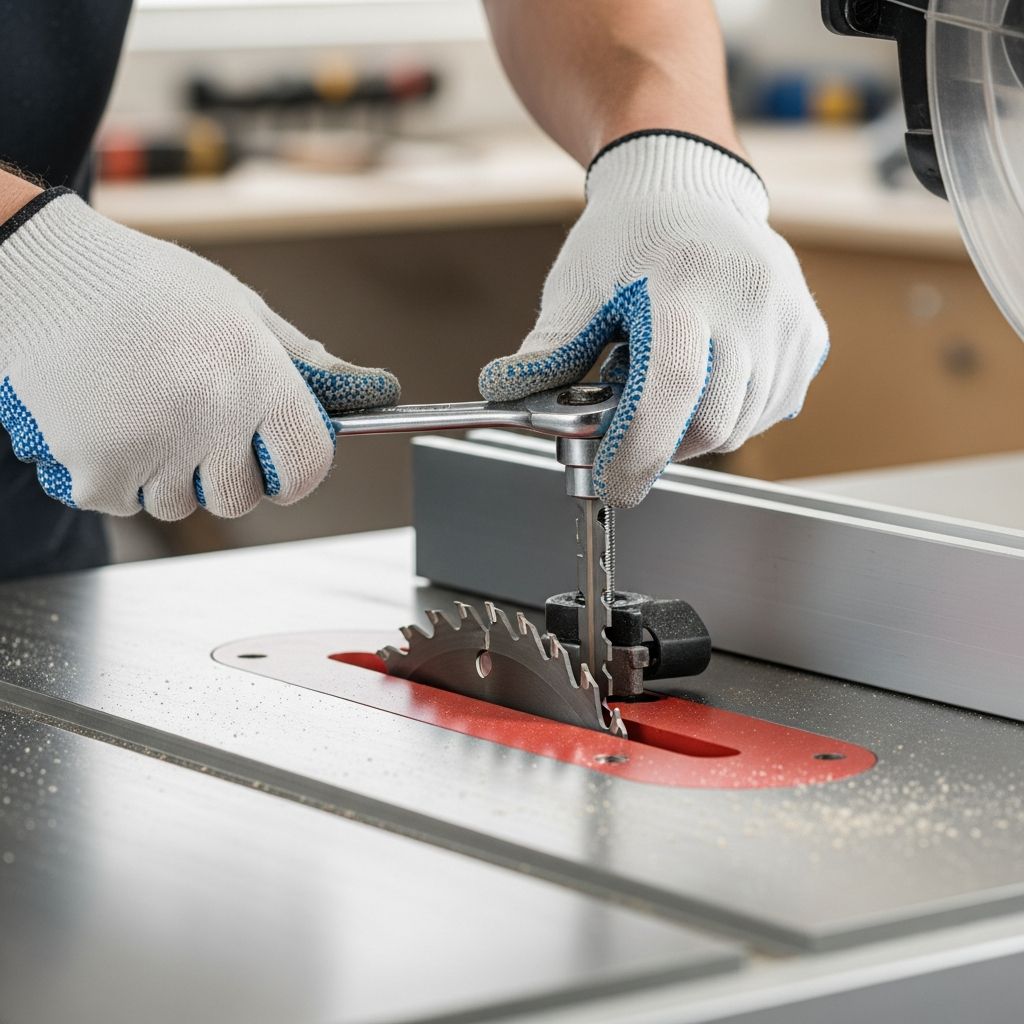
- Position wrenches: Insert the flat wrench into the arbor slot at the back (motor end). Place the open-end wrench on the arbor nut (front).
- Loosen nut: Turn the front wrench counterclockwise while holding the back firm. Use body leverage against the saw frame if stiff. Hand-loosen fully once free.
- Extract components: Remove nut, washer (note “This Side Out” marking), and slide off the blade carefully, avoiding contact with teeth.
Clean the arbor shaft and flanges with a rag to remove sawdust buildup, which can cause wobble.
Precise Installation of the New Blade
Proper orientation ensures safe operation. Align teeth to point forward in the rotation direction—matching saw housing arrows.
- Mount blade: Slide the new blade onto the arbor, ensuring flat against the inner flange.
- Replace washer: Position with marked side facing out.
- Hand-thread nut: Turn clockwise until snug against washer.
- Tighten securely: Use wrenches oppositely—clockwise on nut, hold arbor. Tighten firm but not excessively; self-locking design prevents loosening during use.
- Manual spin test: Rotate blade by hand to check for play, rub, or binding.
Reassembly and Final Checks
Reverse disassembly: reinstall throat plate flush with table, reattach riving knife aligned with blade path, secure guards, reposition fence and miter gauge. Lower blade below table, plug in, and run a test cut on scrap. Listen for unusual noise and observe for straight kerfs.
- Align all components precisely to avoid future misalignment.
- Verify guard drops freely over blade.
- Test run at low speed first.
Common Mistakes and How to Avoid Them
Errors like incorrect rotation cause inefficient cutting or kickback. Overtightening strips threads; undertightening allows slippage. Dropping nuts into the saw base frustrates retrieval—use magnetic tools. Forgetting to unplug risks amputation. Always double-check washer orientation and clean interfaces.
| Mistake | Consequence | Prevention |
|---|---|---|
| Wrong blade direction | Kickback, poor cuts | Match arrows |
| Dirty arbor | Vibration, wobble | Clean before install |
| Over/under tightening | Slippage or damage | Snug with wrenches |
| Skipping safety gear | Injury | Full PPE always |
Advanced Tips for Longevity and Performance
Store blades in padded cases to protect teeth. Use blade wax or cleaners periodically. For jobsite saws like DeWalt models, leverage built-in wrench storage. Consider quick-release arbor systems on newer saws. Track blade life: 20-50 hours per blade depending on material. Hybrid blades balance rip and crosscut needs for versatility.
Troubleshooting Post-Installation Issues
If vibration persists, recheck flatness and tightness. Burning cuts indicate dullness or misalignment—verify fence squareness. Noisy operation? Inspect bearings or flanges. For stuck nuts, apply penetrating oil and tap gently.
FAQs
Do all table saws use the same wrenches?
No, but most contractor and cabinet saws provide matched pairs. Portable models like DeWalt DWE7485 store them onboard.
How often should I replace blades?
Every 20-50 hours of use, or when cuts show tear-out or burning.
Can I use a larger blade?
Never—stick to manufacturer specs to avoid motor overload or hazards.
What’s the best way without two wrenches?
Use a wood block wedged against the blade or arbor lock if available.
Is left-tilt vs. right-tilt different?
Blade change process is identical; tilt only affects bevel cuts.
Enhancing Your Saw’s Capabilities
Beyond basics, invest in dado sets for grooves or stacked dadoes. Digital angle gauges aid precise setup. Dust collection ports keep blades cleaner longer. Regular maintenance like belt tension checks complements blade swaps for peak performance.
References
- How to Replace the Blade on a DeWalt Table Saw — YouTube (DeWalt Tutorial). 2024. https://www.youtube.com/watch?v=RhXrSDPEw64
- How to Change a Blade on Your Table Saw: A Step-by-Step Guide — YouTube (Shop Fix It). 2023. https://www.youtube.com/watch?v=bi1Xhk-AfJw
- How to Change a Table Saw Blade — The Home Depot YouTube. 2022. https://www.youtube.com/watch?v=pAorvbDMbTY
- How to Change a Table Saw Blade — The Home Depot Guide. 2024-02-05. https://www.homedepot.com/c/ah/how-to-change-a-table-saw-blade/9ba683603be9fa5395fab90e72732e3
- How to Change a Table Saw Blade | Rockler Skill Builders — Rockler Woodworking and Hardware YouTube. 2016-11-03. https://www.youtube.com/watch?v=BVf6JEHXPSA
Similar Articles







Read full bio of Sneha Tete