Measuring Bifold Doors: Step-By-Step Complete Guide
Master precise bifold door measurements for flawless installation and perfect fit every time with our detailed step-by-step instructions.
Measuring Bifold Doors: Complete Guide
Bifold doors offer versatile solutions for closets, room dividers, and patio openings, folding neatly to save space while providing easy access. Accurate measurement forms the foundation of any successful installation, preventing costly errors like gaps or binding panels. This guide details every aspect of sizing bifold doors, from essential tools to advanced checks, helping both DIY enthusiasts and professionals achieve precise results.
Why Accurate Measurements Matter for Bifold Doors
Improper sizing leads to operational issues, such as doors that stick, fail to align, or leave unsightly gaps. For interior bifolds, standard rough openings typically match nominal door sizes closely, while exterior versions demand allowances for tracks and seals. Manufacturers rely on your final figures for production, often without built-in tolerances, making multiple verifications essential.
Common pitfalls include out-of-square openings or uneven floors, which can distort measurements. By following systematic methods, you account for these variations upfront, ensuring smooth operation and durability.
Essential Tools for Measuring Bifold Doors
Gather these items before starting to guarantee reliability:
- Tape measure (25-foot minimum for large spans)
- Level (4-foot for plumb checks)
- Framing square or carpenter’s square for angles
- Pencil and notepad for recording data
- Laser measurer (optional for precision in expansive areas)
These tools enable consistent, repeatable assessments across multiple points.
Step-by-Step Process to Measure Width
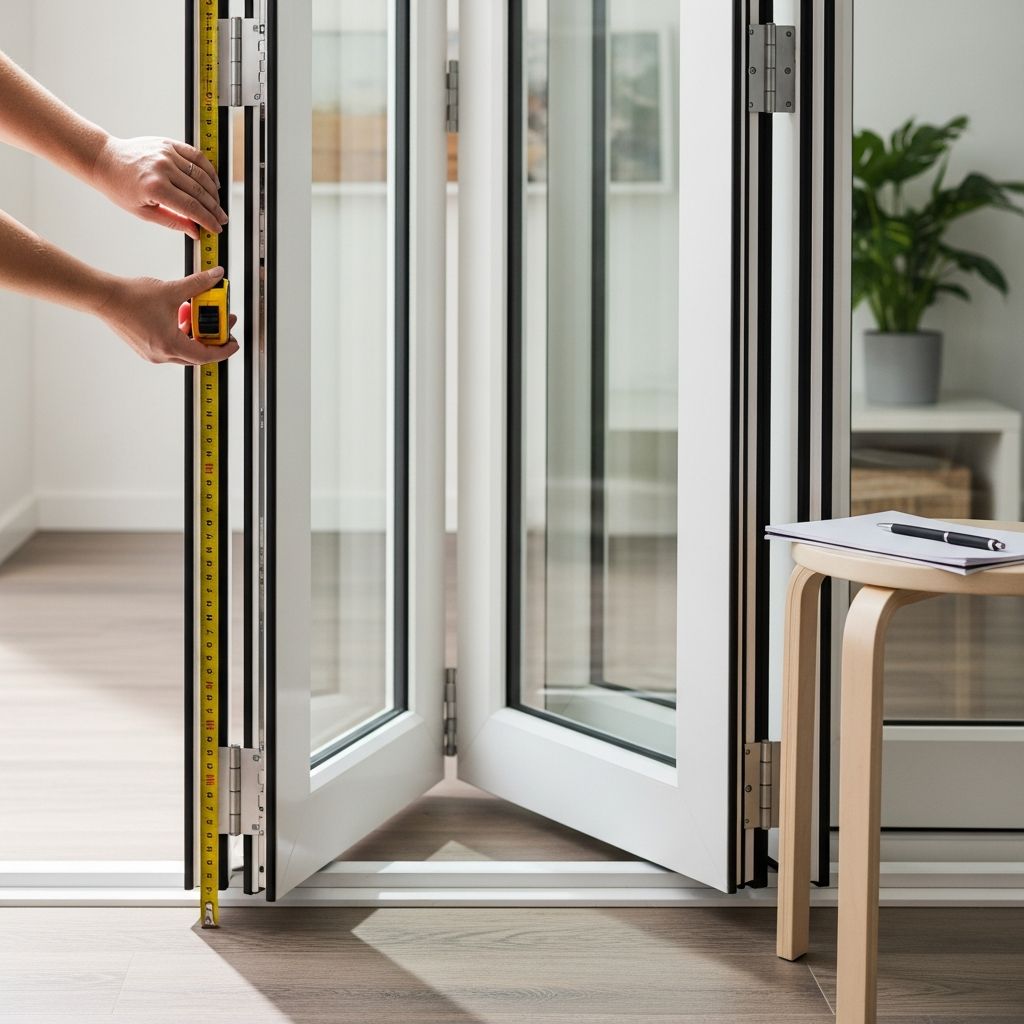
Width represents the horizontal span where panels will operate. Variations from settling walls or framing irregularities require checking at several heights.
- Position the tape at the top of the opening, measuring jamb-to-jamb.
- Repeat at the middle height.
- Measure again at the bottom, ideally from finished floor level.
- Record the smallest value to accommodate any narrowing.
For interior bifolds like 36-inch closet doors, expect rough openings around 36 inches wide by 81 inches tall, but always verify per model. Subtract tolerances—typically 1/2 to 1 inch total—based on manufacturer specs for actual door slab sizing.
Step-by-Step Process to Measure Height
Height runs from floor to header underside, influencing track placement and panel clearance.
- Measure on the left jamb from subfloor or finished surface upward.
- Check the center.
- Measure the right jamb.
- Use the smallest height for conservative sizing, especially interiors.
Exterior bifolds often range 2000-2700mm tall, with wider panels needing proportional heights. Allow 1 inch at the top for headers and seals.
Verifying Squareness and Plumb
An out-of-square aperture causes binding. Diagonal checks confirm geometry:
- Measure from top-left to bottom-right corner.
- Measure top-right to bottom-left.
- Differences under 2mm indicate squareness; larger variances require shimming.
Additionally, use a level on jambs and header to ensure plumb and level. Uneven floors may need adjustable tracks or leveling compounds.
Understanding Tolerances and Clearances
Tolerances prevent over-tight fits. Common allowances include:
| Measurement | Typical Clearance | Tolerance | Notes |
|---|---|---|---|
| Width | 1 inch total (1/2 inch per side) | ±1/8 inch | Use smallest reading; deduct for slabs |
| Height | 1-2 7/8 inches top | ±1/8 inch | From floor to header; largest for rough |
| Diagonals | Equal within 2mm | N/A | Confirms square opening |
Exterior installs often subtract 10mm overall; interiors may need 9/16 inch width per single panel. Always consult specific guidelines, as aluminum frames expand with heat.
Standard Bifold Door Sizes and Rough Openings
Bifolds come in configurations tailored to spaces:
| Type | Common Size | Rough Opening Width | Rough Opening Height | Typical Use |
|---|---|---|---|---|
| Single Bifold | 30×80 inches | 30 9/16 inches | 82 7/8 inches | Closets |
| Double Bifold | 60×80 inches | 62 inches | 81 inches | Room dividers |
| Double Bifold | 72×80 inches | 74 inches | 81 inches | Large closets |
| 3-Panel Exterior | 2000-3300mm wide | Min 2000mm | 2000-2700mm | Patios |
| 4-Panel Exterior | 2800-4400mm wide | Min 2800mm | 2000-2700mm | Wider openings |
For doubles, rough width equals twice slab width plus 15/16 inch. Nominal sizes like 24×84 inches account for 1/2-inch install allowances.
Special Considerations for Interior vs. Exterior Bifolds
Interior Bifold Doors
Primarily for closets, these use top/bottom tracks. Measure existing openings post-removal for replacements. Ensure fold space is clear. Standard heights hit 80-84 inches.
Exterior Bifold Doors
Aluminum or uPVC for patios, these need weather seals and threshold details. Measure from blockwork; consider panel count for width (e.g., 5 panels: 3800-5500mm). Verify windload ratings via official standards.
Tips for Complex Openings and Multi-Panel Setups
For bays or non-rectangular spaces:
- Segment measurements per panel zone.
- Account for blinds or screens if adding (e.g., recess widths to door centers).
- Triple-check with laser for spans over 3m.
Humidity affects wood; measure in stable conditions.
Frequently Asked Questions (FAQs)
What if my measurements vary significantly?
Use the smallest for width/height to ensure fit; note discrepancies for professional adjustment.
Do I measure finished or rough opening?
Rough for new installs (framing); finished for replacements.
How much smaller should the door be than the opening?
Typically 1/2-1 inch width, 1-3 inches height per manufacturer.
Can I install bifolds on uneven floors?
Yes, with adjustable tracks; level first where possible.
What’s the best time to measure?
After framing/flooring; avoid rush for accuracy.
Final Checklist Before Ordering
- Widths: Top, mid, bottom—smallest wins.
- Heights: Left, center, right—smallest.
- Diagonals: Equal ±2mm.
- Plumb/Level: Confirmed with tools.
- Tolerances: Deducted per specs.
- Clearance: Fold space verified.
Re-measure 2-3 times. For quotes, approximations suffice initially, but finals drive manufacturing.
References
- Bifold Door Measuring Guide — Now Aluminium. Accessed 2026. https://nowaluminium.co.uk/pages/bifold-door-measuring-guide
- Bifold Door Rough Opening Dimensions: Installation Guide — Gladiator Window and Doors. Accessed 2026. https://gladiatorwindowanddoors.com/blogs/news/bifold-door-rough-opening-dimensions-installation-guide
- How to Measure up for Bifold Door Installation — Express Bifolds Direct. Accessed 2026. https://www.expressbifoldsdirect.co.uk/how-to-measure-up-for-bifold-door-installation/
- Bifold Doors Sizes Guide – How to Measure — Door Design Lab. Accessed 2026. https://doordesignlab.com/blog/bifold-door-sizes-guide/
- Measurement Guide for Bifold and Sliding — Electra Blinds (PDF). Accessed 2026. https://www.electrablinds.co.uk/pub/media/wysiwyg/pdf/ElectraMeasurementGuidePatioDoorsv3.pdf
- Bifold door sizes: Which size do you need? — VuFold. Accessed 2026. https://www.vufold.co.uk/advice-centre/bi-fold-doors-advice/news-research/bi-fold-door-sizes
Similar Articles




Read full bio of Sneha Tete