Measuring Copper Pipe Fittings: A Complete Guide
Master the art of accurately measuring copper fittings for flawless plumbing installations
Understanding the Fundamentals of Copper Pipe Measurement
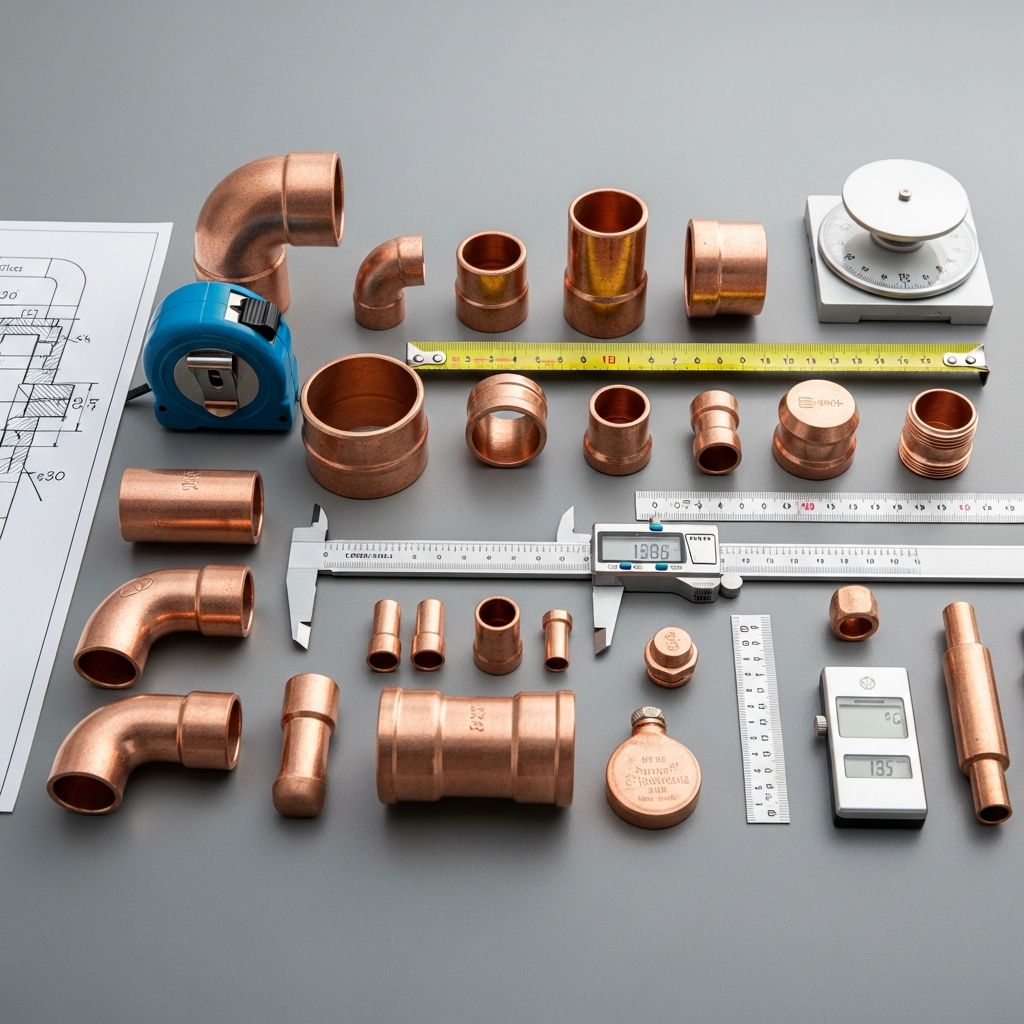
Measuring copper pipe fittings accurately is one of the most essential skills for anyone undertaking plumbing work, whether as a professional or dedicated homeowner. The precision required when measuring fittings directly impacts the success of your installation, affecting water flow, structural integrity, and the overall longevity of your plumbing system. Unlike measuring simple lengths of pipe, fitting measurements involve understanding several interconnected concepts that work together to ensure pipes connect properly to their corresponding fittings.
The process begins with recognizing that copper pipes come in standardized nominal sizes, typically ranging from 3/8 inch to 2 inches in diameter for most residential applications. However, nominal size does not reflect the actual physical dimensions of the pipe. Instead, the outside diameter (OD) remains constant for each nominal size, regardless of wall thickness variations. This consistency allows pipes of different wall thicknesses to fit into the same fittings, making the measurement system more uniform and predictable.
Key Measurement Concepts You Must Know
Before diving into practical measurement techniques, familiarizing yourself with three critical measurement terms will dramatically improve your accuracy and confidence when working with copper fittings.
Center-to-Face Distance
The center-to-face (C to F) measurement represents the distance from the centerline of a fitting to its outer face or edge. This measurement is fundamental because it tells you how far the fitting extends into your overall piping run. Understanding this dimension helps you calculate how much space the fitting actually occupies in your installation, which is crucial when you need to fit multiple components into a confined space or when precision is critical for system design.
Pipe Insertion Depth
When copper pipe enters a fitting, it doesn’t go all the way through. Instead, the pipe stops at a specific point determined by the fitting’s internal design and taper. This insertion depth, sometimes called the “depth of engagement,” represents how far the pipe pushes into the fitting before stopping. The taper on threaded pipes forces the pipe to stop because of the geometry, with the exact distance specified by ANSI standards. This concept is absolutely essential because it directly affects how you calculate fitting allowances.
Fitting Allowance Calculations
The fitting allowance is the amount of pipe length that gets consumed by inserting the pipe into the fitting. You calculate this by subtracting the depth of insertion from the center-to-face measurement. For example, if a fitting has a center-to-face measurement of 1 inch but the pipe only inserts 1/2 inch deep, the fitting allowance would be 1/2 inch. This figure is absolutely critical because it tells you how much you must subtract from your overall desired dimension when calculating the actual length of pipe you need to cut.
Practical Techniques for Measuring Individual Fittings
When you’re on a job site with actual fittings in hand, the most accurate approach involves direct measurement rather than relying solely on reference tables. While reference tables provide excellent starting points, variations in manufacturing can create slight differences between different batches of fittings.
To measure a fitting directly, gather a ruler or measuring tape and position it carefully from the center of the fitting to its outer face. For fittings with threaded connections, the center point represents the geometric center of the opening where the pipe enters. Use a ruler rather than a flexible tape measure when possible, as rulers provide better accuracy for these detailed measurements, especially on smaller fittings where precision matters greatly.
Once you have the center-to-face measurement, measure the depth by inserting a pipe into the fitting and noting exactly how far it travels before stopping. This depth measurement, when subtracted from center-to-face, gives you the fitting allowance specific to that exact fitting.
Working with Multiple Fittings in a Single Run
Real plumbing installations rarely involve just one fitting. Instead, you’ll typically work with multiple fittings arranged in various configurations. When two or more fittings are used in sequence, you must account for the fitting allowance for each one.
Consider a practical example: imagine you need to connect a 90-degree elbow to a 45-degree elbow with copper pipe between them. Your project specifies that these fittings should be positioned center-to-center at 10 inches apart. However, you can’t simply cut a 10-inch pipe because that measurement includes the space where the pipe inserts into each fitting.
For a 3/4-inch copper pipe system, the 90-degree elbow typically has a fitting allowance of 1/2 inch, while the 45-degree elbow has an allowance of 1/4 inch. Adding these together gives you a combined fitting allowance of 3/4 inch. Therefore, your actual pipe length should be calculated as: center-to-center distance (10 inches) minus fitting allowance (3/4 inch) equals 9.25 inches of pipe needed.
Using Reference Tables Effectively
Professional plumbing references provide comprehensive tables listing fitting allowances for different pipe sizes and fitting types. These tables organize information by nominal pipe size in the first column, followed by center-to-center measurements, copper tube sizes, and specific elbow specifications in subsequent columns.
To use these tables effectively, first identify your nominal pipe size (such as 3/4 inch), then locate that row. Move across to find the appropriate fitting type and read the corresponding fitting allowance value. This approach works for 90-degree elbows and tees, which are the most common fittings in residential plumbing.
Handling Specialty and Angle Fittings
Beyond standard 90-degree elbows, plumbing systems sometimes require 22.5-degree, 45-degree, or 60-degree angle fittings to negotiate obstacles or change direction at unconventional angles. While the measurement principle remains identical, these specialty fittings have different fitting allowance values compared to standard elbows.
Specialized reference tables, typically located at the back of comprehensive plumbing references, contain the fitting allowances for these less common angles. The calculation process remains unchanged: you determine your center-to-center dimension, identify all fitting types involved, look up their respective allowances, subtract those allowances from your center-to-center measurement, and the result is your end-to-end pipe length to cut.
Measuring Pipe Size Independently
Sometimes you’ll encounter existing copper pipe and need to determine its size without referring to labels or documentation. Several approaches can help you identify the correct size accurately.
The simplest method involves checking the pipe itself, as many manufacturers stamp the diameter directly on the exterior surface. Look carefully along the length of the pipe, particularly near cut ends or bends, where markings are often most visible and legible.
If no markings are visible, you can measure the opening size by placing a ruler or measuring tape across the inside of the pipe opening, measuring from inner edge to inner edge. Position the measuring device at the center of the opening to ensure a straight, perpendicular measurement directly across the diameter. Common residential sizes are typically 1/2 inch, 3/4 inch, or 1 inch, making identification relatively straightforward once you have the measurement.
Understanding Pipe Dimension Variations
A critical concept in copper piping is understanding that nominal size doesn’t mean actual measurement. The outside diameter remains consistent across different wall thicknesses for pipes of the same nominal size, but the inside diameter varies depending on wall thickness. Thicker-walled pipe (higher schedules like Schedule 80) has a smaller inside diameter than thinner-walled pipe (Schedule 40) of the same nominal size.
This design ensures that all pipes of a given nominal size will fit the same fittings and flanges, regardless of wall thickness. However, when pressure requirements or specific applications demand different wall thicknesses, the internal volume and flow characteristics change accordingly. For most residential plumbing applications, standard Schedule 40 copper tubing provides adequate strength and is the most economical choice.
Common Mistakes to Avoid
Several frequent errors can undermine your measurement accuracy and create frustrating fitting problems during installation.
- Ignoring actual fitting measurements: While reference tables provide excellent guidelines, measuring your actual fittings on the job site yields greater precision than assuming all fittings match standard specifications.
- Confusing outside and inside diameters: When measuring pipe size, ensure you’re measuring the inside opening, not the outside diameter of the pipe material itself, which will be larger.
- Forgetting to account for all fittings: When multiple fittings appear in one run, include the fitting allowance for every single fitting, not just the primary ones.
- Measuring from the wrong reference points: Always measure center-to-center distances and fitting allowances from clear, well-defined points to avoid accumulated measurement errors.
- Overlooking pipe sealant requirements: Even with precise measurements, threaded connections require pipe sealant because slight gaps may exist between the pipe and fitting, and sealant prevents leaks.
Frequently Asked Questions
What if I don’t have the reference tables available?
Measure your actual fittings directly using the center-to-face method described earlier. While this takes more time initially, it provides accurate fitting allowances specific to your exact components and is often more reliable than generic reference data.
Can I use the same fitting allowance for different brands of fittings?
While most quality fittings follow ANSI standards closely, minor variations can exist between manufacturers. For maximum accuracy, particularly on critical installations, measure fittings from each supplier separately before assuming they’re identical.
Does fitting allowance change based on water pressure or temperature?
No. Fitting allowances are purely mechanical dimensions based on how far pipe can physically insert into the fitting. Pressure and temperature don’t affect these mechanical dimensions, though they do affect pipe expansion and contraction over time.
Why can’t I just measure the total distance and subtract an arbitrary amount?
Because each fitting type has a specific allowance based on its design. A 90-degree elbow has a different allowance than a 45-degree elbow or a tee fitting. Using the wrong value results in pipe lengths that won’t fit properly.
Conclusion: Building Measurement Confidence
Mastering copper pipe fitting measurements transforms you from someone uncertain about dimensions into a confident installer who understands exactly how components fit together. Start by learning the three fundamental concepts—center-to-face measurements, insertion depth, and fitting allowances—then practice measuring actual fittings on your first few projects. Over time, these calculations become second nature, and you’ll find yourself completing layouts efficiently and accurately. Whether you’re tackling a simple repair or designing an entire water distribution system, precise fitting measurements form the foundation of professional-quality plumbing work that lasts for decades.
References
- Unit 10 Allowances for Copper Fittings — GOT2LEARN. Video educational content on copper fitting allowance calculations and measurement methodologies. https://www.youtube.com/watch?v=gKLkomzlTxI
- How To Measure Copper Pipe Size Easily — Helpful DIY. 2023-03-12. Video tutorial demonstrating practical techniques for measuring copper pipe dimensions and identifying pipe sizes. https://www.youtube.com/watch?v=IM8u_Kc-qco
- Nominal Pipe to Inch to Metric Conversion Chart — PipingNow.com. Technical reference guide explaining pipe sizing standards and the relationship between nominal sizes and actual dimensions. https://pipingnow.com/pages/nominal-pipe-to-inch-to-metric-conversion-chart
- Pipe Sizing Charts – Circumference, O.D & Threads Per Inch — PlumbingSupply.com. Technical documentation on ANSI pipe standards and pipe-fitting engagement specifications. https://www.plumbingsupply.com/info-pipesizes.html
- Copper Pipe Size Chart: OD, ID, Wall Thickness & Tube Sizes — Petersen Products. Technical reference chart for copper tubing specifications across standard sizes. https://www.petersenproducts.com/pipe-specs/copper-tubing-sizes
- Copper Tube Handbook — Copper Development Association. 2024. Comprehensive technical resource providing design data and sizing guidelines for copper water distribution systems. https://www.copper.org/publications/pub_list/pdf/copper_tube_handbook.pdf
Similar Articles



Read full bio of medha deb