Create Perfect 90-Degree Angles Using Only a Tape Measure
Master the art of laying out precise right angles on any project with just a tape measure—no fancy tools required.
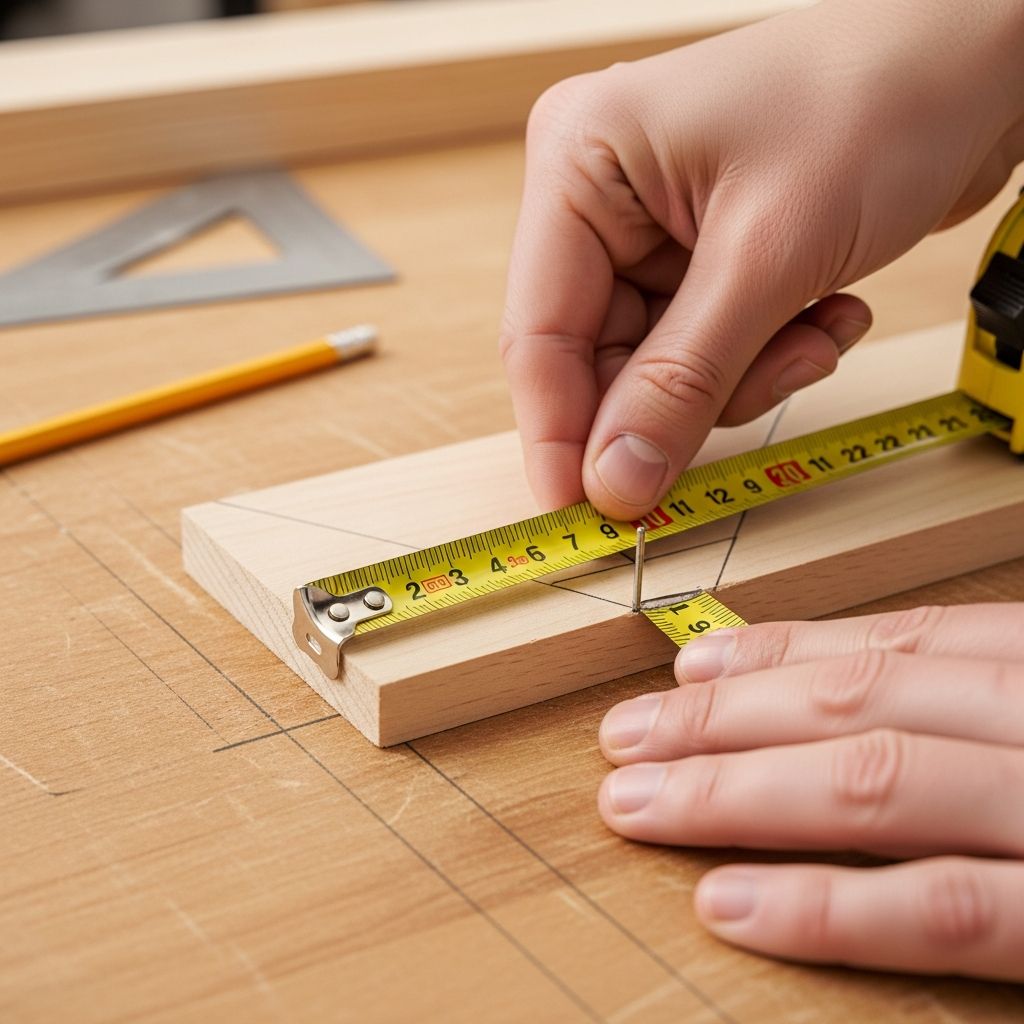
Right angles form the backbone of countless construction and DIY projects, from framing walls to building decks and installing cabinets. Achieving precision without specialized tools like squares or levels can be challenging, but there’s a reliable, ancient mathematical principle that makes it possible with just a tape measure: the Pythagorean theorem. This guide explores how to mark exact 90-degree angles using simple measurements, empowering you to tackle projects with confidence.
Understanding Right Angles and Why Precision Matters
A
90-degree angle
, also known as a right angle, occurs when two lines meet perpendicularly, forming a perfect ‘L’ shape. In geometry, it’s one-quarter of a full 360-degree circle and is fundamental to squares, rectangles, and stable structures. In practical terms, even a slight deviation—say, 1-2 degrees—can compound over length, leading to uneven floors, wobbly frames, or misaligned installations.Professionals and hobbyists alike rely on this angle for squaring foundations, ensuring plumb corners in sheds, patios, and garages. The beauty of the tape measure method lies in its simplicity: it leverages the 3-4-5 triangle ratio, a direct application of the Pythagorean theorem (a² + b² = c²), where 3² + 4² = 9 + 16 = 25 = 5².
The Core Technique: Mastering the 3-4-5 Method
This foolproof approach requires no calculations beyond basic measuring. It’s scalable for any project size and works on flat surfaces like concrete, wood, or soil.
Step-by-Step Instructions for Basic 3-4-5 Layout
- Establish Your Baseline: Start with one line or edge already marked (e.g., a wall edge or string line). Call this Point A.
- Measure the First Leg: From Point A, measure exactly 3 feet (or 36 inches) along your intended direction and mark Point B. Use a taut tape for accuracy.
- Measure the Second Leg: From Point A, measure exactly 4 feet perpendicular to the first leg (eyeball it initially) and mark Point C temporarily.
- Check the Hypotenuse: Measure the distance between Points B and C. It should be precisely 5 feet. If not, adjust Point C inward or outward until the measurement is exact.
- Finalize the Angle: Once the 3-4-5 triangle is perfect, the angle at Point A is exactly 90 degrees. Snap a chalk line from A to the final C position.
This method’s accuracy stems from the fixed ratio: the hypotenuse (diagonal) confirms perpendicularity because only true right angles satisfy the theorem. For video demonstrations, builders often use stakes or spikes driven into the ground for stability.
Scaling Up: Multiples for Larger Projects
The 3-4-5 ratio scales infinitely, making it ideal for big areas like patios or foundations where feet might be too small.
| Scale Multiple | Leg 1 | Leg 2 | Hypotenuse | Best For |
|---|---|---|---|---|
| 1x (Basic) | 3 ft | 4 ft | 5 ft | Small frames, cabinets |
| 2x | 6 ft | 8 ft | 10 ft | Room corners, sheds |
| 3x | 9 ft | 12 ft | 15 ft | Decks, garages |
| 5x | 15 ft | 20 ft | 25 ft | Foundations, patios |
| 10x | 30 ft | 40 ft | 50 ft | Driveways, large builds |
Larger multiples increase precision over distance, as small errors percentage-wise become negligible. For example, on a 30×40-foot foundation, measuring to 50 feet diagonally ensures the corners are square within millimeters.
Practical Applications Across DIY and Construction
Framing Walls and Structures
When erecting stud walls, lay out the bottom plate first, then use 6-8-10 from one end to square the perpendicular plate. Repeat at intervals to keep the entire frame true.
Deck and Patio Building
Stake out corners with the 9-12-15 method. Drive spikes at each point, tie string lines, and verify multiple triangles for overall squareness.
Woodworking and Cabinetry
Scale down to inches: 3-4-5 works perfectly for marking joints on plywood. For bigger panels, use 6-8-10.
Landscaping and Fencing
Outline fence lines or garden beds on uneven ground. Use longer tapes (50-100 ft) and check diagonals on the full rectangle for squareness.
Pro Tip: Always measure twice and adjust incrementally. Wind or soft ground can skew readings—use helpers to hold the tape taut.
Advanced Variations and Troubleshooting
Diagonal Squaring for Rectangles: For full perimeters, measure both diagonals—they must be equal for perfect 90-degree corners. Combine with 3-4-5 at each corner.
- Problem: Hypotenuse too short? Push the leg out.
- Problem: Hypotenuse too long? Pull the leg in.
- Uneven terrain? Level points first or use batter boards.
Indoor Precision: Clamp a straightedge at Point A and pivot it while checking the diagonal.
Metric Equivalents: Use 3-4-5 meters or scale to centimeters (30-40-50 cm) for finer work.
Tools and Tips for Success
Beyond the tape, gather:
- Chalk line for permanent marks.
- Stakes or spikes for ground work.
- Helper or clamps for tape tension.
- Calculator for custom scales (e.g., 5-12-13 triangle as alternative).
Avoid common pitfalls: Measure from the exact corner point, not offsets; use steel tapes for durability; verify in natural light to spot parallax errors.
Frequently Asked Questions (FAQs)
What is the 3-4-5 method, and why does it work?
The 3-4-5 method creates a right triangle where the legs are 3 and 4 units, hypotenuse 5, proving 90 degrees via Pythagoras. It’s universal and scalable.
Can I use this on walls or only on the ground?
Yes, it works anywhere flat. For walls, mark on drywall or use a story pole.
How accurate is it for very large areas?
Extremely—multiples like 30-40-50 ft yield errors under 1/8 inch over 50 feet when done carefully.
Are there other ratios besides 3-4-5?
Yes, 5-12-13 or 8-15-17, but 3-4-5 is simplest and most memorable.
Do I need a partner?
Ideal for long measures, but solo works with fixed points or clamps.
Conclusion: Empower Your Projects with Math Magic
Harnessing the 3-4-5 method transforms any tape measure into a precision squaring tool, saving time and frustration. Practice on small scraps first, then scale to your builds. This technique, rooted in timeless geometry, ensures professional results for DIYers and pros alike.
References
- 90 Degree Angle – Measurement, Construction, Examples — Cuemath. Accessed 2026. https://www.cuemath.com/geometry/90-degree-angle/
- How to Lay Out Right Angles in Construction — Today’s Homeowner. Accessed 2026. https://todayshomeowner.com/woodworking/video/how-to-layout-right-angles-accurately/
- 3-4-5 Method, How to get a perfect right angle when building — YouTube (DIY Creators). Accessed 2026. https://www.youtube.com/watch?v=69cslx6ER7k
- How To Make A Perfect Right Angle [3-4-5 Method] — YouTube (Home Repair Tutor). Accessed 2026. https://www.youtube.com/watch?v=eajEY8WbVwc
- How to measure and mark 90 degree angles in big spaces — YouTube Shorts. Accessed 2026. https://www.youtube.com/shorts/j3LX3nj6RhU
Similar Articles




Read full bio of Sneha Tete