Removing Laminate Countertops: Step-By-Step Guide
Master the step-by-step process to safely remove old laminate countertops and prepare for a stunning kitchen upgrade.
Guide to Removing Laminate Countertops
Laminate countertops, often called Formica, have long been a staple in kitchens due to their affordability and durability. However, when it’s time for an upgrade, removing them requires careful planning to avoid damaging underlying cabinets or walls. This detailed guide walks you through every phase of the process, from initial preparations to final cleanup, empowering you to tackle this project confidently.
Essential Safety Measures Before Starting
Prioritizing safety prevents accidents and ensures a smooth removal. Begin by shutting off electricity at the breaker for any outlets or lights near the work area. Use a non-contact voltage tester to confirm power is disconnected, as hidden wiring in cabinets poses risks. Similarly, turn off the water supply to the sink and drain lines completely to avoid floods.
Wear protective gear including safety glasses, heavy-duty gloves, a dust mask, and knee pads for comfort during prolonged kneeling. Clear the kitchen of appliances, dishes, and drawers to create ample workspace. Lay drop cloths or plywood sheets over floors and remaining cabinet surfaces to shield them from scratches and debris.
Tools and Materials You’ll Need
Gathering the right tools upfront saves time and frustration. Here’s a curated list organized by function:
- Cutting and scraping: Utility knife, oscillating multitool, paint scraper, putty knives (various widths).
- Prying and lifting: Pry bar, flat crowbar, hammer.
- Fastening removal: Screwdriver set, nut driver, reciprocating saw (for stubborn sections).
- Protection and cleanup: Painter’s tape, drop cloths, shop vacuum, heavy-duty trash bags.
- Sink-specific: Sink wrench, plumber’s putty (for reinstall if needed), buckets for water catch.
Optional but helpful: A helper for lifting heavy sections and a heat gun for glued laminates. Rent specialized tools like multitools from hardware stores if you don’t own them.
Step-by-Step Preparation of the Work Area
Thorough prep sets the foundation for success. Empty all cabinets and remove drawers to inspect for plumbing, wiring, or braces. Document any connections with photos for reference during reinstallation. Disconnect the dishwasher by removing its mounting screws from under the countertop—avoid full removal unless necessary.
For drop-in sinks, support the sink with a helper or wood blocks while unscrewing clips from below. Cut through sink caulk with a utility knife, then lift it out carefully. Place all hardware in labeled bags. If a garbage disposal is present, disconnect it electrically and plumb it first.
| Component | Removal Order | Key Tip |
|---|---|---|
| Sink | 1st | Support weight to prevent cabinet sag |
| Dishwasher clips | 2nd | Check manual for extras |
| Drawers/Cabinets | 3rd | Label for reassembly |
Detaching Backsplashes and Wall Seals
Backsplashes are often glued or nailed to walls, creating the first major hurdle. Apply painter’s tape above the caulk line to protect tiles or paint. Score the silicone bead along the entire length with a sharp utility knife, making multiple passes if needed for full severance.
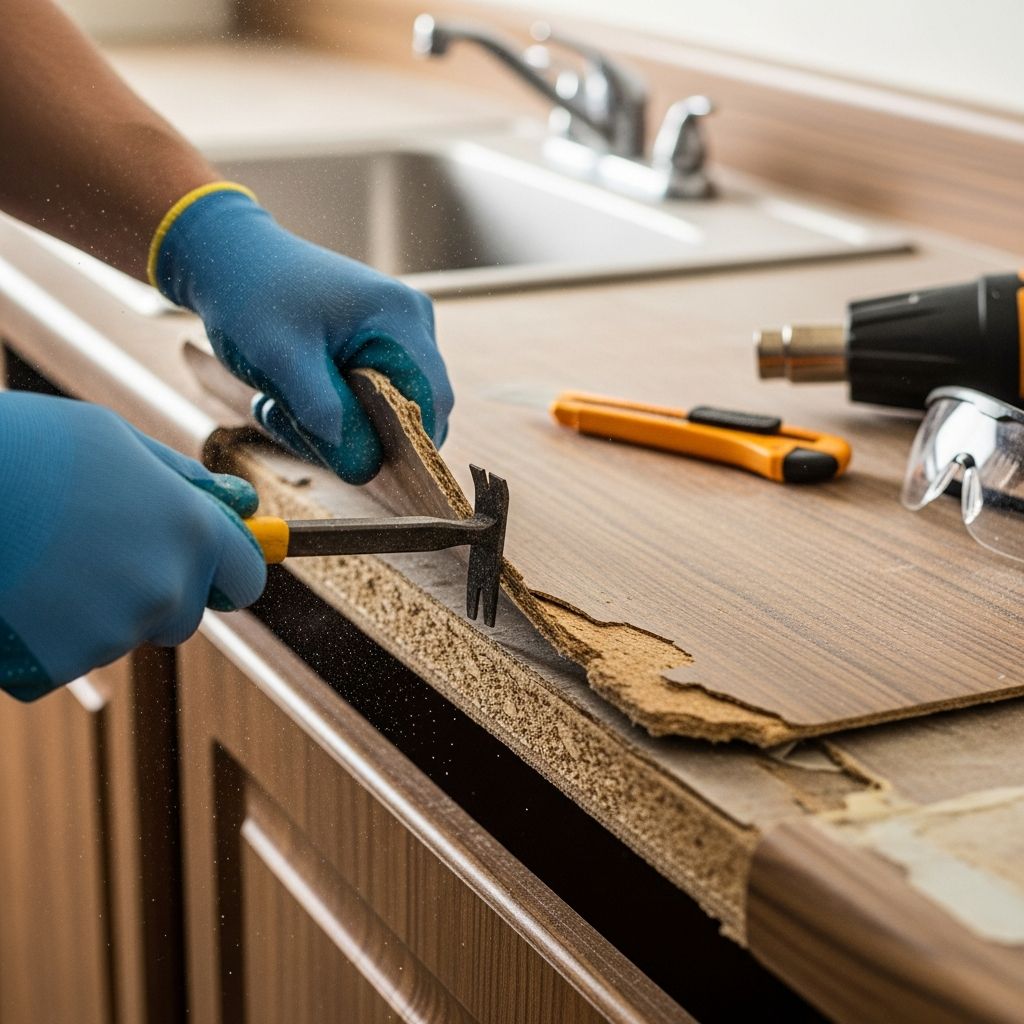
Insert a paint scraper or putty knife between the backsplash and wall, tapping gently with a hammer to drive it in. Work systematically from one end to the other. For stubborn spots over studs, leverage a pry bar for upward force. If heat-softened adhesive is present, use a heat gun briefly to loosen bonds without scorching surfaces. Remove backsplash pieces section by section to maintain control.
Freeing the Countertop from Cabinets
With backsplashes off, focus on countertop attachments. Shine a flashlight underneath to locate screws—common in laminate installs—typically along seams and at corners. Use a screwdriver or drill to remove them, bagging hardware separately.
Next, slice caulk or adhesive seams between countertop and cabinet tops using a utility knife. For glued surfaces, insert a stiff paint scraper and tap it in with a hammer, advancing inch by inch to break the bond. An oscillating multitool excels here, vibrating through adhesive without excessive force. Protect cabinet edges with wood shims or cloth wraps on pry bars.
If a particleboard build-up exists, check for top-mounted fasteners and remove them. Pry the build-up free carefully, bending any protruding nails flat to avoid injury.
Lifting and Removing Countertop Sections
Countertops weigh 50-100 pounds per section, so enlist help. Start at seams or free ends, lifting straight up to clear brackets. If stuck, revisit adhesive areas with the multitool. Work in sequence: islands first, then perimeter sections, sliding them onto sawhorses outdoors for cutting if recycling.
Inspect cabinet tops post-removal for debris, nails, or residue. Sand or scrape remaining adhesive smooth. Patch screw holes with wood filler for a level new install surface.
Handling Special Challenges
Not all jobs are straightforward. For fully glued laminates with no screws, rely on scrapers and pry bars exclusively. In tight corners, a reciprocating saw with a wood blade can cut sections precisely. Older homes may have lead paint under laminates—test and remediate professionally if suspected.
Overhangs or rounded edges require extra prying leverage. If cabinets are particleboard, brace them temporarily to prevent sagging during work.
Cleanup, Disposal, and Surface Prep
Break debris into manageable pieces for disposal. Check local regulations—many areas accept laminate at construction waste sites; recycling centers take clean scraps. Vacuum thoroughly, wiping cabinets with a degreaser.
For new countertop prep, ensure surfaces are flat and clean. Fill imperfections and seal edges against moisture.
Common Mistakes to Avoid
- Rushing caulk cuts, leading to wall damage.
- Ignoring helpers for heavy lifts, risking strains.
- Skipping power/water shutoffs, causing hazards.
- Neglecting labels on hardware, complicating reinstalls.
Cost and Time Estimates
| Aspect | Estimate |
|---|---|
| Time (standard kitchen) | 4-8 hours |
| Tool rental | $50-100 |
| Disposal fees | $100-300 |
Frequently Asked Questions (FAQs)
Can I remove laminate countertops without damaging cabinets?
Yes, with careful prying and adhesive breaking, cabinets remain intact in most cases.
Do I need to remove the entire sink?
For drop-in sinks, yes; undermounts may stay if new counter fits.
What if the countertop is glued down tightly?
Use an oscillating tool or repeated scraper taps; heat helps for some glues.
Is professional help necessary?
DIY is feasible for handy homeowners; hire for complex plumbing/electrical.
How do I dispose of old laminate?
Haul to landfills or recycle; avoid regular trash due to volume.
Next Steps After Removal
With surfaces prepped, explore quartz, granite, or butcher block options. Measure precisely, considering overhangs and sink cutouts. Professional templating ensures fit.
This project revitalizes kitchens affordably. Patience yields professional results—transform your space today!
References
- Steps for Removing Kitchen Countertops — Lowe’s. Accessed 2026. https://www.lowes.com/n/how-to/how-to-remove-a-kitchen-countertop
- How to Remove Laminate Countertops — Hammers Home Reno (YouTube). 2018-04-04. https://www.youtube.com/watch?v=5ORT9t0W7bE
- How to Remove Laminate Kitchen Countertops — HGTV (YouTube). Accessed 2026. https://www.youtube.com/watch?v=tFhsfheopjI
- Plastic Laminate Removal With a Heat Gun — YouTube. Accessed 2026. https://www.youtube.com/watch?v=9B292BRt_88
- How to remove glued on laminate countertop without damaging cabinet — Houzz Discussions. Accessed 2026. https://www.houzz.com/discussions/5887045/how-to-remove-glued-on-laminate-countertop-without-damaging-cabinet
Similar Articles


Read full bio of Sneha Tete