Lawn Mower Fuel Pump Repair: Step-By-Step DIY Guide
Master the art of diagnosing, repairing, and replacing your lawn mower's fuel pump to keep your yard perfectly manicured without costly service calls.
Repairing Lawn Mower Fuel Pumps: A Complete DIY Guide
Lawn mower fuel pumps are essential components that deliver fuel from the tank to the carburetor, ensuring smooth engine operation. When they fail, symptoms like hard starting, stalling, or no fuel flow disrupt your mowing routine. This guide provides detailed steps for identifying problems, performing repairs, and installing replacements, drawing on proven techniques for small engines.
Understanding Fuel Pump Functions and Types
Fuel pumps in lawn mowers operate primarily through vacuum pressure generated by the engine, pulsing fuel into the carburetor. Common types include diaphragm-style pumps mounted on the engine block, carburetor, or near the fuel tank. Round pumps, often non-repairable, require full replacement, while others can be disassembled for internal fixes.
- Diaphragm Pumps: Use a flexible membrane and springs to create suction.
- Mechanical Pumps: Driven directly by engine motion, less common in modern mowers.
- Locations: Typically on the carburetor, engine side, fuel tank proximity, or inline between tank and carburetor.
Regular maintenance prevents failures caused by ethanol-blended fuels that degrade diaphragms and gaskets over time.
Common Signs of Fuel Pump Failure
Recognizing issues early saves time and parts. Key indicators include:
| Symptom | Possible Cause | Quick Check |
|---|---|---|
| Engine cranks but won’t start | No fuel delivery | Observe fuel filter for pulsing |
| Stalls under load | Weak pumping | Listen for clicking during cranking |
| Fuel leaks around pump | Cracked body or hoses | Inspect for wetness or drips |
| Hard restarts when warm | Diaphragm wear | Test vacuum line integrity |
These signs often stem from cracked hoses, worn diaphragms, or clogged valves.
Essential Tools and Safety Precautions
Before starting, gather these tools:
- Needle-nose pliers for hose clamps
- 10mm socket or nut driver for bolts
- Torque wrench for reassembly
- All-purpose parts cleaner and rags
- Fuel line clamps or shut-off valve tool
- Gasket scraper and sanding sponge
- Replacement kit (diaphragm, gaskets, springs)
Safety First: Disconnect the spark plug wire to prevent accidental starts. Work in a well-ventilated area, away from flames. Clamp fuel lines to avoid spills, and wear gloves to handle gasoline.
Step-by-Step Diagnosis Process
Begin with a visual inspection. Locate the pump—often a small circular or rectangular unit with two hoses.
- Check Hoses: Look for cracks, softening, hardening, or leaks. Squeeze to test flexibility; replace if brittle.
- Inspect Pump Body: Search for hairline cracks, corrosion, or damage. Metal bodies can sometimes be salvaged; plastic ones usually need replacement.
- Test Fuel Flow: Remove the fuel line at the carburetor. Crank the engine (spark plug disconnected) and check for steady fuel spurts. No flow indicates pump failure.
- Vacuum Line Check: Ensure the line from the engine (valve cover or crankcase) is intact—no cracks or blockages.
- Filter Inspection: Clogged filters mimic pump issues; replace if dirty.
If flow is weak or absent, proceed to repair or replacement.
Disassembling the Fuel Pump
With safety measures in place:
- Turn off the fuel valve or clamp lines at the tank base.
- Loosen mounting screws (usually 2-4) and detach from bracket or carburetor.
- Use pliers to loosen hose clips and pull hoses off. Note inlet (from tank) and outlet (to carb) positions.
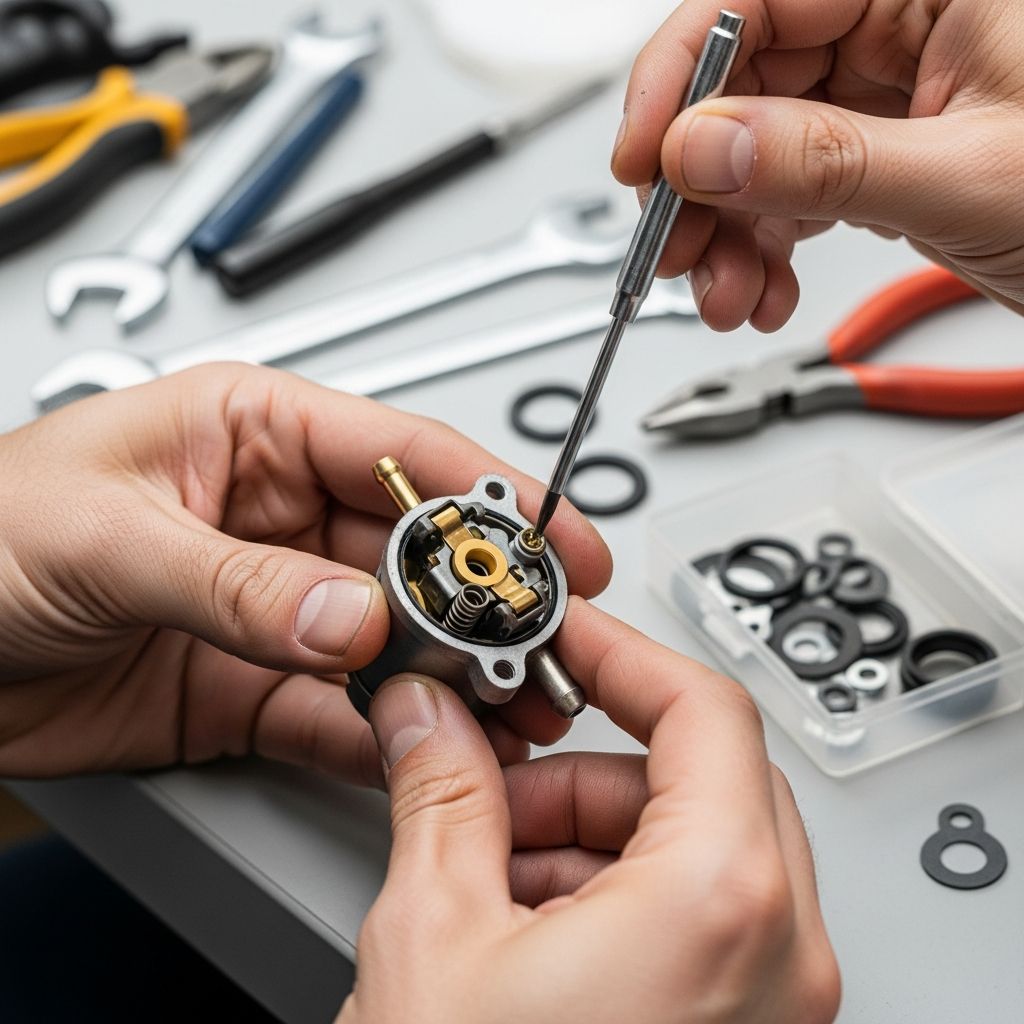
- Remove pump screws to separate the cover, diaphragm, and internals.
Soak metal parts in cleaner for 15 minutes max. Scrutinize for wear.
Repairing Internal Components
Most pumps are rebuildable with OEM kits.
- Discard old diaphragms, gaskets, springs, and valves—they rarely last beyond one rebuild.
- Clean mating surfaces with a scraper and sanding sponge for flat seals.
- Inspect check valves for sticking; replace if needed.
Reassembly: Insert valve spring, diaphragm (correct orientation), gasket, and cover. Torque screws evenly to spec (typically 2-3 ft-lbs; consult manual).
Full Fuel Pump Replacement Guide
For irreparable units like round pumps:
- Acquire a compatible replacement (e.g., Stens kit for Kohler engines includes fittings, seals, bolts).
- Prep new pump: Lubricate O-rings on fittings. Align inlet/outlet to match old setup.
- Mount to engine block or carb with new gasket/O-ring. Secure bolts finger-tight first.
- Reattach hoses, ensuring clamps are tight but not crushing.
- Reconnect vacuum line if separate.
For John Deere models, use 10mm tools and place rags under work area to catch drips.
Post-Repair Testing and Troubleshooting
Reconnect spark plug. Prime the system, then start the engine.
- Leak Check: Run at idle; inspect all connections for drips. Tighten as needed.
- Performance Test: Mow for 15-20 minutes; monitor for stalling.
- No Start? Verify fuel solenoid (if equipped) and compression.
If issues persist, check carburetor jets or ignition timing.
Preventive Maintenance Tips
Extend pump life:
- Drain fuel annually; use stabilizer.
- Replace hoses every 2-3 seasons.
- Store mower with full tank to prevent condensation.
- Inspect vacuum lines for rodent damage.
Ethanol-free fuel reduces diaphragm corrosion significantly.
Frequently Asked Questions (FAQs)
Can all lawn mower fuel pumps be repaired?
No, round plastic types must be replaced entirely. Diaphragm models often rebuild with kits.
How do I know if it’s the pump or carburetor?
Test fuel flow at carb inlet. No fuel points to pump; fuel but no start suggests carb issues.
What’s the cost of a replacement pump?
Kits range $15-40; full assemblies $30-80, depending on brand like Briggs or Kohler.
Do I need special tools for Kohler engines?
A circlip tool helps, but pliers suffice. Lubricate O-rings for easy fitting install.
Why does my mower run on starting fluid but not gas?
Classic fuel delivery problem—pump, lines, or filter culprit.
Advanced Tips for Specific Brands
Briggs & Stratton: Follow torque specs; always replace gaskets.
Kohler Command: Use aftermarket kits like Stens; clean gasket surfaces meticulously.
John Deere: Remove spark cap first; match hose nipple angles precisely.
Consult model-specific PDFs for diagrams.
References
- How to Fix a Fuel Pump in a Lawn Mower or Snow Blower — Briggs & Stratton. 2023. https://www.briggsandstratton.com/eu/en_gb/support/faqs/browse/lawn-mower-fuel-pump.html
- How to find, fix and install lawn mower fuel pump — Briggs & Stratton. 2023. https://www.briggsandstratton.com/na/en_us/support/faqs/browse/lawn-mower-fuel-pump.html
- How to REMOVE REPLACE FIX REPAIR a FUEL PUMP — YouTube (Jeff’s Little Mower Garage). 2022-10-15. https://www.youtube.com/watch?v=pXXY3u3Lk8o
- How to Install Fuel Pump on John Deere Riding Lawn Mower — YouTube (John Deere Parts). 2021-05-20. https://www.youtube.com/watch?v=acqPHf-u4FQ
- Lawnmower problem with Fuel pump — iFixit. 2016-08-12. https://www.ifixit.com/Answers/View/428565/Lawnmower+problem+with+Fuel+pump
Similar Articles








Read full bio of Sneha Tete