Replace AC Condenser Unit: Step-By-Step Guide For Homeowners
Master the step-by-step process to replace your central air conditioner condenser unit safely and effectively at home.
Replace AC Condenser Unit Guide
The outdoor condenser unit is a critical component of your central air conditioning system, responsible for releasing heat absorbed from inside your home. When it fails due to age, wear, or damage, replacing it restores cooling efficiency. This guide provides a thorough, original walkthrough for homeowners confident in DIY projects, emphasizing safety and proper techniques drawn from professional practices.
Understanding the AC Condenser Role
Your central AC system comprises an indoor evaporator coil, compressor, and the outdoor condenser. The condenser dissipates heat via coils and a fan, enabling the refrigerant cycle that cools your air. Common failure signs include inadequate cooling, strange noises, leaks, or high energy bills. Units typically last 10-15 years; beyond that, replacement often outperforms repair.
- Heat Rejection: Condenser coils transfer heat to ambient air.
- Fan Operation: Draws air over coils for efficient dissipation.
- Refrigerant Flow: High-pressure gas condenses into liquid here.
Assess If Replacement Is Needed
Before diving in, diagnose accurately. Inspect for bent fins, corrosion, or oil spots indicating refrigerant leaks. Test the capacitor with a multimeter and listen for compressor humming without startup. If the unit cycles excessively or blows warm air, it’s likely condenser-related. Professional diagnosis via manifold gauges confirms low refrigerant or electrical faults.
| Symptom | Possible Cause | Action |
|---|---|---|
| Warm air from vents | Failed compressor or low refrigerant | Check pressures; consider full replacement |
| Loud rattling | Loose components or debris | Clean first; replace if persistent |
| High bills | Inefficient heat exchange | Measure amp draw on fan/compressor |
| Leaks visible | Coil puncture or line damage | Immediate recovery and swap |
Gather Essential Tools and Materials
Preparation prevents mishaps. Stock up on specifics for a smooth process.
- Power Tools: Cordless drill, reciprocating saw for stubborn mounts.
- HVAC-Specific: Manifold gauge set, vacuum pump, micron gauge, core removal tool, nitrogen tank/regulator.
- Hand Tools: Adjustable wrenches, screwdrivers, torque wrench, flare tool for lines.
- Safety Gear: Gloves, safety glasses, insulated voltage tester.
- Materials: New condenser (matched tonnage/SEER), brazing torch, flux/silver solder, thread sealant.
Acquire a compatible unit; check existing model’s specs for BTU capacity and refrigerant type (R-410A or R-32).
Prioritize Safety Protocols
Electricity and refrigerant pose severe risks. First, locate the double-pole disconnect at the unit and flip it off. Verify with a non-contact voltage tester at multiple points. Shut off the indoor furnace/air handler breaker too. Refrigerant recovery requires EPA Section 608 certification for legal handling—DIYers must use a professional service or certified recovery machine to avoid fines and environmental harm.
Warning: Mishandling refrigerant releases greenhouse gases; improper power handling risks electrocution.
Recover Refrigerant Properly
Pump down the system first: Run AC in cool mode until outdoor temps drop, closing service valves to trap refrigerant indoors. Connect recovery machine to high/low sides, evacuate to 0 psig or per machine specs. Triple evacuate if reusing lines—pull vacuum to 500 microns, break with nitrogen, repeat thrice. This removes moisture/air, preventing compressor damage.
- Attach gauges: Blue to suction, red to liquid line.
- Recover to machine specs, monitoring for restrictions.
- Disconnect carefully, cap lines immediately.
Remove the Faulty Condenser
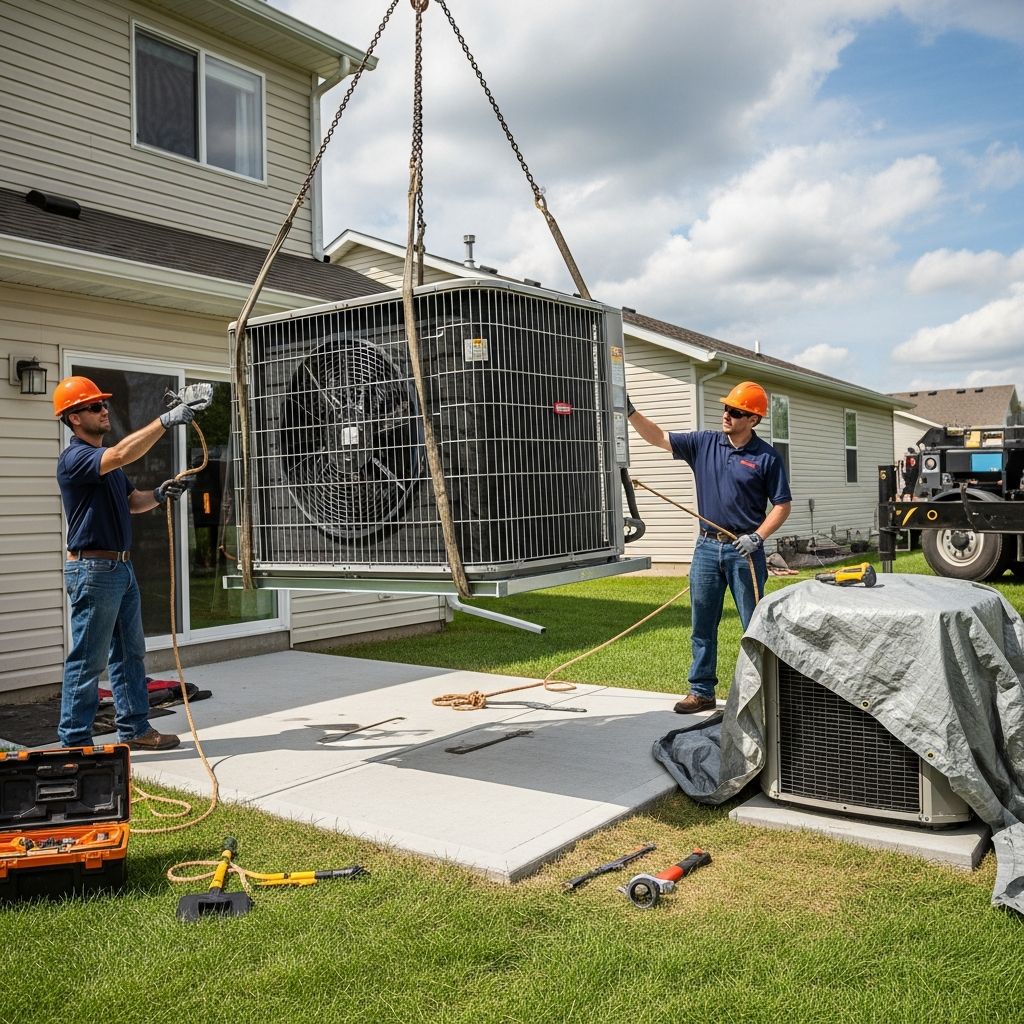
With power off and refrigerant recovered, dismantle systematically. Photograph wiring for reference. Unscrew fan shroud, lift off fan blade (note orientation). Disconnect copper lines using two wrenches to avoid twisting—cut if brazed. Unbolt base from pad, lift unit (often 100+ lbs—use help or dolly). Clean pad, ensure level concrete or gravel base.
Pro Tip: Straighten fins with a fin comb if salvageable for resale/scrap.
Prepare and Position New Unit
Unbox new condenser on a stable surface. Remove shipping brackets, protective caps. Place on pad, shim for perfect level (use 1/8″ variances max). Orient discharge air away from walls (24″ clearance). Secure bolts finger-tight initially.

Reconnect Refrigerant Lines
Braze new connections if needed: Flow nitrogen through lines during brazing to prevent oxidation. Use phos-copper or silver alloy rods, 15% silver min for strength. Post-braze, soap-test joints under nitrogen pressure for bubbles. Flare soft lines if pre-flared ends don’t match.
- Suction Line: Larger insulated copper.
- Liquid Line: Smaller, uninsulated.
- Torque per manufacturer specs (e.g., 25-30 ft-lbs).
Handle Electrical and Control Wiring
Match wires exactly using photos: Typically, black/hot, white/neutral, green/ground to contactor; capacitor wires by terminal (HERM, FAN, C). Install new contactor/capacitor if specs differ. Seal conduit entries with grommets. Run new thermostat wire if extended.
Evacuate and Charge the System
Reinstall Schrader cores with tool. Hook vacuum pump to both ports, pull to 500 microns (hold 15 mins—no rise). Break vacuum with refrigerant vapor, pull again. Charge by weight (scale) or superheat/subcooling method. For fixed orifice: superheat 8-12°F; TXV: subcool 10°F. Use wet bulb temp for charts.
Test Run and Diagnostics
Reconnect power, start unit. Monitor amps (fan ~1A, compressor 8-12A typical). Check pressures: 125-155 psig suction, 300-450 discharge (R-410A, 80°F ambient). Feel lines: Suction cool/insulated, liquid warm. Scan for temp drops across coils (15-20°F).
| Parameter | Target Range | Issue if Out |
|---|---|---|
| Suction Pressure | 125-155 psi | Low: Undercharge; High: Overcharge |
| Discharge Pressure | 300-450 psi | High: Dirty coils; Low: Weak compressor |
| Superheat | 8-12°F | Adjust charge accordingly |
Leak Detection and Final Checks
Pressurize with nitrogen (150 psi), apply bubble solution everywhere. Use electronic sniffer for precision. Monitor vacuum hold overnight if possible. Clean coils, reinstall fan/grille. Cycle test multiple times, check indoor airflow.
Common Pitfalls and Pro Tips
Avoid over-torquing flares (leaks ensue). Never skip nitrogen brazing—internal scaling kills compressors. Match line set lengths; long runs need access fittings. In humid areas, add crankcase heater. Annual maintenance extends life: Clean coils, level checks.
- Mistake: Ignoring pad level → Uneven oil return.
- Tip: Use app-based psychrometric charts for charging.
Cost Analysis and When to Call Pros
DIY saves $1,500-3,000 vs. pro install ($4k-7k total). Factor tools ($500+ investment). If uncertified for refrigerant, hire tech for recovery/charge ($300-600). Complex issues like ductwork warrant experts.
Frequently Asked Questions (FAQs)
Can I replace just the condenser without indoor unit?
Possible if matched SEER/tonnage, but efficiency drops. Best swap both for 16+ SEER.
How long does replacement take?
DIY: 8-12 hours over 2 days; pros: 4-6 hours.
Is R-410A replacement compatible with R-22?
No—requires full system retrofit; R-22 phased out.
What if vacuum doesn’t hold?
Leak—recheck joints, use bigger pump.
DIY warranty voided?
Some manufacturers require pro install; check docs.
References
- Energy Star Residential Air Conditioners Guide — U.S. Department of Energy. 2024-06-01. https://www.energystar.gov/products/heating_cooling/air_conditioning_central
- Refrigerant Recovery and Recycling Requirements — U.S. Environmental Protection Agency. 2023-09-15. https://www.epa.gov/section608/refrigerant-recovery-and-recycling-requirements
- AC System Evacuation Procedures — ACCA Technical Manual 6. 2022-11-20. https://www.acca.org/standards/technical-manuals
- Service Application Manual — Emerson Climate Technologies. 2021-05-10. https://climate.emerson.com/Documents/SAM.pdf
- HVAC Charging Methods — ASHRAE Handbook. 2024-01-15. https://www.ashrae.org/technical-resources/handbooks
Similar Articles








Read full bio of Sneha Tete