Replace Exterior Door Jamb: Step-By-Step Weekend DIY Guide
Master the art of replacing your exterior door jamb with this detailed DIY tutorial, ensuring durability, weatherproofing, and a professional finish for your home's entryway.
Replace Exterior Door Jamb: DIY Guide
Replacing an exterior door jamb revitalizes your home’s entryway, addressing issues like rot, warping, or poor fit that compromise security and energy efficiency. This project, achievable over a weekend, involves precise removal, measurement, and installation to ensure a weather-tight seal.
Why Your Exterior Door Jamb Needs Replacement
Exterior door jambs endure constant exposure to moisture, temperature swings, and physical wear. Over time, wood rots at the bottom from ground splash or poor drainage, leading to gaps that allow drafts, insects, and water intrusion. Warped jambs cause doors to stick or fail to latch securely, while outdated frames reduce insulation value. Early replacement prevents costly structural damage to surrounding walls and maintains curb appeal. Common triggers include visible cracks, soft spots when probed with a screwdriver, or difficulty operating the door smoothly.
Essential Tools and Materials for the Job
Gather these items before starting to avoid delays. Prioritize quality for safety and longevity.
- Removal tools: Pry bar, utility knife, reciprocating saw, chisel, hammer, putty knife.
- Measurement and fitting: Tape measure, level (4-foot), speed square, shims (cedar or composite).
- Cutting and shaping: Circular saw, hand saw, oscillating multi-tool, router (for hinge mortises).
- Fastening and sealing: Galvanized deck screws (2-3 inch), 16d casing nails, polyurethane caulk, weatherproof flashing tape, construction adhesive.
- Finishing: Sandpaper, exterior paint or stain, insulation foam (low-expansion).
- Safety gear: Gloves, safety goggles, dust mask, knee pads.
Opt for pressure-treated or PVC jambs for rot resistance in exterior applications.
Preparing the Workspace Safely
Clear the area around the door, protecting flooring with drop cloths. Disconnect power to nearby outlets if using power tools. Work on a dry day to aid caulking and painting. If the door is heavy, enlist a helper for removal. Test-fit the new jamb dry before permanent installation to confirm dimensions.
Step-by-Step Removal of the Old Jamb
Begin by supporting the door to prevent falls.
- Detach the door: Remove hinge pins with a chisel and hammer—tap from below until pins slide out. Have a partner hold the door while lifting it off. Lay it flat on a padded surface.
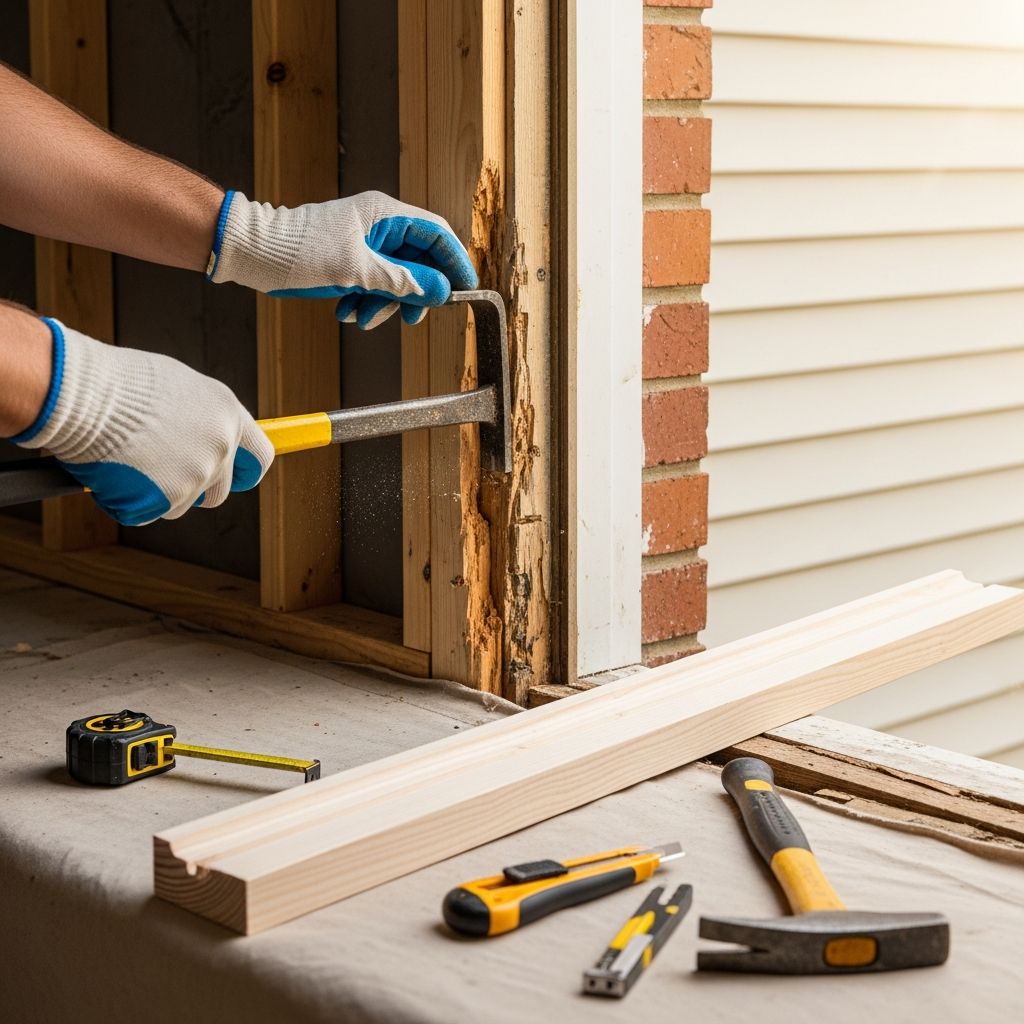
- Strip exterior trim: Score caulk lines with a utility knife to avoid siding damage. Pry off brick molding or casing using a putty knife for thin gaps, progressing to a pry bar. Work gently to salvage reusable pieces.
- Expose the jamb: Scrape loose paint, caulk, and debris with a putty knife and sandpaper. Inspect for rot, focusing on the sill and bottom edges.
- Cut and extract: Saw through the jamb vertically on the hinge side, about 1 inch from the wall, using a reciprocating saw to cut nails. Pry sections free starting from the top. For bottom rot, cut horizontally above damaged areas to isolate removal.
- Clear the rough opening: Pull remaining nails, remove old shims, and vacuum debris. Check framing for straightness with a level; sister weak studs with 2x4s if needed.
This phase typically takes 1-2 hours, revealing the rough opening for new installation.
Measuring and Customizing the New Jamb
Accuracy here ensures a plumb, square fit.
| Dimension | How to Measure | Tolerances |
|---|---|---|
| Width | Across rough opening at three points | 1/16 inch max variance |
| Height | From sill to header, both sides | Match tallest; shim shorter |
| Diagonal | Corner to corner | Equal within 1/8 inch |
| Depth | Wall thickness | Add extensions if needed |
Transfer hinge and strike plate locations to the new jamb using a router or chisel for mortises. For prehung units, verify squareness by measuring diagonals—adjust if over 1/8 inch out. Cut jamb legs to length with a miter saw, beveling sill ends at 45 degrees for drip edge.
Installing the New Jamb Securely
- Set the sill: Place treated lumber or PVC sill across the bottom, level it with shims under each end and center. Secure with deck screws into subfloor or rim joist.
- Apply flashing: Run self-adhesive tape over the sill-to-jamb joint and up wall sides for waterproofing.
- Position the frame: Insert jamb into opening, hinge side first. Use shims at hinge locations (top, middle, bottom) to plumb with a level. Check reveal (gap) uniformity—1/8 inch ideal.
- Secure temporarily: Drive 3-inch screws through shims into framing, avoiding over-tightening which bows the jamb. Test door swing; adjust shims as needed.
- Insulate gaps: Spray low-expansion foam into voids, trimming excess after curing. Avoid overfill to prevent pressure distortion.
Rehanging the Door and Finalizing Fit
Reinsert hinge pins loosely. Close the door to mark strike plate position. Shim the latch side for even gaps (1/8 inch top/bottom, 1/4 inch center for sweep clearance). Nail casing with 16d nails at 12-inch intervals, predrilling to prevent splitting. Apply caulk to all exterior seams, tooling smooth for a clean seal.
Weatherproofing and Finishing Touches
Install door sweep and weatherstripping for air sealing. Paint or stain exposed wood promptly, using primer on raw edges. Add thresholds or sweeps matching your door style. Inspect for level and operation—door should latch snugly without binding.
Common Pitfalls and Pro Tips
- Over-shimming: Causes bowing; use composite shims for compressibility.
- Moisture neglect: Always flash and caulk; extend kick-out diverters if under rooflines.
- Uneven framing: Plane high spots rather than forcing fit.
- DIY upgrade: PVC or composite jambs resist rot better than pine.
For sloped sites, raise sill height to prevent water pooling.
Frequently Asked Questions (FAQs)
Can I replace just the bottom jamb if only it’s rotted?
Yes, cut horizontally above rot and splice in a new bottom section, overlapping 6-8 inches with adhesive and screws.
How do I handle thick walls needing jamb extensions?
Glue and nail 2-inch extension kits to jamb legs, routing mortises accordingly.
What’s the best caulk for exterior use?
Polyurethane or silicone-based for flexibility and adhesion in wet conditions.
Do I need a building permit?
Check local codes; often not required for like-for-like replacements, but egress doors may need inspection.
How long does this project take?
4-8 hours for experienced DIYers; add time for drying and painting.
Troubleshooting Installation Issues
If the door binds on the latch side, remove shims and reposition. Sagging? Add mid-jamb screws. Drafts post-install? Revisit weatherstripping and foam fill. Regular maintenance like annual caulk checks extends life.
This comprehensive approach yields pro results, enhancing security and efficiency. With patience, even novices achieve lasting repairs.
References
- A Step-by-Step Guide to Replacing Your Exterior Door Jamb — Oreate AI Blog. 2023. https://www.oreateai.com/blog/a-stepbystep-guide-to-replacing-your-exterior-door-jamb/f2103bb1c13616057d10d932af76970f
- DIY Exterior Door Jamb Repair Using PVC Trim (Pro Results) — YouTube (Home Mender). 2022. https://www.youtube.com/watch?v=o1fO8yVFa3g
- Exterior Door Jamb Complete Build – Part 1 — YouTube (Mainely DIY Mom). 2022-11-15. https://www.youtube.com/watch?v=fY0YCrZMklI
- How to install an exterior door and jamb. Replace. Easy — YouTube (The Home Mender). 2023. https://www.youtube.com/watch?v=2iQBCsVXrL4
- How to Replace or Remove a Door Jamb — Aspire Doors Blog. 2023. https://www.aspire-doors.co.uk/blog/how-to-replace-a-door-jamb
- How to Install a New Door Jamb in an Old Doorway — Fine Homebuilding. 2023. https://www.finehomebuilding.com/project-guides/windows-doors/replace-an-old-entry-door
Similar Articles







Read full bio of medha deb