Replacing Bulbs in Pendant Lights: Complete Guide
Master the safe and simple process of swapping bulbs in pendant lights to refresh your home lighting effortlessly.
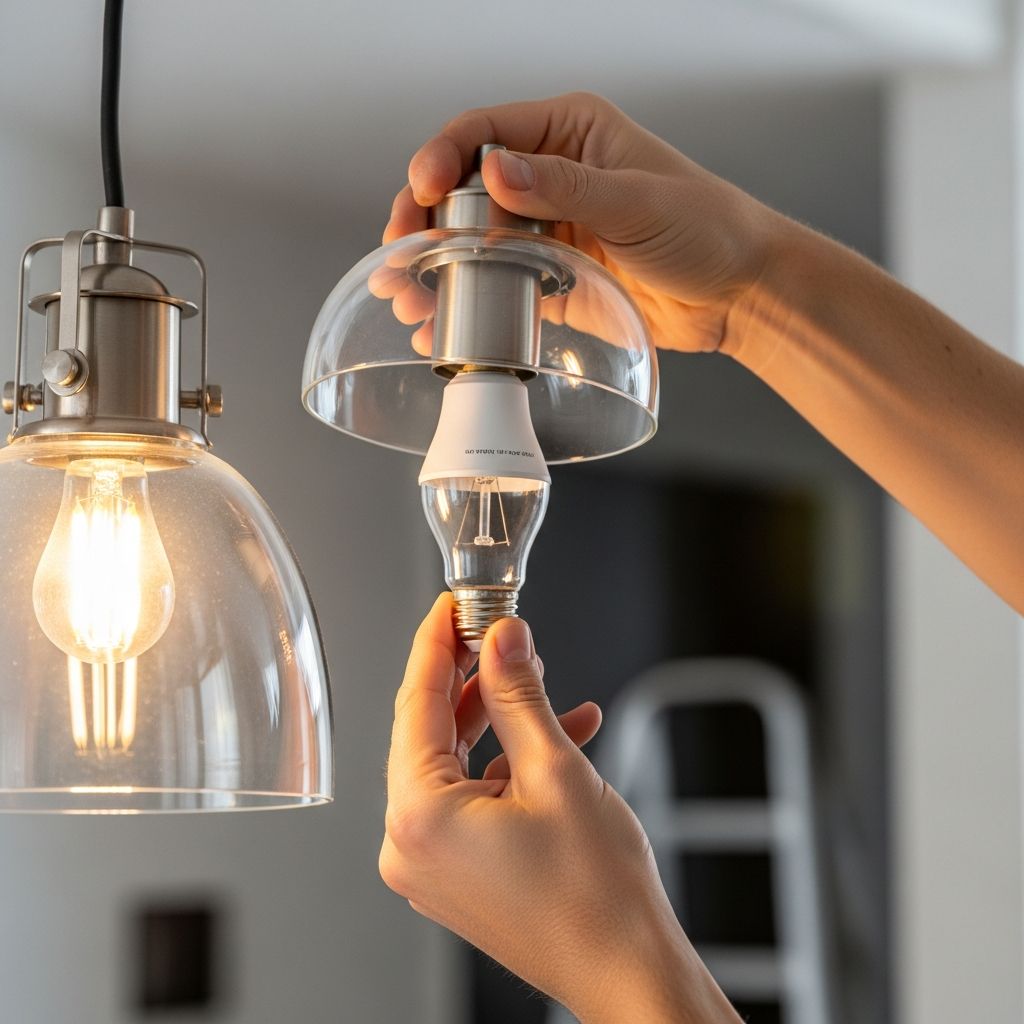
Pendant lights add elegance and focused illumination to kitchens, dining areas, and living spaces. Over time, bulbs burn out, dim, or fail, requiring replacement to maintain optimal lighting. This guide provides a thorough walkthrough for safely changing bulbs in pendant fixtures, covering preparation, execution, and post-replacement checks. Whether your pendant has an enclosed globe, open design, or adjustable height, these instructions ensure success without professional help.
Understanding Pendant Light Designs
Pendant lights vary widely in construction, affecting bulb access. Common types include single-bulb globes, multi-light clusters, and linear bars. Enclosed models feature glass shades or metal cages that protect the bulb but may require disassembly. Open-style pendants allow direct reach, ideal for quick swaps. Adjustable-height versions use rods or cords, sometimes needing shortening for bulb access. Recognizing your fixture’s design prevents damage during maintenance.
- Globe pendants: Bulb hidden inside frosted or clear glass; unscrew or unclip shade first.
- Open pendants: Exposed socket; reach in directly but watch for hot surfaces.
- Multi-bulb pendants: Repeat process for each socket; balance weight evenly.
- Track or rail pendants: Individual heads slide or pivot for easier access.
Before starting, consult the manufacturer’s manual for model-specific details. Most fixtures use standard E26 or E27 bases, but verify compatibility.
Essential Tools and Materials
Gather these items beforehand to streamline the process:
| Item | Purpose |
|---|---|
| Non-contact voltage tester | Confirms power is off |
| Stable step ladder | Safe elevated access |
| Gloves (cotton or rubber) | Protects hands from heat/glass |
| Replacement bulbs | Matching wattage, base, shape |
| Screwdriver set | Loosens set screws or nuts |
| Soft cloth | Cleans fixture without scratching |
Select bulbs based on fixture specs: LED for energy savings (up to 80% less energy than incandescent), halogen for brightness, or smart bulbs for dimming/app control. Avoid exceeding maximum wattage to prevent overheating.
Prioritizing Electrical Safety
Safety is paramount when working with lighting fixtures. Electricity poses risks of shock or fire. Begin by identifying the circuit breaker serving the light: turn it on, flip breakers until the pendant dims or extinguishes, then switch that breaker off. Confirm with a voltage tester near wires and sockets—no light or beep means safe.
Allow the fixture to cool if recently used; bulbs can reach 200°F (93°C). Wear gloves to avoid oils from skin contaminating new bulbs, shortening lifespan. Work with a partner for heavy or high fixtures. If unsure about wiring or persistent issues like flickering, consult a licensed electrician per National Electrical Code standards.
Step-by-Step Bulb Replacement Process
Follow these sequential steps for most pendants:
- Position ladder securely under the fixture, ensuring all legs are level.
- Access the bulb: For enclosed designs, support the shade with one hand while unscrewing counterclockwise with the other. Some use finials (decorative nuts) at the top—loosen gently to slide shades up rods.
- Remove old bulb: Grip the base, not glass, and turn counterclockwise. If stuck, wiggle gently; never force. Dispose responsibly—LEDs last 25,000 hours, reducing waste.
- Inspect socket: Check for corrosion, burns, or loose contacts. Clean with a dry cloth; replace if damaged.
- Install new bulb: Align base prongs or threads, turn clockwise until snug (hand-tight, about 1/4 turn past contact). Do not overtighten.
- Reassemble shade: Reverse removal—secure finial or clips firmly but not excessively.
For adjustable pendants, lower the fixture by loosening rod couplings or sliding along the cord. High ceilings may need a bulb changer pole with suction cup.
Handling Tricky Pendant Configurations
Not all pendants are straightforward. Vintage or decorative models might have:
- Caged or clustered designs: Pry open hinged doors or remove individual cages.
- Glass globes with internal sockets: Slide off secondary plates after loosening top nuts.
- Cord-hung fixtures: Tie temporary knots in excess cord to support weight during access.
If the pendant is too high or complex, consider temporary removal: disconnect wires (noting colors—black hot, white neutral, green/bare ground), lower, change bulb on a table, then reinstall. Always cap exposed wires with nuts if leaving overnight.
Selecting the Right Bulb for Your Pendant
Compatibility ensures performance and safety. Key factors:
| Specification | Details |
|---|---|
| Base type | E26 (US standard), E27 (international), GU10 (pin), etc. |
| Wattage max | Never exceed fixture rating (e.g., 60W incandescent = 9W LED equivalent) |
| Shape | A19 globe, G25 decorative, PAR spotlight |
| Color temperature | 2700K warm white for ambiance, 4000K cool for tasks |
| Dimmable | Match with compatible dimmer switch |
Energy Star-rated LEDs reduce costs; a 60W incandescent replacement uses 8-10W LED while emitting 800 lumens. For globes, choose frosted to diffuse light evenly.
Troubleshooting Common Problems
Issues arise post-replacement:
- No light: Verify power, check bulb in another socket, test switch.
- Flickering: Loose connections, incompatible dimmer, or faulty bulb—secure wires or swap.
- Overheating: Wrong wattage; downsize immediately.
- Bulb won’t unscrew: Use gloves for grip; apply penetrating oil if seized (power off).
Test after restoring power: flip breaker, toggle switch. If persistent, inspect for hidden faults like neutral wire issues.
Maintenance Tips for Longevity
Extend fixture life with regular care: dust shades monthly, inspect wiring annually, upgrade to LEDs for 90% heat reduction. Clean sockets with compressed air. For smart pendants, update firmware via app. Proper maintenance prevents 70% of electrical fires from faulty lighting.
Frequently Asked Questions
Can beginners replace pendant light bulbs?
Yes, with basic tools and safety adherence, it’s a straightforward DIY task taking 5-15 minutes.
Do I need to turn off the breaker every time?
Absolutely—voltage testers confirm, but breakers eliminate risk.
What if my pendant has a non-standard bulb?
Check fixture label or manual; specialty bases like candelabra (E12) require exact matches.
Is it safe to use higher wattage bulbs?
No—risks fire; always adhere to max rating printed on fixture.
How often should I replace pendant bulbs?
Incandescent: 1,000 hours; LED: 25,000+ hours; replace when dimming 30%.
Enhancing Your Space with Pendant Lighting
Beyond replacement, pendants offer design flexibility. Layer with recessed cans for ambiance, or cluster multiples over islands. Dimmable LEDs create moods—from bright task lighting (5000 lumens) to cozy glows. Upgrading fixtures? Match bulb types during install for seamless integration.
Regular bulb changes keep pendants performing, enhancing home aesthetics and efficiency. With these techniques, maintain brilliant illumination effortlessly.
References
- Replace A Pendant Light: Step By Step Guide — Indochina Light. 2023. https://indochinalight.com/blogs/lighting-guide/how-to-replace-a-pendant-light
- Pendant Light Fixture – Replacing the Light Bulb — Eichler Network. 2022. https://www.eichlernetwork.com/content/pendant-light-fixture-replacing-light-bulb
- A Complete Guide for Pendant Light Bulbs and Globes — Swift Beacon. 2024. https://swiftbeacon.com/blogs/pendant-lights/a-complete-guide-for-pendant-light-bulbs-and-globes
- How To Change A Lightbulb On A Pendant Light (IKEA) — YouTube (Transcript). 2021. https://www.youtube.com/watch?v=795eR71hL7M
- How to Replace a Pendant Light — YouTube (Transcript). 2020. https://www.youtube.com/watch?v=un87eee8HyA
- Light Bulb Buying Guide — Schoolhouse. 2023. https://schoolhouse.com/blogs/how-to/light-bulb-buying-guide
Similar Articles







Read full bio of medha deb