Restore Tufted Couch Buttons: Step-By-Step DIY Guide
Master the art of repairing loose or missing tufted buttons on your couch with this comprehensive DIY tutorial and expert tips.
Restore Tufted Couch Buttons: DIY Guide
Tufted upholstery adds elegance and depth to couches, but buttons can pop loose over time due to wear, pets, or heavy use. Repairing them yourself restores the look without expensive reupholstering. This guide provides detailed methods for various scenarios, ensuring your furniture looks new again.
Understanding Tufted Upholstery Basics
Tufting involves pulling fabric tight with buttons anchored by strong twine or cord through foam and fabric layers, creating a puckered, diamond-patterned effect. Common issues include buttons detaching from the front, twine breaking, or uneven tension. Identifying the problem—whether accessible cushion or fixed back—determines your approach.
- Removable cushions: Easiest for beginners; unzip and access backing directly.
- Fixed backs: Require partial disassembly but yield professional results.
- Leather vs. fabric: Leather needs careful piercing to avoid cracks.
Success relies on matching original tension for uniform puckers. Patience prevents fabric tears or misalignment.
Essential Tools and Materials for the Job
Gather these before starting to avoid interruptions. Most are inexpensive and reusable for future projects.
| Category | Item | Purpose |
|---|---|---|
| Tools | Long upholstery needle (12+ inches) | Threading twine through thick layers |
| Tools | Needle-nose pliers | Removing staples and gripping cords |
| Tools | Flathead screwdriver | Releasing fabric edges |
| Tools | Staple remover or nippers | Precise staple extraction |
| Materials | Upholstery twine (waxed, strong) | Anchoring buttons securely |
| Materials | Matching buttons (fabric-covered) | Seamless replacement |
| Materials | Electric staple gun | Re-securing fabric |
| Materials | Scissors or razor blade | Trimming excess twine |
Source matching fabric from hidden areas like undersides or welts for authenticity. Professional button makers charge minimally for covers.
Step-by-Step: Repairing Buttons on Removable Cushions
For back cushions that zip off, this method is straightforward and takes under 30 minutes per button.
- Unzip and flip cushion: Locate the button hole on the front; ensure access to the back panel.
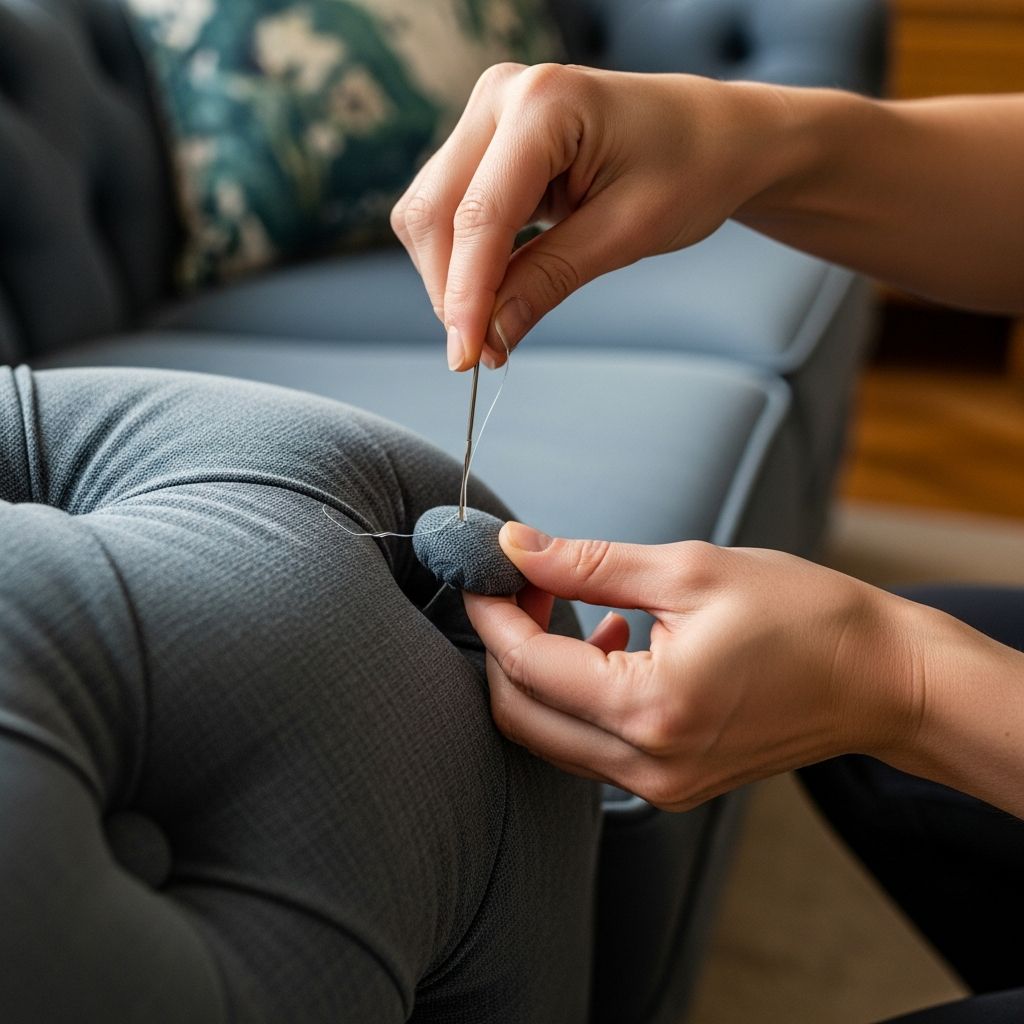
- Prepare twine and button: Double a 2-foot twine length, loop through button shank, and thread ends into needle eye.
- Pierce from front: Push needle through existing hole, aiming straight to back. Wiggle gently if foam resists.
- Attach backing button: On back, thread twine through second button’s hole (one way, then reverse for lock), pulling to match surrounding puckers.
- Secure with knots: Tie three figure-eight knots for strength; trim excess and tuck ends inside.
- Rezip and test: Tug gently to confirm tension holds.
This technique mimics factory methods, ensuring durability.
Advanced Repair: Fixed Back or Arm Tufting
Non-removable sections demand more disassembly but prevent full reupholstery costs.
- Access interior: Remove bottom tack strips or staples holding fabric to frame using pliers and screwdriver. Photograph layers for reassembly.
- Release fabric edges: Gently pry staples from rails; lift fabric to expose burlap webbing and old twine.
- Remove damaged button: Cut old twine close to button; pull free from front.
- Thread new setup: Attach button to fresh twine as before; push needle through hole from front, emerging at back.
- Anchorage variation: Staple twine ends to frame rail securely, doubling back for extra hold. Alternative: Knot around webbing roll for leverage.
- Reassemble layers: Replace burlap, padding, fabric; staple methodically, stretching evenly.
Stapling to rails provides reliable tension without slippage.
Troubleshooting Common Challenges
Even pros face snags; here’s how to overcome them.
- Misaligned holes: Use original puncture; enlarge slightly with needle if needed, but avoid widening.
- Stubborn foam: Apply soapy water to lubricate; push with steady pressure.
- Uneven puckering: Adjust by pulling one twine side more; match neighbors precisely.
- Leather tears: Preheat needle tip lightly; work slowly to prevent cracking.
- Weak knots: Practice figure-eight on scrap: left strand slips, right anchors.
For leather, extra caution preserves material integrity.
Preventive Maintenance for Long-Lasting Tufts
Extend repairs by protecting tufting daily.
- Vacuum gently weekly to remove debris catching twine.
- Use throw pillows over high-contact areas.
- Avoid sharp pet claws with covers or trims.
- Rotate cushions monthly for even wear.
- Inspect annually; re-tension loose buttons early.
These habits can double furniture lifespan, per upholstery experts.
Customizing with New Tufted Details
Beyond fixes, add buttons to plain cushions for style upgrades.
- Punch new holes symmetrically using template.
- Follow threading process, spacing 4-6 inches for diamonds.
- Secure identically for cohesive depth.
This restyling refreshes dated pieces affordably.
Safety and When to Call Pros
Work in ventilated areas; unplug tools post-use. Wear gloves to avoid pinches. If frame damage or extensive tears appear, consult upholsterers—costs average $50-200 per section vs. $1000+ for new couches.
Frequently Asked Questions (FAQs)
What if I can’t find matching fabric?
Harvest from chair undersides or welts; upholstery shops cover buttons cheaply using scraps.
How strong should twine be?
Use waxed upholstery twine (40-60 lb test) to withstand pulling forces.
Can this work on leather couches?
Yes, but pierce slowly; test tension lightly to avoid stress cracks.
How long does a repair last?
Properly done, 5-10 years; knots and staples ensure longevity.
What’s the cost of DIY vs. pro?
DIY: $5-20 in supplies; pro: $100+ per button, depending on access.
References
- How to Replace a Button on a Tufted Chair — Houzz. 2018-10-01. https://www.houzz.com/magazine/how-to-replace-a-button-on-a-tufted-chair-stsetivw-vs~10332408
- Repair Your Button Tufting at Home – BuildASofa Explainer Series — YouTube (BuildASofa). 2020-05-15. https://www.youtube.com/watch?v=T8arszmRL-c
- Repairing a Popped or Broken Button — YouTube. 2019-03-22. https://www.youtube.com/watch?v=1xkS9jNwKnc
Similar Articles




Read full bio of Sneha Tete