Solar Panel Shutdown: 7-Step Safe Emergency Guide
Master the essential steps to safely disconnect solar panels, protecting your home and family during emergencies or maintenance.
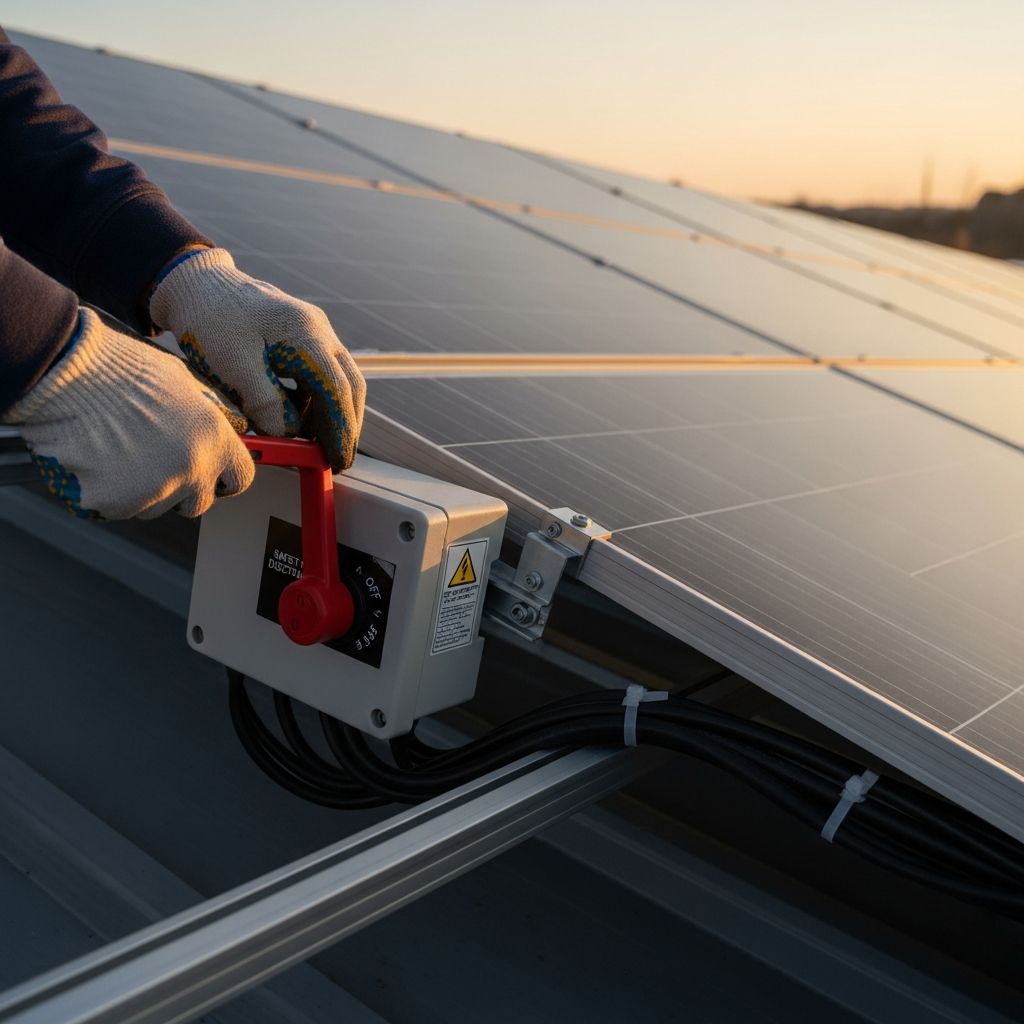
Safe Solar Panel Shutdown Guide
Solar energy systems power homes reliably, but knowing how to isolate them quickly is vital for safety during fires, storms, or repairs. This guide details the complete process, from preparation to verification, ensuring zero energy flow and compliance with electrical codes.
Understanding Solar System Power Flow
Solar panels generate direct current (DC) electricity when exposed to sunlight, even if the grid is down. This ‘islanded’ power can energize circuits, posing risks to firefighters or technicians. Inverters convert DC to alternating current (AC) for home use, while batteries store excess energy. Disconnecting requires interrupting both DC and AC paths in sequence to prevent arcs or shocks.
Key components include PV array disconnects, inverter switches, AC breakers, and battery isolators. Per NEC 690.64(B), inverters connect via dedicated breakers, simplifying identification.
Essential Safety Equipment and Precautions
Before touching any component, gear up properly. Insulated gloves (Class 0, rated 1000V), safety glasses, and rubber-soled shoes form the baseline. Remove jewelry to avoid conduction, and work at dusk or cover panels with opaque tarps to halt generation.
- Personal Protective Equipment (PPE): Insulated tools, arc-flash clothing for high-voltage arrays.
- Testing Tools: Multimeter for zero-voltage checks, non-contact voltage tester.
- Environmental Checks: No rain, wind, or fire nearby; evacuate if hazards present.
Follow Lockout/Tagout (LOTO): Notify others, shut down, isolate, lock, tag, and verify zero energy.
Step-by-Step Emergency Disconnection Process
In crises like fires or storms, prioritize rapid isolation. Assess danger first—if flames or sparks visible, call 911 and retreat.
- Secure the Area: Confirm no immediate threats. Don PPE.
- Block Sunlight: Drape heavy, dark covers over panels to stop DC production.
- DC Isolation: Locate PV disconnect near arrays or inverter. Flip to OFF; lock if possible.
- Inverter Shutdown: Turn off inverter DC input first, then AC output. For models like PV Powered, follow lever sequence.
- AC Breaker Off: At main panel, switch solar-dedicated breaker, then main if directed.
- Battery Disconnect (If Applicable): Positive terminal first, using insulated wrench. App-based for smart systems.
- Verify: Multimeter test all points for 0V DC/AC.
| Step | Component | Order | Verification |
|---|---|---|---|
| 1-2 | Panels | First | Tarp coverage |
| 3 | DC Switch | DC before AC | Switch OFF/locked |
| 4 | Inverter | DC then AC | No display lights |
| 5 | Main Panel | Last | Breakers tripped |
Systems with Batteries or Microinverters
Battery setups add complexity. Disconnect via dedicated switch or app (e.g., VictronConnect), positive lead first to avoid sparks. Microinverters (Enphase) require AC breaker off at panel; some have DC shutoffs.
For rapid shutdown systems (NEC 690.12), modules comply automatically, but manual overrides ensure full de-energization within 30 seconds.
Routine Maintenance Shutdown
For cleaning or inspections, follow emergency steps minus urgency. Wait 5-10 minutes post-shutdown for capacitors to discharge. Use non-load-break disconnects only under zero load to avoid arcs.
Panel removal: After disconnections, unbolt mounts while securing panels. Store flat, shaded. Reconnect reverse order: DC, AC, inverter, main breaker.
Common Mistakes and How to Avoid Them
- Skipping Verification: Always multimeter-check; ghost voltage persists.
- Wrong Sequence: DC before AC prevents inverter damage.
- Ignoring Codes: Ensure NEMA 3R enclosures, labeled switches per CSA Z462.
- Solo Work: Have a spotter; notify utility.
Post-Disconnect Inspection and Reconnection
Never restart yourself post-emergency—call certified installers for arc, corrosion checks. For routine: Monitor inverter display for normal output. If faults, reset breakers after 5 minutes.
Utility coordination prevents backfeed; some require meter pulls.
Frequently Asked Questions
Can I disconnect solar panels alone?
Yes, for trained owners following LOTO, but hire pros for complex systems or post-damage.
What if no disconnect switch exists?
Older installs may lack them—cover panels, trip breakers, call electrician immediately.
How long can panels stay disconnected?
Short-term fine; prolonged risks degradation—reconnect promptly.
Do solar panels produce power at night?
No, but residual charge lingers—wait and test.
Is professional help always needed to restart?
Post-emergency yes; routine no, if steps followed.
Optimizing Your System for Safe Access
Install lockable, labeled disconnects at accessible heights. Single-point grounding avoids faults. Train household on locations. Annual pro audits ensure code compliance.
By 2026, smart apps enable remote shutdowns, but manual overrides remain essential.
References
- Residential Solar Energy System Disconnection Tips — MAG Solar. 2023. https://magsolar.ca/how-to-manually-disconnect-your-residential-solar-energy-system-in-an-emergency/
- Solar Panel Disconnect (The Safe & Proper Way) — Shop Solar Kits. 2024. https://shopsolarkits.com/blogs/learning-center/solar-panel-disconnect
- How should I disconnect my solar panels? — Sun Powered Yachts. 2023. https://www.sunpoweredyachts.com/single-post/how-should-i-disconnect-my-solar-panels
- How To Safely Turn Off Your Solar Panels — Solar Insure. 2024. https://www.solarinsure.com/how-to-safely-turn-off-your-solar-panels
- PV System Disconnect Manual — Solar Direct (PV Powered). 2022. http://shop.solardirect.com/pdf/solar-electric/inverters/pvp_disconnect_manual.pdf
- Solar Disconnect Switch Guide — Solar Tech Online. 2025-01-01. https://solartechonline.com/blog/solar-disconnect-switch-guide/
- How to safely open non-load break rated disconnects in PV systems — Fluke Corporation. 2024. https://www.fluke.com/en-us/learn/blog/renewable-energy/non-load-break-disconnect
Similar Articles








Read full bio of Sneha Tete