Sizing Septic Drain Fields: Complete Guide
Master the essentials of calculating septic drain field sizes for efficient wastewater management and regulatory compliance.
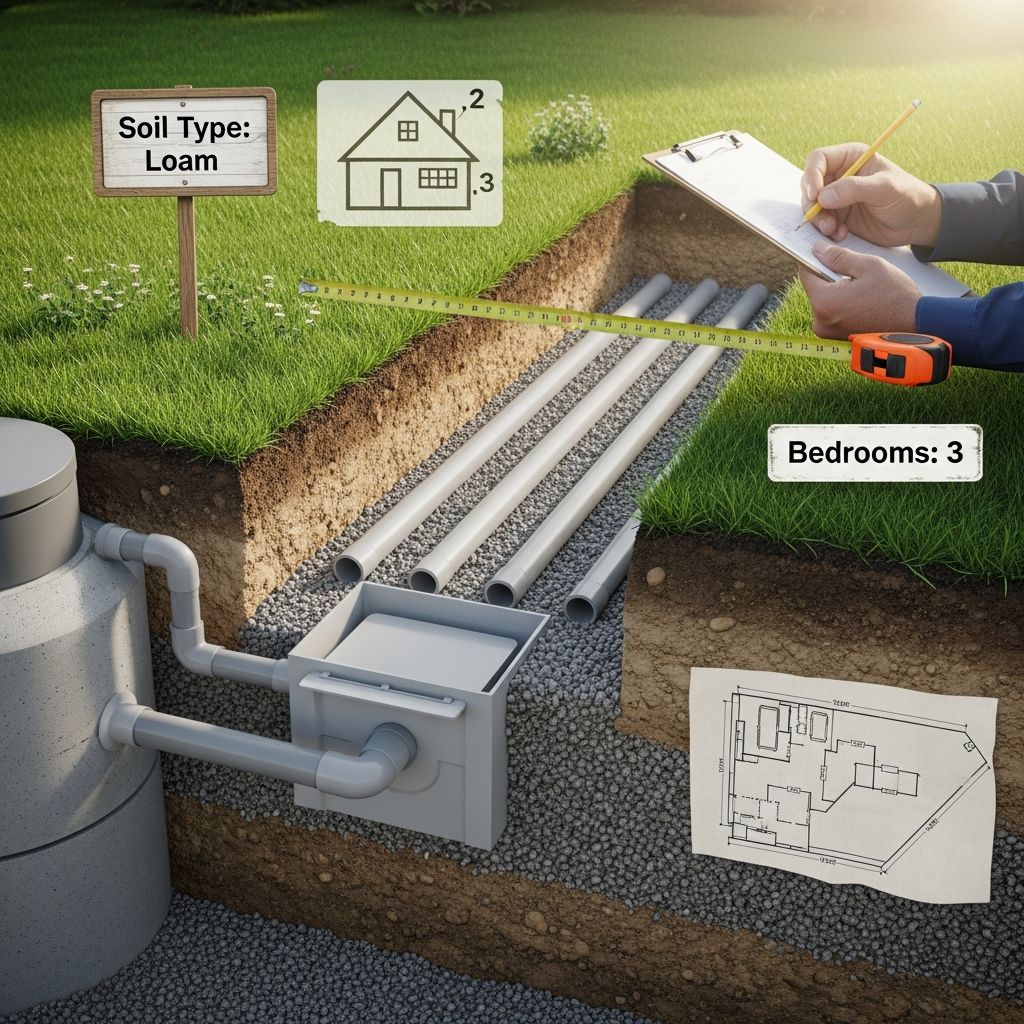
Properly sized septic drain fields, also known as leach fields, are critical for effective onsite wastewater treatment. These systems distribute effluent from the septic tank into the soil for natural filtration and dispersal, preventing backups, groundwater contamination, and system failure. Incorrect sizing leads to costly repairs or environmental hazards, making accurate calculations essential for new installations, expansions, or replacements.
Fundamentals of Septic System Components
A typical septic system consists of a septic tank and a drain field. The tank settles solids, allowing liquid effluent to flow to the drain field. Here, the soil’s natural processes further treat the wastewater through microbial activity and absorption. Drain fields use trenches, beds, or chambers filled with gravel or synthetic materials to maximize contact with soil.
Key factors influencing overall system performance include household wastewater volume, soil permeability, and site topography. Understanding these ensures the drain field can handle daily loads without saturation.
Assessing Daily Wastewater Flow
Start sizing by estimating daily design flow (DDF), the anticipated wastewater volume. This is based on household occupancy, often tied to bedroom count as a proxy for residents. For residential systems, standards recommend 150 gallons per bedroom per day in many U.S. regions.
For a three-bedroom home, assume 450 gallons daily (1,700 liters). Adjust for actual usage: high-water fixtures like hot tubs increase flow, while low-flow appliances reduce it. Commercial or multi-family sites use fixture unit counts or measured data.
- Bedrooms: 1-2: 300 gal/day; 3: 450 gal/day; 4+: add 100 gal/bedroom.
- Occupancy: 50-75 gal/person/day for conservative estimates.
- Adjustments: +20% for garbage disposals; -20% for low-water fixtures.
Role of Soil Percolation Testing
Soil percolation (perc) tests measure absorption rates, dictating drain field dimensions. Conduct tests at proposed field depth (18-36 inches) by digging holes, filling with water, and timing drainage.
Rates are expressed in minutes per inch (min/inch). Fast-draining sands (under 5 min/inch) need smaller fields; slow clays (over 50 min/inch) require larger ones to avoid ponding. Local health departments oversee testing to ensure compliance.
| Soil Texture | Typical Perc Rate (min/inch) | Hydraulic Loading Rate (gal/sq ft/day) |
|---|---|---|
| Coarse Sand/Gravel | 1-5 | 0.8-1.2 |
| Sandy Loam | 5-15 | 0.5-0.8 |
| Loam | 15-30 | 0.3-0.5 |
| Clay Loam | 30-50 | 0.2-0.3 |
| Clay | >50 | <0.2 (may need advanced treatment) |
This table illustrates how perc rates translate to loading rates, the gallons per square foot soil can handle daily.
Calculating Required Drain Field Area
Drain field size = DDF ÷ Soil Loading Rate (SLR). For a 450 gal/day home with sandy loam (SLR 0.6 gal/sq ft/day): 450 ÷ 0.6 = 750 sq ft.
Focus on basal (bottom) area for trenches, excluding sidewalls in most designs. Example from Canadian standards: 1,300 L/day (343 gal) on loamy sand (HLR 30 L/m²/day, ~0.62 gal/sq ft): 1,300 ÷ 30 = 43.3 m² (466 sq ft).
For trenches (width 2-3 ft), total length = Area ÷ Width. Using 2 ft wide: 466 ÷ 2 = 233 ft, split into multiple laterals.
Drain Field Layout and Configurations
Common designs include trench, bed, and chamber systems. Trenches are narrow excavations (12-36 inches wide, up to 100 ft long) spaced 6 ft apart. Beds cover larger flat areas.
- Gravity Systems: Simple, sloped distribution; limit to 500-1,000 sq ft without dosing.
- Pressure Distribution: Pumps ensure even flow; ideal for poor soils or slopes.
- Chamber Systems: Plastic units replace gravel; effective width equals chamber bottom dimension.
Spacing prevents hydraulic interference; minimum 6 ft center-to-center. Shallow ‘at-grade’ fields suit high water tables.
Septic Tank Sizing Guidelines
Tanks must precede the drain field, sized for 2-3 days retention: minimum 1,000 gal for 3 bedrooms. Pump tanks need working volume = 1 day DDF + 15-50% reserve.
| Bedrooms | Min Tank Size (gal) | Daily Flow Est. (gal) |
|---|---|---|
| 1-2 | 850-1,000 | 300 |
| 3 | 1,000-1,200 | 450 |
| 4 | 1,200-1,500 | 600 |
| 5+ | 1,500+ | 750+ |
Navigating Local Regulations and Permits
Health departments set minimum sizes, often overriding calculations. Nebraska requires 750 sq ft for 3-bedroom homes at 25 min/inch perc. Arizona uses GPD ÷ SAR for disposal area. Always submit perc tests and designs for approval.
Consider setbacks: 10-50 ft from wells, property lines, water bodies. Future expansions reserve 20-50% extra capacity.
Advanced Sizing for Challenging Sites
High water tables, steep slopes, or poor soils demand alternatives: mound systems, sand filters, or aerobic treatments reduce field size by improving effluent quality. Pressurized systems suit >1,000 sq ft fields.
Serial distribution sequences loading; avoid on slopes >15% without dosing.
Maintenance Impacts on Sizing and Longevity
Oversizing by 20-50% extends life. Regular pumping (every 3-5 years) prevents biomat clogging, which halves effective area over time.
Review as-built plans for existing fields; they’re the most accurate size record.
Frequently Asked Questions (FAQs)
What is a percolation test and why is it needed?
A perc test digs holes to measure soil drainage time, essential for sizing drain fields to match absorption capacity and avoid failures.
How many square feet for a 3-bedroom house drain field?
Typically 300-900 sq ft, depending on soil perc (e.g., 750 sq ft at 25 min/inch).
Can I expand my drain field later?
Yes, but design initial system with reserve area; check regulations for expansions.
What if soil perc is too slow?
Use advanced treatments or alternative systems like mounds to reduce required field size.
How often should I inspect my septic system?
Annually for tanks, post-rain for fields; pump every 3-5 years based on use.
Conclusion
Accurate drain field sizing balances flow, soil capability, and regulations for decades of reliable service. Consult professionals for site-specific designs.
References
- Sizing A Septic System | Tank And Drain Field Factors — Ground Stone. 2024-01. https://groundstone.ca/2024/01/septic-system-sizing/
- Determining the Appropriate Septic System Size: Ultimate Guide — Septic 911. Accessed 2026. https://septic911.com/determining-the-appropriate-septic-system-size/
- Drainfield Size & Design — University of Nebraska-Lincoln Water. Accessed 2026. https://water.unl.edu/article/wastewater/drainfield-size-design/
- How To Calculate Septic Tank Drain Field Size — YouTube/Septic Tank UK. Accessed 2026. https://www.youtube.com/watch?v=xaYKP7UOWEg
- Residential Sizing Charts for Trench, Chamber, or Pit Disposal — Maricopa County, AZ. Accessed 2026. https://www.maricopa.gov/DocumentCenter/View/7461/Residential-Sizing-Charts-for-Trench-Chamber-or-Pit-Disposal-PDF
- Understanding Drain Field Sizes — ACE Septic and Waste. Accessed 2026. https://www.acesepticandwaste.com/blog/understanding-drain-field-sizes/
Similar Articles








Read full bio of Sneha Tete