Smoothing Ceramic Tile Edges After Cutting
Master professional techniques to refine rough cut edges on ceramic tiles for flawless installations and durable results in any DIY project.
Ceramic tiles often develop rough, jagged edges after cutting, which can pose safety risks and compromise the visual appeal of installations. Proper edge refinement transforms these imperfections into smooth, professional finishes that enhance durability and ease handling. This guide explores diverse techniques ranging from simple manual methods to powered solutions and decorative trims, enabling DIY enthusiasts to achieve factory-like quality.
Why Edge Finishing Matters in Tile Projects
Raw cut edges on ceramic tiles result from the shearing action of tile cutters or wet saws, leaving micro-chips and uneven surfaces. These irregularities not only snag fingers during handling but also increase breakage risk by up to 35% in production settings, a principle that applies to home projects as well. Smoothing edges improves safety, reduces grout line weaknesses, and ensures tiles align seamlessly during installation.
Dimensionally accurate edges, typically within ±0.1mm tolerance for high-quality work, promote consistent spacing and prevent lippage. Professionally finished edges can cut installation time by 20%, making projects more efficient. Beyond functionality, refined edges elevate aesthetics, matching the polished face of tiles for a cohesive look in kitchens, bathrooms, and floors.
Essential Tools for Tile Edge Refinement
Selecting the right tools depends on project scale and desired finish. Basic kits suit small jobs, while powered options accelerate larger undertakings.
- Rubbing or sanding stones: Coarse and fine grits for manual smoothing; ideal for quick fixes on single tiles.
- Angle grinders with diamond pads: Versatile for aggressive material removal and polishing; use wet for dust control.
- Tile edge polishers: Specialized rotary tools for precise, mirror-like finishes on porcelain and ceramic.
- Wet tile saws: For initial straight cuts; follow with edge work to minimize roughness.
- Safety gear: Gloves, goggles, respirators, and ear protection to guard against silica dust and flying debris.
Invest in diamond-impregnated accessories, as they last 10-15 times longer than standard abrasives, delivering uniform results with less effort.
Manual Smoothing Techniques for Beginners
Handheld methods offer control and portability, perfect for spot treatments or delicate tiles.
Using Rubbing Stones Effectively
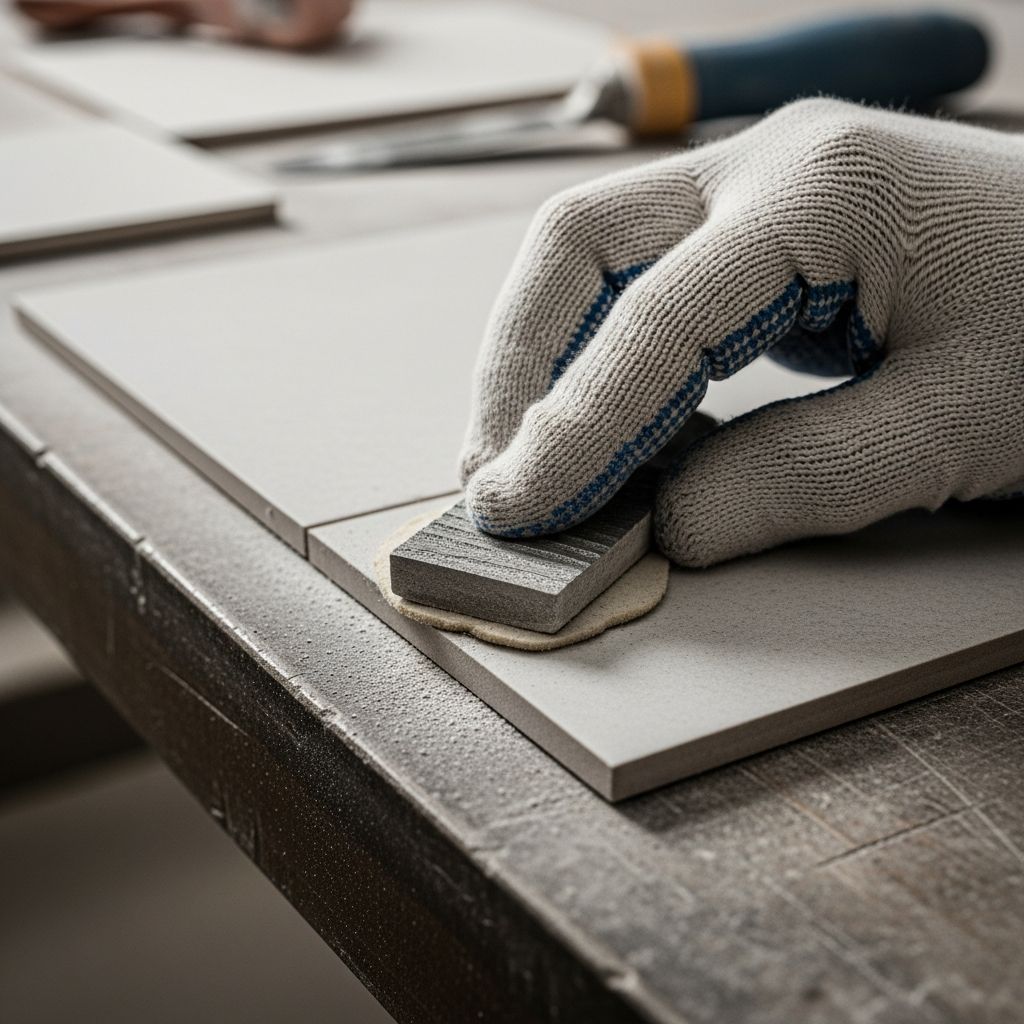
Rubbing stones, available in dual-grit designs (e.g., coarse blue for stock removal, fine side for polishing), provide a straightforward solution. Hold the tile securely and rub the stone along the edge at a 45-degree angle, applying light pressure in circular motions. Progress from coarse to fine grit, wetting the stone periodically to clear debris and reduce friction.
This technique removes jagged peaks within minutes, yielding smooth edges suitable for most installations. For best results, work in sections of 6-12 inches, checking progress frequently to avoid over-grinding.
File and Sandpaper Alternatives
Diamond files mimic stone action with greater precision for intricate shapes. Wrap medium-grit (120-220) wet/dry sandpaper around a wooden block for flat edges, progressing to 400-800 grit for gloss. These low-cost options excel on thin tiles where power tools risk chipping.
Power Tool Methods for Professional Results
Powered tools expedite processing, ideal for multiple tiles or high-volume projects.
Angle Grinder with Progressive Diamond Pads
Equip an angle grinder (4-5 inch) with a sequence of diamond polishing pads: start with 50-100 grit for smoothing, advance through 200, 400, to 3000 grit for shine. Operate at low RPM (1500-3000) with constant water flow to cool the tile and bind dust.
| Grit Level | Purpose | Speed (RPM) | Passes Needed |
|———–|——–|————-|—————|
| 50-100 | Rough smoothing | 2000-3000 | 2-3 |
| 200-400 | Intermediate refinement | 1500-2500 | 1-2 |
| 800-1500 | Pre-polish | 1000-2000 | 1 |
| 3000+ | High gloss | 800-1500 | 2-4 |
Maintain a light touch and even motion to prevent gouging or heat cracks. This method achieves surfaces reflecting light, rivaling factory edges.
Dedicated Tile Edge Polishers
These compact rotary devices feature adjustable guards and water feeds, simplifying edge work. They excel on curved or contoured profiles, delivering consistent torque without the grinder’s bulk.
Advanced Finishing Profiles and Applications
Beyond flat smoothing, create functional and decorative edges.
Chamfering and Beveling for Durability
Chamfer edges at 15-45 degrees using specialized diamond wheels to eliminate stress concentrations, reducing handling breakage. A 30-degree chamfer suits floors, while 45-degree bevels add elegance to walls. Precision grinding maintains ±0.1-0.2mm tolerances.
Rounding and Bullnose Effects
Round edges mimic bullnose tiles, using progressive polishing for radii up to 2mm. This profile prevents chipping in high-traffic areas and softens visual transitions.
| Profile Type | Best Use Case | Tolerance | Tool Recommendation |
|————–|—————|———–|——————–|
| Square Sharp | Walls | ±0.05mm | Fine grinder |
| Micro-Bevel | Floors | ±0.1mm | Bevel wheel |
| Rounded | Decorative | ±0.15mm | Polishing pads |
| Chamfered | Heavy Duty | ±0.2mm | Chamfer tool |
Non-Abrasive Finishing Solutions
When mechanical smoothing isn’t feasible, alternative coverings provide quick fixes.
Caulking for Seamless Edges
Apply color-matched caulk along raw edges post-grouting for mosaics or tumbled stone. This creates watertight seals, hiding imperfections economically. Use a caulking gun with steady pressure, smoothing with a wet finger for a grout-like finish.
Trim and Profile Installations
Metal Schluter strips, plastic edges, or pencil rounds cap exposed edges professionally. Cut to length with a hacksaw, adhere with thinset, and grout over for integration. Cove base trims suit wall transitions, applied with dedicated adhesives.
- Measure precisely before cutting.
- Pre-apply adhesive to backs.
- Press firmly and level with a roller.
Safety Protocols and Best Practices
Dust from ceramic contains crystalline silica, harmful when inhaled. Use wet methods exclusively, employ respirators, and ventilate workspaces. Secure tiles in vises to prevent slips, and inspect tools for damage pre-use.
Optimize parameters: feed rates of 2-5m/min, coolant flows, and monitored RPM ensure quality without waste. Test on scrap tiles to dial in techniques.
Troubleshooting Common Edge Issues
Over-grinding causes rounded profiles; remedy with finer grits. Uneven polish stems from inconsistent pressure—practice steady motions. For porcelain’s hardness, extend dwell times on coarse stages.
FAQs
What is the fastest way to smooth a single cut tile edge?
Use a rubbing stone: rub along the edge with medium pressure for 1-2 minutes per side.
Can I polish porcelain tile edges to match the face?
Yes, progressive diamond pads from 50 to 3000 grit achieve glossy, reflective finishes.
Is caulking a permanent edge solution?
It provides a clean, waterproof seal but may need reapplication every 5-10 years.
What angle grinder settings work best for tiles?
Low speeds (1000-3000 RPM) with water; variable speed models prevent burning.
How do I avoid chipping during edge work?
Start with coarse grits gently and maintain wet conditions to reduce stress.
References
- 7 Essential Techniques for Ceramic Tile Edge Finishing — Basair Tools. 2023-2024. https://basair-tools.com/7-essential-techniques-for-ceramic-tile-edge-finishing/
- Polish Porcelain Tile Cut Edge: How to Get a High-End, Smooth Finish — TileHub. 2023-2024. https://tilehub.com/blogs/tilehub/polish-porcelain-tile-cut-edge
- How To Smooth Out Rough Edges Of A Cut Tile — YouTube (Helpful DIY). 2015-04-24. https://www.youtube.com/watch?v=8C983ulf1t4
- 4 Easy Ways To Finish Tile Edges Like A Pro — MSI Surfaces. 2025-04-29. https://www.msisurfaces.com/blogs/post/2025/04/29/4-easy-ways-to-finish-tile-edges.aspx
- How to Finish Tile Edges: 8 Different Techniques — Mercury Mosaics. 2023-2024. https://mercurymosaics.com/blogs/news/how-to-finish-tile-edges
Similar Articles



Read full bio of Sneha Tete