Solar-Powered Swamp Cooler Complete DIY Guide
Harness the sun to power your evaporative cooler for eco-friendly, off-grid cooling in hot climates.
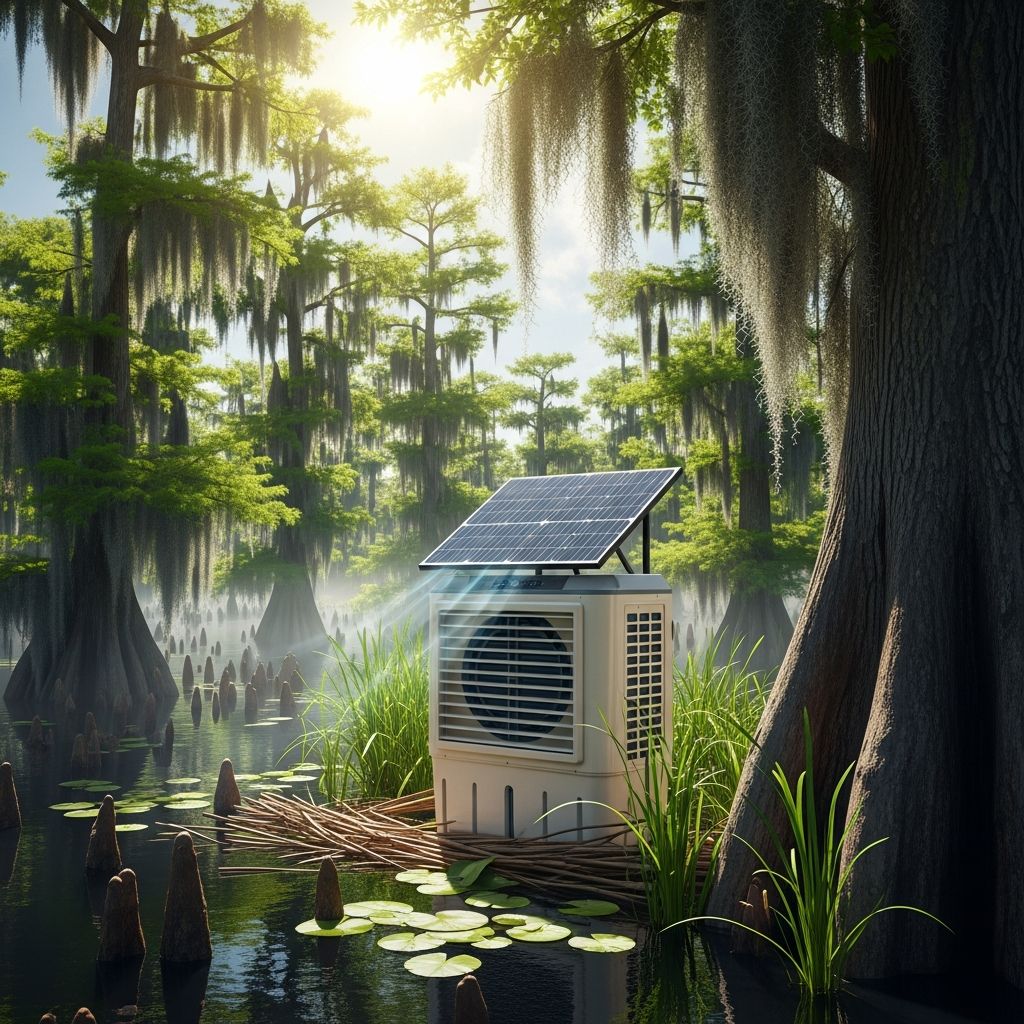
Solar-Powered Swamp Cooler Guide
Evaporative coolers, commonly known as swamp coolers, offer an energy-efficient way to beat the heat in arid regions by using water evaporation to lower air temperature. Transitioning these units to solar power eliminates reliance on grid electricity, cuts operational costs, and promotes environmental sustainability. This guide provides a detailed roadmap for DIY enthusiasts to retrofit their swamp cooler, covering everything from initial assessments to long-term upkeep.
Understanding Evaporative Cooling and Solar Integration
Swamp coolers work by drawing hot outdoor air through water-saturated pads, where evaporation absorbs heat and produces cooler, humidified air. Unlike refrigerant-based air conditioners, they consume far less electricity—typically 100-400 watts—making them prime candidates for solar conversion. Solar power systems capture sunlight via photovoltaic (PV) panels, converting it to usable electricity either directly or through storage in batteries.
The primary benefits include zero fuel costs after installation, silent operation without fossil fuels, and independence during power outages. In sunny locales like the southwestern U.S., a well-designed system can provide cooling for 6-8 hours daily during peak summer. However, success depends on local climate: these systems excel in low-humidity areas (below 30% relative humidity) where evaporation is most effective.
Assessing Your Current Swamp Cooler Setup
Begin by evaluating your existing unit. Locate the manufacturer’s label, usually on the side or back, noting amperage (amps), voltage (typically 115V AC for standard models), and wattage if listed. For example, a 1.5-amp unit at 115 volts requires about 173 watts (calculated as amps × volts).
- Safety first: Unplug the cooler from the wall outlet and turn off the circuit breaker to prevent shocks.
- Inspect components: Check the fan motor, water pump, pads, and housing for wear. Replace damaged pads to ensure efficiency post-conversion.
- Measure runtime needs: Estimate daily usage, e.g., 6 hours in afternoons, to size your solar array accurately.
This assessment informs whether to pursue a direct DC conversion or an AC inverter-based system.
Conversion Pathways: DC Direct vs. AC Inverter Systems
Two main approaches exist for solar integration, each balancing cost, complexity, and functionality.
| Aspect | DC Direct Drive | AC Inverter System |
|---|---|---|
| Components Needed | DC fan motor, DC pump, solar panel, wiring | Solar panel, battery, charge controller, inverter, wiring |
| Pros | Simpler wiring, no battery losses, lower upfront cost | Uses existing cooler, nighttime operation, scalable |
| Cons | Daylight-only, requires motor/pump swap | Higher cost, efficiency losses (10-20%) |
| Best For | Budget builds, daytime use | Full-day cooling, reliability |
| Estimated Cost | $200-500 | $500-1200 |
DC direct suits minimalists willing to modify internals, while AC inverter preserves the original cooler for easier setup and extended runtime via batteries.
System Design: Sizing Components for Optimal Performance
Accurate sizing prevents underperformance. Assume 5-6 peak sun hours daily in optimal areas, per U.S. solar irradiance data.
Solar Panel Selection
Match panel wattage to cooler demand plus 20-30% for losses. For a 200-watt cooler, select a 250-300 watt monocrystalline panel for higher efficiency (18-22%). Position south-facing at a 30-degree tilt for maximum yield.
Battery and Storage Calculations
For inverter systems, use deep-cycle batteries (e.g., 100Ah 12V lead-acid or lithium). One 100Ah battery stores ~1.2kWh, sufficient for 6 hours at 200W. Formula: Capacity (Wh) = Voltage × Ah × Depth of Discharge (50% for lead-acid).
Charge Controller and Inverter Specs
Choose a PWM or MPPT controller rated 1.25× panel amps (e.g., 20A for 300W panel). Inverter should exceed cooler watts by 20% (e.g., 300W pure sine wave for clean motor startup).
Gathering Materials and Tools
- Solar panel (250-400W)
- Deep-cycle battery (100-200Ah)
- MPPT charge controller (20-40A)
- Pure sine wave inverter (300-500W)
- Heavy-gauge copper wire (10-6 AWG), fuses, connectors
- DC motor/pump (if direct drive)
- Mounting brackets, sealant, multimeter, wire strippers
Source from reputable solar retailers. Budget $600-1500 total, recouped in 2-4 years via energy savings.
Step-by-Step Installation Process
- Mount the Solar Panel: Secure on a sturdy roof or ground rack, wire to charge controller’s PV input using weatherproof MC4 connectors.
- Setup Battery Bank: Place in a ventilated, shaded indoor spot. Connect to controller’s battery terminals; install fuse within 12 inches.
- Wire Charge Controller and Inverter: Link controller load output to inverter DC input. Ground all components.
- Integrate Cooler (AC Path): Plug cooler into inverter AC outlet. For DC, swap motor/pump, wire directly to panel/controller.
- Test System: Charge battery fully (4-6 hours sun), verify voltages (12-14V battery, 110-120V inverter output), then power on cooler.
Professional electricians recommend fuses/breakers at every junction for safety, per NEC guidelines.
Safety Protocols and Common Pitfalls
Prioritize safety: Wear gloves, avoid live wires, and use insulated tools. Key risks include battery acid spills, overcharging fires, or improper grounding leading to shocks.
- Ventilation: Batteries emit hydrogen gas—never enclose without airflow.
- Water Management: Prevent leaks near electrics; use marine-grade wiring.
- Oversizing: Avoid; match exactly to prevent waste.
Troubleshoot: No power? Check connections/fuses. Weak cooling? Clean pads, verify water flow.
Maintenance for Longevity and Efficiency
Annual checks extend life to 10+ years. Drain and refill water reservoir weekly to inhibit algae. Clean pads monthly, inspect wiring for corrosion. Monitor battery specific gravity (lead-acid) or voltage (lithium). In winter, store batteries fully charged indoors.
Track performance with a kill-a-watt meter to optimize usage.
Cost Analysis and Return on Investment
Initial outlay: $800 average. Daily savings: 1.2kWh × $0.15/kWh = $0.18/day, or $65/year. Payback in 12 years, faster with incentives like federal ITC (30% credit). Long-term: Free cooling indefinitely.
Advanced Enhancements
Upgrade to two-stage cooling (pre-cool air first), add thermostats, or integrate smart controllers for automation. Pair with home solar for whole-house off-grid capability.
Frequently Asked Questions (FAQs)
Can any swamp cooler be converted to solar?
Most standard 115V units yes, but check motor condition. High-wattage commercial models may need larger arrays.
How many sun hours do I need?
Minimum 4-5 daily for viability; use NREL solar maps for your location.
Will it work in humid climates?
Limited; swamp coolers add humidity, reducing effectiveness above 40% RH.
What if I have no DIY experience?
Consult a certified solar installer to avoid risks and ensure code compliance.
Can I run it at night?
Yes, with batteries; direct DC won’t without storage.
References
- Photovoltaic and Wind System Sizing Guidelines — National Renewable Energy Laboratory (NREL). 2024-06-15. https://www.nrel.gov/docs/fy24osti/88020.pdf
- Off-Grid Solar Photovoltaic Systems Handbook — U.S. Department of Energy. 2023-11-01. https://www.energy.gov/eere/solar/articles/off-grid-solar-photovoltaic-systems-handbook
- National Electrical Code (NEC) Article 690: Solar Photovoltaic Systems — National Fire Protection Association (NFPA). 2023-08-25. https://www.nfpa.org/codes-and-standards/all-codes-and-standards/list-of-codes-and-standards/detail?code=70
- Evaporative Cooling Systems Design Manual — American Society of Heating, Refrigerating and Air-Conditioning Engineers (ASHRAE). 2022-07-12. https://www.ashrae.org/technical-resources/bookstore/handbook-fundamentals-2021
- Battery Storage for Residential Solar — Sandia National Laboratories. 2024-02-20. https://www.sandia.gov/ess-ssl/publications/battery-storage-for-residential-solar/
Similar Articles








Read full bio of medha deb