Testing Car AC Compressor Clutch: Step-By-Step Guide
Master the diagnostics of your vehicle's AC compressor clutch with step-by-step tests using basic tools for reliable cooling performance.
Testing Car AC Compressor Clutch
Your vehicle’s air conditioning system relies on the compressor clutch to engage and circulate refrigerant effectively. When it fails to activate, you experience warm air blowing from the vents despite the AC being on. This guide provides a thorough exploration of diagnostic techniques, from basic visual inspections to advanced electrical testing, empowering you to pinpoint issues without professional intervention.
Understanding the AC Compressor Clutch Mechanism
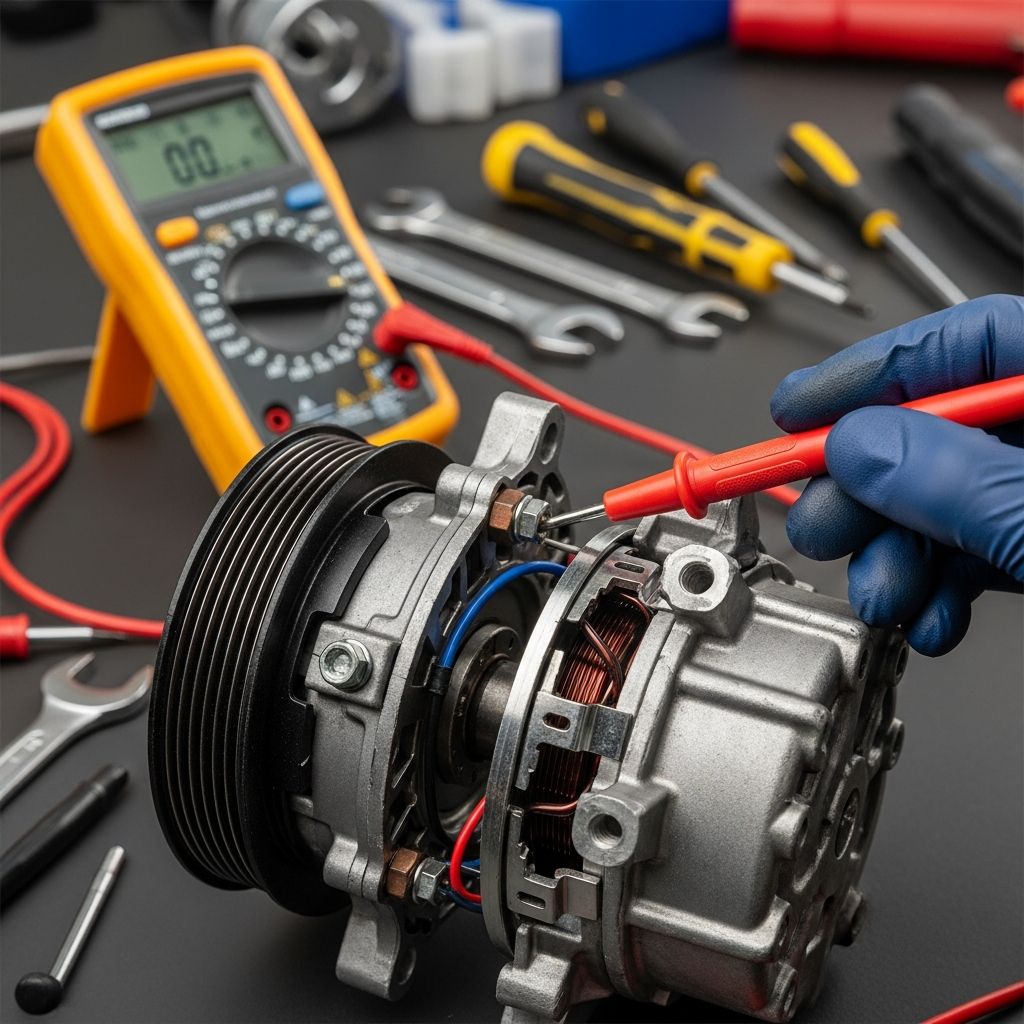
The AC compressor clutch is an electromagnetic component attached to the front of the compressor pulley. It consists of a coil that generates a magnetic field when powered, pulling the clutch plate against the pulley to spin the compressor. This cyclic engagement maintains optimal refrigerant pressure. Common failure signs include no audible click upon AC activation, visible pulley spin without clutch engagement, or inconsistent cooling.
Key components include the clutch coil, armature plate, and electrical connector. The system integrates with pressure switches and relays to prevent operation under low refrigerant or high-pressure conditions, protecting against damage.
Essential Tools for Accurate Diagnosis
Gather these items before starting:
- Digital multimeter for resistance and voltage measurements.
- AC manifold gauge set to monitor high and low-side pressures.
- Circuit tester or power probe for direct power application.
- Safety gloves, eye protection, and insulated tools.
- Vehicle service manual for model-specific specs like clutch resistance (typically 3-5 ohms).
These tools allow comprehensive testing without disassembly, minimizing risks.
Initial Safety Precautions and Preparations
Park on a level surface, engage the parking brake, and disconnect the battery negative terminal initially. Wear protective gear to shield against refrigerant exposure, which can cause frostbite. Ensure the engine is off and cool. Locate the AC compressor, usually belt-driven near the engine front, by tracing the serpentine belt.
Verify refrigerant levels first, as low charge prevents clutch engagement via safety switches. Symptoms of low refrigerant include clutch non-engagement and low-side pressure below 25 psi with AC on.
Visual and Audible Inspection Basics
Start the engine, set AC to max cool, and observe the compressor pulley. The center hub should spin synchronously with the outer pulley upon engagement—a distinct click confirms activation. If the pulley spins freely without the clutch engaging, proceed to electrical tests.
Inspect wiring for frays, corrosion, or loose connections at the clutch terminals. Check the serpentine belt for wear or slippage, as it drives the pulley.
Electrical Testing with a Multimeter
Multimeter tests confirm coil integrity and power supply. Set to ohms (Ω) and probe the clutch terminals—expect 3-5 ohms for a healthy coil. Infinite resistance signals an open coil; zero ohms indicates a short.
Switch to DC volts, reconnect battery, turn AC on, and back-probe terminals. Readings of 10-16V confirm proper voltage; lower suggests relay, fuse, or wiring faults.
| Test Type | Expected Reading | Problem Indication |
|---|---|---|
| Coil Resistance | 3-5 Ω | OL or 0 Ω |
| Clutch Voltage (AC On) | 10-16 VDC | <10 V |
| Ground Continuity | <1 Ω | OL |
Direct Power Application Test
Bypass controls by supplying 12V directly to the clutch. Use a fused jumper wire or power probe: connect positive to the clutch power terminal (often yellow wire) and negative to ground (black wire). A healthy clutch clicks and engages firmly against the pulley.
Caution: Limit test duration to 10-15 seconds to avoid overheating. No engagement points to a faulty coil or mechanical bind.
Pressure Testing for System Health
Attach manifold gauges to low-side (larger line) and high-side ports. With engine at 2000 RPM and AC maxed:
- Low-side: 25-45 psi.
- High-side: 150-250 psi (varies by ambient temp).
Clutch non-engagement with normal pressures implicates electrical issues; abnormal pressures suggest leaks, blockages, or overcharge.
Troubleshooting Common Faults
Faulty Relay or Fuse: Swap the AC clutch relay with a similar one (e.g., fan relay). Check fuses in the under-hood box.
Pressure Switch Failure: Low-pressure switch opens below 25 psi; high-pressure above 400 psi. Test continuity across switch terminals.
Wiring Issues: Trace harness for breaks, using a test light to verify power flow from relay to clutch.
Mechanical Seizure: If clutch engages but compressor doesn’t pump, internal failure requires replacement.
Advanced Diagnostics: Relay and Switch Checks
Locate the AC clutch relay in the fuse box. Apply 12V across its terminals—clicking confirms functionality. For pressure switches, jumper terminals briefly with AC on; engagement indicates switch fault.
Use an OBD-II scanner if your vehicle supports it for AC-related codes like P0534 (low refrigerant).
When to Seek Professional Help
If tests reveal normal readings yet no cooling, suspect expansion valve, evaporator issues, or precise refrigerant leaks needing UV dye or sniffer detection. Compressor replacement demands evacuation, new components, and recharge by certified techs to comply with EPA regulations.
Preventive Maintenance Tips
- Run AC weekly for 5 minutes, even in winter, to lubricate seals.
- Inspect belts and wiring annually.
- Recharge with UV dye every 2 years to detect leaks early.
- Maintain cabin air filter for efficient airflow.
FAQs
Why won’t my AC compressor clutch engage?
Common causes: low refrigerant, bad clutch coil, faulty relay, or pressure switch issues. Start with pressure and voltage tests.
Can I test the clutch without gauges?
Yes, use multimeter for resistance and direct 12V power test for engagement.
What resistance should the clutch coil read?
Typically 3-5 ohms; consult your service manual for exact specs.
Is it safe to jump the clutch directly?
Yes, briefly with a fused connection to avoid damage.
How do I know if pressures are normal?
Low-side 25-45 psi, high-side 150-250 psi at 2000 RPM, 80°F ambient.
Conclusion
Mastering AC compressor clutch testing saves time and money, restoring comfort swiftly. Regular checks prevent summer breakdowns.
References
- AC Compressor Clutch Diagnosis — Pelican Parts Forum. 2005-10-16. https://forums.pelicanparts.com/porsche-911-technical-forum/246390-ac-compressor-clutch-diagnosis.html
- How To Test Car AC Compressor With Multimeter — Kaiweets. N/A. https://kaiweets.com/blogs/news/how-to-test-car-ac-compressor-with-multimeter
- How to test AC compressor clutch – easy trick — YouTube (proclaimliberty2000). N/A. https://www.youtube.com/watch?v=dnCvt7C8oNQ
- How to QUICKLY Test A/C Clutch At Home — YouTube. N/A. https://www.youtube.com/watch?v=KT_ITd9crI0
- Car AC Not Cooling – How To Easily Check AC Clutch — YouTube (proclaimliberty2000). N/A. https://www.youtube.com/watch?v=0tP5utn-3Ak
Similar Articles








Read full bio of Sneha Tete