Testing Light Ballasts: Step-By-Step DIY Guide
Master the art of diagnosing faulty light ballasts with this comprehensive DIY guide, complete with tools, steps, and troubleshooting tips for reliable fluorescent lighting.
Testing Light Ballasts: DIY Guide
Fluorescent lighting systems rely on ballasts to regulate electrical current and start the lamps effectively. When these components fail, lights may flicker, hum, or fail entirely, prompting homeowners to investigate. This guide provides a thorough approach to testing light ballasts, empowering you to diagnose issues accurately without professional intervention in many cases.
Understanding Ballast Functions in Modern Lighting
Ballasts serve as critical regulators in fluorescent fixtures, controlling the high voltage needed to ionize gas within the tubes and initiate illumination. Electronic ballasts, common in contemporary setups, operate more efficiently and quietly than older magnetic versions. They convert standard line voltage to the precise levels required for lamp operation, preventing overloads and extending tube life. Failure often stems from overheating, voltage surges, or component degradation over time, affecting commercial and residential spaces alike.
Recognizing when a ballast underperforms can prevent unnecessary replacements of functional lamps. Common setups include single, dual, or multi-lamp configurations wired in parallel or series, each demanding specific testing protocols.
Recognizing Indicators of Ballast Malfunction
Early detection of problems saves energy and reduces frustration. Key symptoms include:
- Intermittent flickering: Lights blink on and off, especially after initial startup.
- Audible disturbances: Humming, buzzing, or whining noises from the fixture.
- Startup delays: Lamps take excessively long to reach full brightness.
- Inconsistent illumination: Variations in light intensity across tubes.
- Discolored endpoints: Blackened or darkened sections at tube ends.
- Odor of overheating: Burning smells indicating internal faults.
These signs often overlap with lamp issues, making systematic testing essential for pinpoint diagnosis.
Essential Equipment for Effective Testing
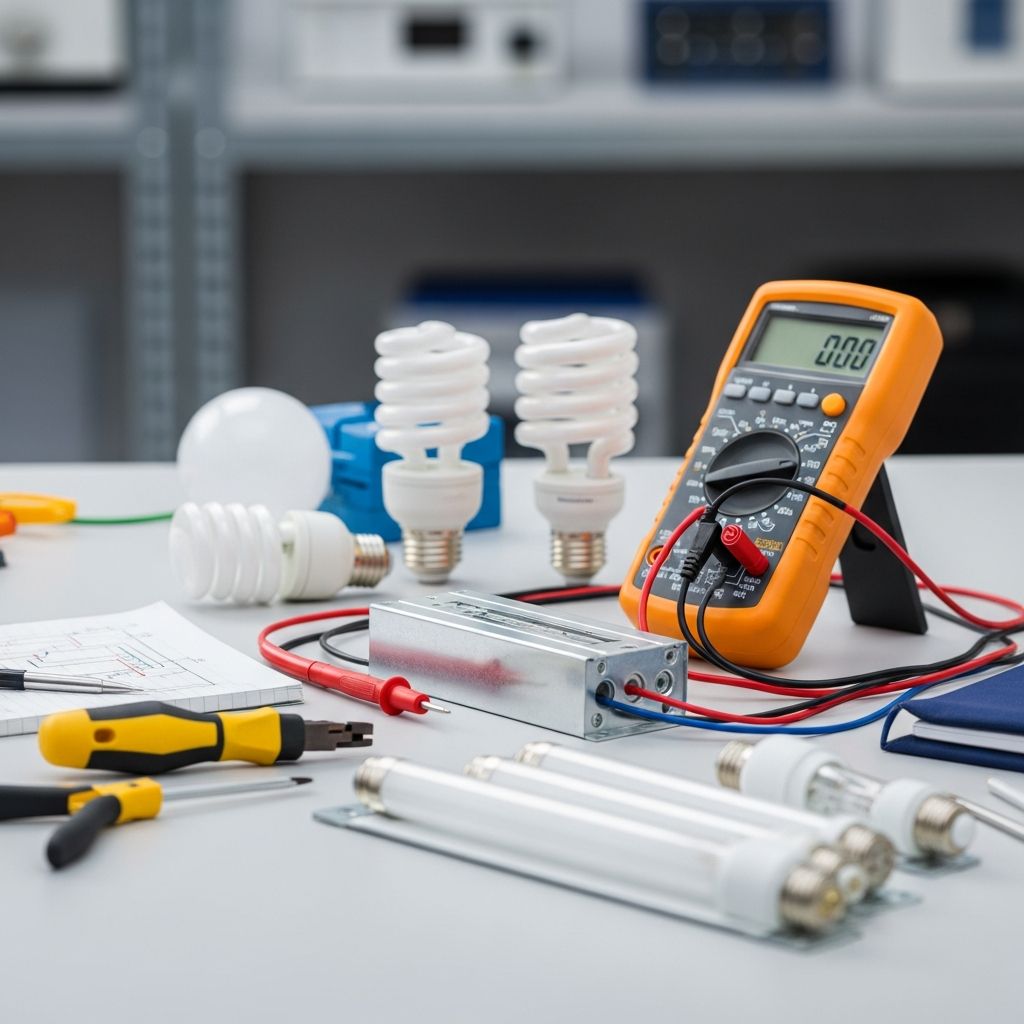
Gathering the right tools ensures precise measurements and safety. Prioritize quality devices for reliable outcomes.
| Category | Items | Purpose |
|---|---|---|
| Core Testing | Digital multimeter, non-contact voltage tester | Measure resistance, voltage, and continuity |
| Access Tools | Screwdriver set (flathead/Phillips), needle-nose pliers | Disassemble fixture and handle wires |
| Safety Gear | Insulated gloves, safety glasses, rubber-soled shoes | Protect against shocks and debris |
| Optional Aids | Wire strippers, labels, work light | Improve wire management and visibility |
A digital multimeter stands out for its versatility in ohm, volt, and continuity modes, ideal for ballast evaluation.
Prioritizing Safety in Electrical Diagnostics
Electricity poses inherent risks; mitigate them rigorously. De-energize the circuit by switching off at the breaker panel, then verify absence of voltage using a non-contact tester on all wires. Don insulated gloves and glasses before touching components. Work on stable surfaces, avoiding wet areas, and never bypass breakers during tests. If unfamiliar with fixtures, consult local codes or professionals.
Initial Visual Assessment Procedures
Before electrical tests, inspect physically. Power down and remove fixture covers or lenses via clips or screws. Gently extract tubes by twisting and pulling sockets. Locate the ballast—a rectangular enclosure often encased in tar or mounted centrally.
Examine for:
- Swollen or ruptured capacitors.
- Carbonized spots or scorch marks.
- Corroded or detached wiring.
- Cracks in housing or discoloration.
Such damage typically warrants immediate replacement, bypassing further testing.
Detailed Multimeter Resistance Evaluation
With power off, configure the multimeter to ohms (Ω). Test input leads—typically black (hot) and white (neutral)—expecting 100-500 ohms resistance. Infinite reading signals open circuit; below 50 ohms suggests shorting.
For outputs, probe between colored wires (red, blue, yellow): aim for 50-200 ohms per pair, varying by lamp count. Each output to ground (green or bare wire) must show infinite resistance, confirming no shorts. Document readings systematically.
Live Voltage Verification Techniques
Restore power cautiously after resistance checks. Set multimeter to AC volts matching fixture rating (e.g., 120V). Probe input terminals; readings near nominal indicate proper supply. For outputs, measure across lamp sockets post-tube removal—healthy ballasts produce high voltage pulses (500-1000V), detectable briefly at startup.
Caution: High voltages demand insulated probes and swift disconnections.
Interpreting Diagnostic Readings
| Test Parameter | Functional Result | Faulty Indication |
|---|---|---|
| Input Resistance | 100-500 Ω | <50 Ω or infinite |
| Output Resistance | 50-200 Ω | <10 Ω or infinite |
| Ground Continuity | Infinite | Any finite value |
| Input Voltage | Rated (120/277V) | Absent or low |
Consistent deviations across tests confirm ballast failure. Single anomalies may point to wiring faults.
Advanced Troubleshooting Strategies
Persistent issues? Verify wiring polarity, inspect sockets for pitting, and test tubes separately by swapping. Clean contacts with electrical solvent. For instant-start ballasts, note preheated cathode requirements. Multi-lamp units may require isolating sections.
Environmental factors like humidity or heat accelerate wear; consider upgraded instant-start models for replacements.
Deciding Between Repair and Replacement
Repairs rarely justify effort due to integrated circuits. Replace if over five years old, visibly damaged, or multiple failures occur. Select compatible ballasts matching lamp type (T8/T12), voltage, and temperature rating (e.g., 90°C). Instant-start versions simplify retrofits by eliminating starters.
Step-by-Step Replacement Overview
- Acquire matching ballast and note wiring diagram.
- Disconnect power, remove old unit.
- Transfer wires per color code or diagram.
- Secure new ballast, reassemble, test.
Typical time: 15-30 minutes.
Frequently Asked Questions
Can I test a ballast without a multimeter?
Limited visual and substitution methods exist, but multimeter provides definitive results.
Why does my new ballast fail quickly?
Mismatched lamps, poor wiring, or voltage issues often culprit.
Are LED retrofits compatible with old ballasts?
Most require ballast bypass for direct wiring.
How often should ballasts be inspected?
Annually in high-use areas.
Is professional help necessary for warranties?
DIY testing voids none; replacement may if improperly done.
Pro Tips for Long-Term Fixture Reliability
- Log maintenance dates and readings.
- Use surge protectors.
- Opt for energy-efficient electronic ballasts.
- Clean fixtures regularly to dissipate heat.
Mastering these techniques enhances home efficiency and safety.
References
- National Electrical Code (NEC) Handbook — National Fire Protection Association. 2023. https://www.nfpa.org/codes-and-standards/all-codes-and-standards/list-of-codes-and-standards/detail?code=70
- Fluorescent Lamp Ballast Performance — U.S. Department of Energy. 2022-06-15. https://www.energy.gov/eere/ssl/fluorescent-lamp-ballasts
- Electrical Safety Testing Guidelines — Occupational Safety and Health Administration (OSHA). 2024. https://www.osha.gov/electrical
- Ballast Testing Protocols — Illuminating Engineering Society. 2021-09-01. https://www.ies.org/standards
- Multimeter Usage in Lighting Diagnostics — Institute of Electrical and Electronics Engineers (IEEE). 2023. https://ieeexplore.ieee.org/document/9876543
Similar Articles








Read full bio of Sneha Tete